MACAU DAILY TIMES 澳門每日時報

Top Menu

  • Our Team
  • Editorial Statute
    • Code of Ethics
    • Privacy Policy
    • Terms and Conditions
  • Archive
    • PDF Editions
  • Contacts
  • Extra Times
    • Drive In
    • Book It
    • tTunes
    • Features
    • World of Bacchus
    • Taste of Edesia

Main Menu

  • Home
  • Macau
    • Photo Shop
    • Advertorial
  • Interview
  • Greater Bay
  • Business
    • Corporate Bits
  • China
  • Asia
  • World
  • Sports
  • Opinion
    • Editorial
    • Our Desk
    • Business Views
    • China Daily
    • Multipolar World
    • The Conversation
    • World Views
  • Our Team
  • Editorial Statute
    • Code of Ethics
    • Privacy Policy
    • Terms and Conditions
  • Archive
    • PDF Editions
  • Contacts
  • Extra Times
    • Drive In
    • Book It
    • tTunes
    • Features
    • World of Bacchus
    • Taste of Edesia
logo
FOUNDER & PUBLISHER Kowie Geldenhuys
EDITOR-IN-CHIEF Paulo Coutinho
Macau,

MACAU DAILY TIMES 澳門每日時報

  • Home
  • Macau
    • Photo Shop
    • Advertorial
  • Interview
  • Greater Bay
  • Business
    • Corporate Bits
  • China
  • Asia
  • World
  • Sports
  • Opinion
    • Editorial
    • Our Desk
    • Business Views
    • China Daily
    • Multipolar World
    • The Conversation
    • World Views
  • Multiple flights in Europe diverted because of bomb threats after earlier hoaxes

  • Delivery riders consider return to petrol bikes over EV reliability concerns

  • Woman in critical condition after bus hits wheelchair user

  • Bus operators renewed for six years with LRT transfer requirements

  • LVS chief Dumont and wife take controlling 69% stake in Mavericks

  • DSAL reports 3,897 workplace accident victims, four deaths

Asia-PacificHeadlinesThe Conversation
Home›Asia-Pacific›Sri Lankans throw out old guard in election upset

Sri Lankans throw out old guard in election upset
By -
Wednesday, September 25, 2024
139
0

What nation’s new Marxist-leaning leader means for economy, IMF loans

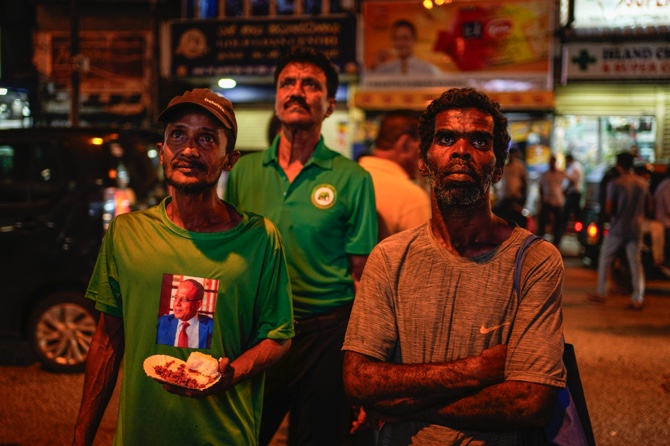
Sri Lankans voted for a new direction in leadership on Sept. 22, 2024, electing a leftist anti-poverty campaigner as president of the South Asian nation.

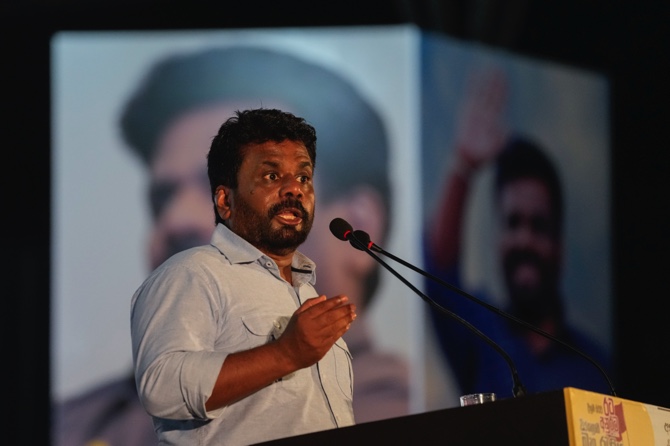
The ascent of Anura Kumara Dissanayake marks a break with the past and from the establishment parties and politicians blamed for taking the country to the brink of economic collapse in 2022.

Dissanayake characterized the victory as a “fresh start” for Sri Lanka – but he will nonetheless need to address the economic baggage left by his predecessors and the impact of an International Monetary Fund loan that came with painful austerity demands. The Conversation turned to Vidhura S. Tennekoon, an expert on Sri Lanka’s economy at Indiana University, to explain the task facing the new president – and how Dissanayake intends to tackle it.

What do we know about the new president?

Anura Kumara Dissanayake leads both the National People’s Power alliance, or NPP, and the Janatha Vimukthi Peramuna, or JVP. Rooted in Marxist ideology, the JVP was founded in the 1960s with the aim of seizing power through a socialist revolution. But after two failed armed uprisings in 1971 and 1987-89 – which resulted in the loss of tens of thousands of lives – the party shifted toward democratic politics and has remained so for over three decades.

Until this election, the JVP remained a minor third party in Sri Lanka’s political landscape, while power alternated between the alliances led by the two traditional political parties – the United National Party and the Sri Lanka Freedom Party – or their descendant parties.

In 2019, under Dissanayake’s leadership, the NPP was formed as a socialist alliance with several other organizations. While the JVP continues to adhere to Marxist principles, the NPP adopted a center-left, social democratic platform – aiming to attract broader public support.
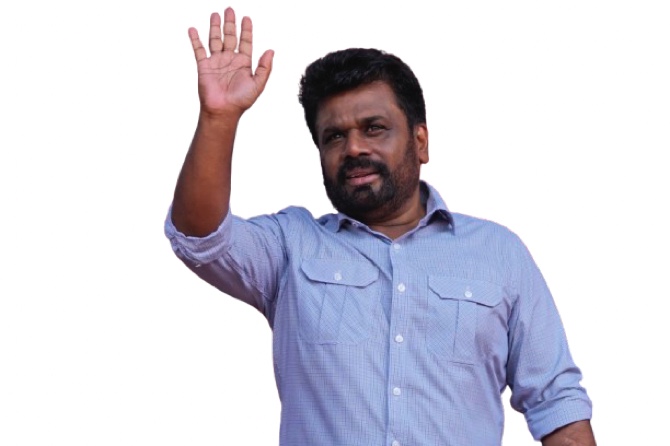
Despite these efforts, Dissanayake garnered only 3% of the vote in the 2019 presidential election.

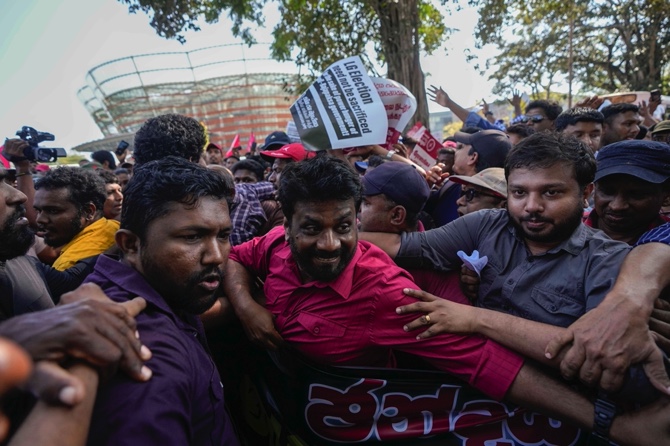
But the political landscape shifted dramatically during the economic crisis of 2022. Many Sri Lankans, frustrated with the two traditional parties that had governed the country for over seven decades, turned to the NPP, seeing it as a credible alternative.

The party’s anti-corruption stance, in particular, resonated strongly because many people blamed political corruption for the economic collapse.

It helped deliver 42% of the vote to Dissanayake.

While a significant achievement, it also marks a historic first for Sri Lanka — Dissanayake is the first president to be elected without majority support; the remaining 58% of votes were split between candidates from the two traditional parties.

His immediate challenge will be to secure a parliamentary majority in the upcoming elections, a crucial step for his administration to govern effectively.

What kind of economy is Dissanayake inheriting?

Two and a half years ago, Sri Lanka experienced the worst economic crisis in its history. With foreign reserves nearly depleted, the country struggled to pay its bills, leading to severe shortages of essential goods. People waited in long lines for cooking gas and fuel, while regular blackouts became part of daily life. The Sri Lankan rupee plummeted to a record low, driving inflation to 70%. The economy was contracting, and the country defaulted on its international sovereign bonds for the first time.

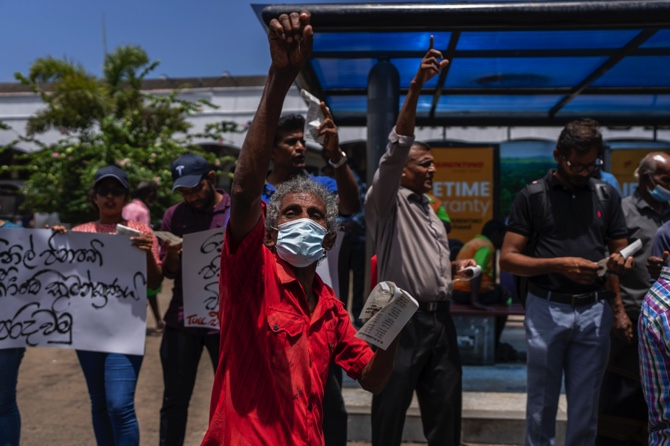
This sparked a massive protest movement that ultimately forced President Gotabaya Rajapaksa to resign. In July 2022, Parliament appointed Ranil Wickremesinghe to complete the remainder of Rajapaksa’s term.

In the two years that followed, Sri Lanka’s economy made an unexpectedly rapid recovery under Wickremesinghe’s leadership. After securing an agreement with the International Monetary Fund, the currency stabilized, the central bank rebuilt foreign reserves, and inflation fell to single digits. By the first half of 2024, the economy had grown by 5%.

The government successfully restructured its domestic debt, followed by a restructuring of its bilateral debt – that is, government-to-government loans, mostly from China but also from India and Western counties, including the United States. Just days before the election, an agreement was reached with international bondholders to restructure the remaining sovereign debt.

Despite these achievements, Wickremesinghe was overtaken in the presidential race by both Dissanayake and opposition leader Sajith Premadasa. Wickremesinghe’s unpopularity stemmed largely from the harsh austerity measures implemented under the IMF-backed stabilization program.

Dissanayake now inherits an economy that, while more stable, remains vulnerable. He will have limited room to maneuver away from the carefully planned economic path laid out by his predecessor, even as voters expect him to fulfill popular demands.

How does he plan to improve the economy?

As a leader from a Marxist party, Dissanayake will likely pursue policies to reflect collective decisions made by the politburos and central committees of the NPP and JVP, rather than his individual views. He advocates for an economic system where activities are coordinated through a central government plan, emphasizing the importance of “economic democracy.”

His party believes prosperity should be measured not just by economic growth but by the overall quality of life. They argue that people need more than just basic necessities — they require secure housing, food, health care, education, access to technology and leisure.
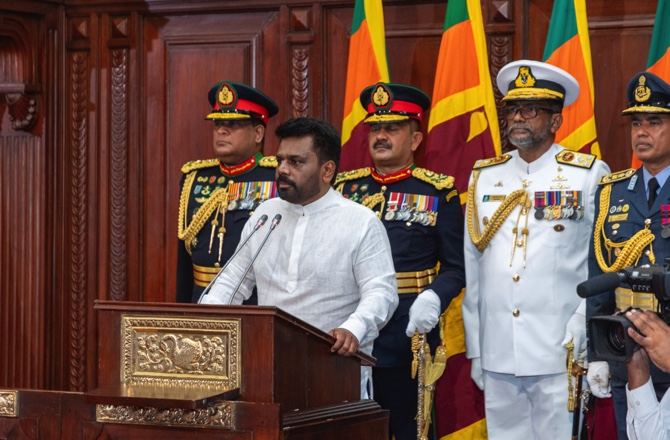
Dissanayake’s long-term vision is to transform Sri Lanka into a production-based economy, focusing on sectors like manufacturing, agriculture and information technology rather than service industries. One of the key policies is to promote local production of all viable food products to reduce reliance on imports. To support these activities, the NPP plans to establish a development bank. Additionally, they NPP proposes increasing government spending on education and health care, in line with Sri Lanka’s tradition of providing free, universal access to both.

Where does this leave the IMF loans?

Historically, Dissanayake’s party has been critical of the IMF and its policy recommendations. Given the severity of Sri Lanka’s economic crisis, Dissanayake has acknowledged the need to stay within the IMF program for now. But he has vowed to renegotiate with the IMF to make the program more “people-friendly.” Dissanayake’s proposals include raising the personal income tax exemption threshold to double its current level and removing taxes on essential goods. Dissanayake’s party also plans adding jobs to the public sector, despite the ongoing effort to reduce the government workforce to manage the deficit.

Dissanayake’s populist policies, aimed at attracting mass support during the campaign, will inevitably strain government revenues while increasing expenses. However, the IMF program requires Sri Lanka to maintain a primary budget surplus of at least 2.3% of gross domestic product to ensure debt sustainability. Dissanayake has promised not to jeopardize the country’s economic stability by deviating from this target. His strategy is to improve the efficiency of tax collection, which he believes will generate enough revenue to fund his policies.

Additionally, his party has criticized the deal struck by Wickremesinghe’s government with international lenders, calling it unfavorable to the country. Dissanayake has promised to seek better terms. However, since these agreements are already in place, it remains uncertain whether the new government will attempt to renegotiate them. Vidhura S. Tennekoon, Indiana University, MDT/The Conversation
Share this:

  • Share on Facebook (Opens in new window) Facebook
  • Share on X (Opens in new window) X
  • Share on LinkedIn (Opens in new window) LinkedIn
  • Share on WhatsApp (Opens in new window) WhatsApp
  • Print (Opens in new window) Print

Like this:

Like Loading…

Related

TagsSri Lanka
Previous Article

DSAMA: Marine debris issues under control

Next Article

‘Macanese Nights 2024’ celebrates Macau’s culinary heritage

Related articles More from author

  • Asia-PacificBuzz

    Sri Lanka police raise security at popular surf site over threat to Israelis

    Thursday, October 24, 2024
    By -
  • Asia-Pacific

    Acting president declares emergency amid protests

    Tuesday, July 19, 2022
    By -
  • Asia-PacificBuzz

    Passenger bus skids off a cliff in Sri Lanka, killing 21 people and injuring 35

    Monday, May 12, 2025
    By -
  • Asia-Pacific

    Sri Lanka reaches deal on debt restructuring with bilateral creditors including China and France

    Friday, June 28, 2024
    By -
  • Asia-Pacific

    Sri Lanka sends two ministers to Russia for oil amid crisis

    Tuesday, June 28, 2022
    By -
  • Asia-Pacific

    A railway union strike leaves tens of thousands of commuters stranded

    Friday, July 12, 2024
    By -

Leave a reply Cancel reply

You must be logged in to post a comment.

  • World

    Mediators see progress in diplomatic efforts to halt Iran war, two regional officials say

  • Macau

    Pitbull’s fans party like clones worldwide

  • Business

    US probes e-commerce giant Alibaba’s accounting practices

DAILY EDITION

Thursday, November 5, 2026 – edition no. 5068

Greater Bay

MDT MACAU GRAND PRIX SPECIAL

November 2026
M T W T F S S
 1
2345678
9101112131415
16171819202122
23242526272829
30  
« Oct    

Timeline

  • Thursday, November 5, 2026

    Multiple flights in Europe diverted because of bomb threats after earlier hoaxes

  • Thursday, November 5, 2026

    Delivery riders consider return to petrol bikes over EV reliability concerns

  • Thursday, November 5, 2026

    Woman in critical condition after bus hits wheelchair user

  • Thursday, November 5, 2026

    Bus operators renewed for six years with LRT transfer requirements

  • Thursday, November 5, 2026

    LVS chief Dumont and wife take controlling 69% stake in Mavericks

  • Thursday, November 5, 2026

    DSAL reports 3,897 workplace accident victims, four deaths

  • Thursday, November 5, 2026

    Democrats win House and Senate as voters rebuke Trump and Republicans

  • Thursday, November 5, 2026

    Two passport stories, one question of belonging

  • Thursday, November 5, 2026

    Four universities improve in QS Asia rankings

  • Thursday, November 5, 2026

    IAS increases number of family mediators to 57

Extra Times

Extra TimesHeadlinesTaste of Edesia

A Symphony of Heritage: Reviving the Imperial Feast at Chai Jia Chai

In the heart of modern dining, where fusion often threatens to overshadow tradition, an evening at Chai Jia Chai stands as a resolute testament to the enduring majesty of Chinese ...
  • Nickelback is in familiar form on cameo-heavy album

    By MDT/AP
    Friday, October 30, 2026
  • TUMI Debuts “Gifts for the Journey” Holiday Edit

    By -
    Friday, October 30, 2026
  • Toast to the Tropics: The Macallan “Coconut Dreams” Dinner

    By -
    Friday, October 23, 2026
  • ‘Clayface’ arrives as a pretty good R-rated revenge thriller-horror romance

    By MDT/AP
    Friday, October 23, 2026
  • Recent

  • Popular

  • Multiple flights in Europe diverted because of bomb threats after earlier hoaxes

    By MDT/AP
    Thursday, November 5, 2026
  • Delivery riders consider return to petrol bikes over EV reliability concerns

    By Renato Marques, MDT
    Thursday, November 5, 2026
  • Woman in critical condition after bus hits wheelchair user

    By -
    Thursday, November 5, 2026
  • Bus operators renewed for six years with LRT transfer requirements

    By Yuki Lei, MDT
    Thursday, November 5, 2026
  • LVS chief Dumont and wife take controlling 69% stake in Mavericks

    By Nadia Shaw, MDT
    Thursday, November 5, 2026
  • DSAL reports 3,897 workplace accident victims, four deaths

    By Lynzy Valles, MDT
    Thursday, November 5, 2026
  • Democrats win House and Senate as voters rebuke Trump and Republicans

    By MDT/AP
    Thursday, November 5, 2026
  • Canidrome may have its days numbered, decision in ‘one or two months’

    By Paulo Coutinho, MDT
    Thursday, May 26, 2016
  • Animal Welfare | Macau: Anima slams Canidrome management for avoiding debate

    By -
    Wednesday, May 4, 2016
  • Editorial | Canidoomed

    By Paulo Coutinho, MDT
    Wednesday, June 1, 2016
  • Animal Welfare | Canidrome presented with ultimatum: close or move

    By Daniel Beitler, MDT
    Friday, July 22, 2016
  • Australia regulator cracks down on alleged exportation of dogs to Macau

    By Paulo Coutinho, MDT
    Friday, June 10, 2016
  • Animal rights | Canidrome: Anima in fresh airline negotiations as Canidrome closure looks more likely

    By Daniel Beitler, MDT
    Friday, May 27, 2016
  • USE OF ENGLISH IN MACAU | A ‘de facto’ official language

    By Catarina Pinto
    Monday, July 6, 2015
  • Contact our Administrator
  • Contact our Editor-in-Chief
  • Contacts
  • Our Team
  • Privacy Policy
  • Terms and Conditions
  • Editorial Statute
  • Code of Ethics
COPYRIGHT © MACAU DAILY TIMES 2008-2026. ALL RIGHTS RESERVED
MACAU DAILY TIMES
  • Home
  • Macau
    • Photo Shop
    • Advertorial
  • Interview
  • Greater Bay
  • Business
    • Corporate Bits
  • China
  • Asia
  • World
  • Sports
  • Opinion
    • Editorial
    • Our Desk
    • Business Views
    • China Daily
    • Multipolar World
    • The Conversation
    • World Views
  • Our Team
  • Editorial Statute
    • Code of Ethics
    • Privacy Policy
    • Terms and Conditions
  • Archive
    • PDF Editions
  • Contacts
  • Extra Times
    • Drive In
    • Book It
    • tTunes
    • Features
    • World of Bacchus
    • Taste of Edesia
Loading Comments...

You must be logged in to post a comment.

%d