MACAU DAILY TIMES 澳門每日時報

Top Menu

  • Our Team
  • Editorial Statute
    • Code of Ethics
    • Privacy Policy
    • Terms and Conditions
  • Archive
    • PDF Editions
  • Contacts
  • Extra Times
    • Drive In
    • Book It
    • tTunes
    • Features
    • World of Bacchus
    • Taste of Edesia

Main Menu

  • Home
  • Macau
    • Photo Shop
    • Advertorial
  • Interview
  • Greater Bay
  • Business
    • Corporate Bits
  • China
  • Asia
  • World
  • Sports
  • Opinion
    • Editorial
    • Our Desk
    • Business Views
    • China Daily
    • Multipolar World
    • The Conversation
    • World Views
  • Our Team
  • Editorial Statute
    • Code of Ethics
    • Privacy Policy
    • Terms and Conditions
  • Archive
    • PDF Editions
  • Contacts
  • Extra Times
    • Drive In
    • Book It
    • tTunes
    • Features
    • World of Bacchus
    • Taste of Edesia
logo
FOUNDER & PUBLISHER Kowie Geldenhuys
EDITOR-IN-CHIEF Paulo Coutinho
Macau,

MACAU DAILY TIMES 澳門每日時報

  • Home
  • Macau
    • Photo Shop
    • Advertorial
  • Interview
  • Greater Bay
  • Business
    • Corporate Bits
  • China
  • Asia
  • World
  • Sports
  • Opinion
    • Editorial
    • Our Desk
    • Business Views
    • China Daily
    • Multipolar World
    • The Conversation
    • World Views
  • Macau faces slower growth as gaming revenue and spending weaken

  • Gov’t plans to divest CTM stake to avoid market conflict

  • Three chefs. One horizon. Six Michelin stars

  • Red Market former post office quarters to be rebuilt at owners’ expense from 2027

  • ExCo backs bill proposing tougher oversight and new dissolution powers for associations

  • Lawmaker urges insurance reform as compensation delays disrupt treatment

China
Home›China›Secret historians preserve past amid state amnesia 

Secret historians preserve past amid state amnesia 
By -
Thursday, March 12, 2015
89
0
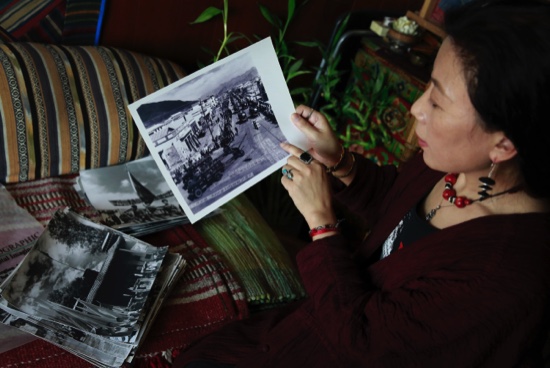
Tsering Woeser, a Tibetan poet, shows old photos of the Chinese military destroying temples and persecuting Buddhist priests and officials in the far western region of Tibet, which were taken by her father during the Cultural Revolution, at her home on the outskirts of Beijing

Tsering Woeser, a Tibetan poet, shows old photos of the Chinese military destroying temples and persecuting Buddhist priests and officials in the far western region of Tibet, which were taken by her father during the Cultural Revolution, at her home on the outskirts of Beijing

In his small ground-floor apartment just a few blocks from Beijing’s landmark Bird’s Nest stadium, Chinese language teacher, writer and do-it-yourself documentary maker Xu Xing is urgently preserving what he can of China’s forbidden past.
Traveling usually by himself all over the country, the tall 58-year-old has recorded hours of interviews with everyday Chinese who were jailed, sometimes for years, on the barest of political charges during the decade-long spasm of social chaos known as the Cultural Revolution. Xu has edited that footage into documentaries that he only shows to those he trusts, in living rooms and coffee houses, preserving for history memories kept secret for decades.
“I want it so that this never happens in China again, so this is my tireless job,” Xu said on a recent afternoon sitting at his kitchen-top editing bay. “I tell the people I interview, ‘Clearly, I can’t bring you any money or other reward. The main thing I do is let other people know your story.’”
With the ruling Communist Party zealously enforcing its own version of Chinese history, Xu’s truth-telling is nothing less than an act of defiance. The government has largely succeeded in erasing or playing down whole swaths of Communist-era history by controlling what’s talked about in the country’s classrooms, museums and books, as well as in other areas of public life.
Ask the average Chinese under the age of 30 about the 1989 Tiananmen Square massacre, which scholars say claimed the lives of hundreds of pro-democracy student activists and bystanders in the heart of Beijing, and the answer will likely be ignorance or at best vague recognition. The same amnesia cloaks other dark periods of 20th-century Chinese history such as the catastrophic famines of the late 1950s, widely blamed on the government’s push to rapidly industrialize, and the Cultural Revolution, which persecuted millions from 1966 to 1976.
Fu King-Wa, a journalism and media studies professor at the University of Hong Kong, said many of his students from mainland China learned of the Tiananmen massacre for the first time through his lectures.
Hong Kong, a semi-autonomous Chinese city, enjoys more freedom compared to the mainland, where Chinese who research and publicize the past on their own are often censored or jailed for causing trouble.
“This is authoritarian control of people’s access to information. They want to create a unified version of how to understand this historical issue,” Fu said.
Xu and other secret historians have taken it upon themselves to preserve photos, interview eyewitnesses and do the archival work that the Chinese government has banned most historians inside the country from doing.
You Weijie, whose husband died in the Tiananmen massacre, has conducted interviews with relatives of more than 40 other victims and stored the audio and video recordings overseas. Some are available online.
Tsering Woeser held onto dozens of her father’s old photos of the Chinese military destroying temples and persecuting Buddhist priests and officials in the far western region of Tibet during the Cultural Revolution. In 2006, a Taiwan-based publisher put out a book of the photos.
Others in China run underground history magazines or preserve their memories of China’s forbidden past in paintings.
These secret historians are exposed to police surveillance and, in many cases, to near-poverty, because they have little opportunity to make a living from their work.
Woeser, You and Xu said they were aware of the dangers they invited by speaking to The Associated Press, but said they had already been the targets of police scrutiny and were willing to run the additional risk.
“They’re afraid of this,” Xu said of Chinese authorities. “They don’t let anybody see this. This is their crime.”
The Chinese government’s concerns about historical revision were spelled out in what was believed to be a confidential party document leaked to the public in 2013 and first printed in a Hong Kong newspaper.
The document called out critics who consider the Chinese Communist Party to be “a continuous series of mistakes,” and warned that “historical nihilism” rejecting the party’s version of history “is tantamount to denying the legitimacy of the CCP’s long-term political dominance.”
For China’s secret historians, however, documenting that history is the only way to make sure its tragedies aren’t repeated.
Woeser, a Tibetan poet, said she had wondered as a girl why her father had taken photos of the destruction in the region, especially since he had been sent there as a Chinese soldier in the 1960s to help tighten the government’s hold. Later, she said, she herself returned to track down the people captured in those photos.
“A lot of people have already died,” she said, seated beside a private altar she’s built to the exiled Tibetan leader the Dalai Lama. “So I think this is a very urgent thing. Because memory is important to people, and if the person is there, the memory is there. If the person isn’t there, then the memory has disappeared.”
At different times, Woeser has been placed under house arrest for her work. You said she has also been placed under surveillance; police are permanently stationed on the ground floor of her apartment building. Xu is often stopped and questioned by local police while tracking down Cultural Revolution survivors.
What they find and record often clashes with how the Chinese government memorializes the country’s tumultuous history since 1949, when the Communist Party seized control after a brutal civil war.
In the government’s telling, the student protesters who filled Tiananmen Square demanding political reforms were launching a “counterrevolutionary riot,” and only 300 or so were killed, as opposed to about 1,000 victims counted by other sources. The famines sparked by the Great Leap Forward of the 1950s, which scholars believe claimed upward of 30 million lives, are known in official versions as “three years of natural disaster,” with at most a few million perishing.
The Chinese government has acknowledged some fault for the Cultural Revolution, saying the political purges were “responsible for the most severe setback and the heaviest losses … since the founding of the People’s Republic.” Still, the period is rarely mentioned in Chinese media, and few relics of the time appear outside private collections.
That amnesia comes at an enormous price, and not just for victims who have yet to see justice or compensation, said Xun Zhou, a history professor at the University of Essex who has interviewed hundreds of rural Chinese about the famines of the Great Leap Forward and other historical events.
Avoiding that history has prevented any move toward the kind of reconciliation that in other societies has helped heal historical wounds, she said.
“If you’re going to have reconciliation, you have to talk about things in the open, you have to face these unresolved historical issues,” Xun said. “Now, there’s no national memory of history. There’s only individual memory, no collective memory.” Jack Chang and Isolda Morillo, AP

Share this:

  • Share on Facebook (Opens in new window) Facebook
  • Share on X (Opens in new window) X
  • Share on LinkedIn (Opens in new window) LinkedIn
  • Share on WhatsApp (Opens in new window) WhatsApp
  • Print (Opens in new window) Print

Like this:

Like Loading…

Related

Previous Article

Thailand | Parents of ex-princess jailed for ...

Next Article

Beijing approves new nuclear reactors in industry ...

Related articles More from author

  • China

    China counters with tariffs on US products and it will also investigate Google

    Wednesday, February 5, 2025
    By -
  • China

    Philanthropist commits USD1.5 billion to conservation

    Monday, October 16, 2017
    By -
  • China

    Hong Kong | Lai given 13 months jail for Tiananmen vigil

    Tuesday, December 14, 2021
    By -
  • China

    VPNs | China cracks down on tools used to get around web filters

    Tuesday, January 24, 2017
    By -
  • China

    Premier Li arrives in New Zealand for talks

    Monday, March 27, 2017
    By -
  • China

    US expands trade penalties on solar imports from mainland, Taiwan

    Monday, July 28, 2014
    By -

Leave a reply Cancel reply

You must be logged in to post a comment.

  • Macau

    Retail | Sa Sa confident in Macau’s propects

  • HeadlinesMacau

    Xi jinping’s Visit to Lisbon | Portugal signs agreement to join Belt and Road Initiative

  • China

    Workers at machinery plant protest poor management 

DAILY EDITION

Friday, November 13, 2026 – edition no. 5074

Greater Bay

MDT MACAU GRAND PRIX SPECIAL

November 2026
M T W T F S S
 1
2345678
9101112131415
16171819202122
23242526272829
30  
« Oct    

Timeline

  • Friday, November 13, 2026

    Macau faces slower growth as gaming revenue and spending weaken

  • Friday, November 13, 2026

    Gov’t plans to divest CTM stake to avoid market conflict

  • Friday, November 13, 2026

    Three chefs. One horizon. Six Michelin stars

  • Friday, November 13, 2026

    Red Market former post office quarters to be rebuilt at owners’ expense from 2027

  • Friday, November 13, 2026

    ExCo backs bill proposing tougher oversight and new dissolution powers for associations

  • Friday, November 13, 2026

    Lawmaker urges insurance reform as compensation delays disrupt treatment

  • Friday, November 13, 2026

    Further analysis with legal application in the case of Au Kam San

  • Friday, November 13, 2026

    Gov’t bets on sports events to drive tourism and community spending

  • Friday, November 13, 2026

    Sai Van free sports ground to reopen today

  • Friday, November 13, 2026

    IAM to expand colorful public waste bin makeover project

Extra Times

Extra TimesHeadlinesTaste of Edesia

Three chefs. One horizon. Six Michelin stars

There are moments when separate culinary philosophies align so precisely that the result transcends mere menu-making. At Chef Tam’s Seasons, Wynn Palace, three two-Michelin-starred titans—each ranked among Asia’s 50 Best ...
  • James Gray delivers a milestone crime drama in ‘Paper Tiger’

    By MDT/AP
    Friday, November 13, 2026
  • The Twelve25 × La Vie exchange

    By -
    Friday, November 13, 2026
  • A fiery milestone: Feng Wei Ju’s 20th anniversary tribute to Starworld Macau

    By Irene Sam, MDT
    Friday, November 6, 2026
  • In ‘I Play Rocky,’ a middleweight crowd-pleaser about the making of a classic

    By MDT/AP
    Friday, November 6, 2026
  • Recent

  • Popular

  • Macau faces slower growth as gaming revenue and spending weaken

    By Lynzy Valles, MDT
    Friday, November 13, 2026
  • Gov’t plans to divest CTM stake to avoid market conflict

    By Lynzy Valles, MDT
    Friday, November 13, 2026
  • Three chefs. One horizon. Six Michelin stars

    By Irene Sam, MDT
    Friday, November 13, 2026
  • Red Market former post office quarters to be rebuilt at owners’ expense from 2027

    By Yuki Lei, MDT
    Friday, November 13, 2026
  • ExCo backs bill proposing tougher oversight and new dissolution powers for associations

    By Nadia Shaw, MDT
    Friday, November 13, 2026
  • Lawmaker urges insurance reform as compensation delays disrupt treatment

    By Nadia Shaw, MDT
    Friday, November 13, 2026
  • Further analysis with legal application in the case of Au Kam San

    By -
    Friday, November 13, 2026
  • Canidrome may have its days numbered, decision in ‘one or two months’

    By Paulo Coutinho, MDT
    Thursday, May 26, 2016
  • Animal Welfare | Macau: Anima slams Canidrome management for avoiding debate

    By -
    Wednesday, May 4, 2016
  • Editorial | Canidoomed

    By Paulo Coutinho, MDT
    Wednesday, June 1, 2016
  • Animal Welfare | Canidrome presented with ultimatum: close or move

    By Daniel Beitler, MDT
    Friday, July 22, 2016
  • Australia regulator cracks down on alleged exportation of dogs to Macau

    By Paulo Coutinho, MDT
    Friday, June 10, 2016
  • Animal rights | Canidrome: Anima in fresh airline negotiations as Canidrome closure looks more likely

    By Daniel Beitler, MDT
    Friday, May 27, 2016
  • USE OF ENGLISH IN MACAU | A ‘de facto’ official language

    By Catarina Pinto
    Monday, July 6, 2015
  • Contact our Administrator
  • Contact our Editor-in-Chief
  • Contacts
  • Our Team
  • Privacy Policy
  • Terms and Conditions
  • Editorial Statute
  • Code of Ethics
COPYRIGHT © MACAU DAILY TIMES 2008-2026. ALL RIGHTS RESERVED
MACAU DAILY TIMES
  • Home
  • Macau
    • Photo Shop
    • Advertorial
  • Interview
  • Greater Bay
  • Business
    • Corporate Bits
  • China
  • Asia
  • World
  • Sports
  • Opinion
    • Editorial
    • Our Desk
    • Business Views
    • China Daily
    • Multipolar World
    • The Conversation
    • World Views
  • Our Team
  • Editorial Statute
    • Code of Ethics
    • Privacy Policy
    • Terms and Conditions
  • Archive
    • PDF Editions
  • Contacts
  • Extra Times
    • Drive In
    • Book It
    • tTunes
    • Features
    • World of Bacchus
    • Taste of Edesia
Loading Comments...

You must be logged in to post a comment.

%d