Luxury wellness sector shifts toward preventive health services

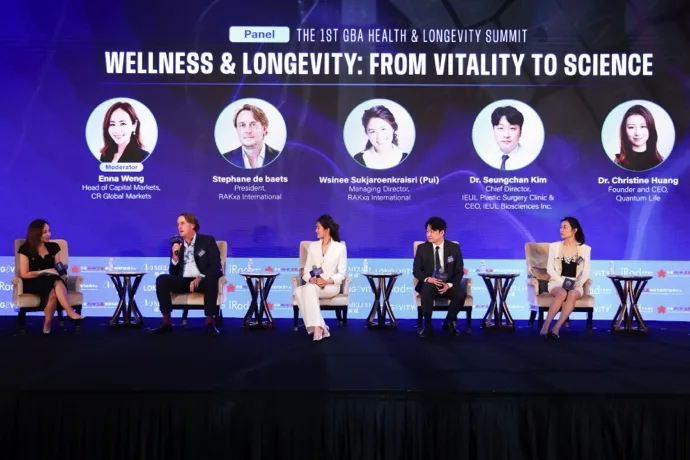
Luxury hospitality and wellness businesses are moving toward personalized health assessments and preventive services, industry executives told attendees at the inaugural Greater Bay Area Health and Longevity Summit.
At the inaugural Greater Bay Area Health and Longevity Summit held last week at Studio City, four panelists discussed how retreats, medical testing and data analysis could reshape wellness travel.
The session, “Wellness & Longevity: From Vitality to Science,” explored a shift from conventional spa experiences toward programs combining diagnostics, nutrition, stress management and clinical services.
Stephane de Baets, founder and president of asset management firm Elevated Returns, said luxury travelers were increasingly interested in living longer and better, rather than simply booking larger rooms or enjoying designer surroundings.
“I believe wellness is a five-star or four-star experience,” he said.
De Baets described efforts to provide imaging and biomarker testing outside hospitals, presenting prevention as a service people might seek before feeling unwell.
“Nowadays people think you go to a hospital because you’re sick. I don’t want to go and feel sick. I want to go to a place like iRad or RAKxa because you don’t want to be sick. So, the prevention in RAKxa is to be able to know what’s your predisposition, where you are, and how can you improve it?” he said.
At RAKxa Wellness & Medical Retreat, that approach means tailoring a stay to the individual, said Wsinee Sukjaroenkraisri, vice president of business strategy and programs.
Describing a hypothetical weeklong visit to Bangkok, she said doctors would coordinate with practitioners and chefs to personalize activities, meals and treatments rather than impose a standard restrictive regimen.
“So, our doctors at RAKxa, even though from different medicine modalities, […] have the same goal – to have the guests have better health,” she said.
Those plans also need reassessment, she added, as an approach suited to one stage of life may not work at another.
Turning to age-reversal treatments, Dr. Seungchan Kim, chief director of IEUL Plastic Surgery, discussed using biomarkers, including epigenetic measures, to track regenerative treatments. He cautioned, however, that such indicators could not establish an exact biological age.
Appearance was also an unreliable guide to internal aging, he said. Sun exposure, smoking and weight changes could affect the skin differently from internal organs, making separate assessments necessary.
“Think about the marathon runner. The marathon runner is exposed to sun damage, so the skin may be older than the inside of the body, and his cartilage is older than others. But his heart can be younger than others.”
Kim also discussed stem-cell treatments and hyperbaric oxygen therapy in recovery, although proposed benefits should be distinguished from established clinical evidence.
Cost presented another barrier. QuantumLife founder and CEO Huang acknowledged that detailed testing remained expensive and said broader access was a priority.
“It shouldn’t be just like privilege […] Aging is everybody having it, and the actual solution will not be that so difficult,” Huang said. “Solution can be: be happy, sleep early […] But we need to understand what the root cause is.”
For de Baets, the challenge also extended beyond the retreat. He said another core mission was helping guests sustain routines at home. “You want to create wellness-centric communities,” he added.
“So maybe in the future, I’m going to buy a home next to a wellness center where I can get my preventive diagnosis. I can have my treatment, but I live my life with my family and my kids go to school.”
“So I think increasing initiative, increasing touch point, and having one umbrella brand of [unclear] that can connect people throughout their journey around the world,” de Baets said.





Leave a reply
You must be logged in to post a comment.