Spain’s royals visit Ceuta as territory grapples with migration crisis


Spain’s King Felipe VI and Queen Letizia greet the crowd during their visit to the Spanish enclave of Ceuta [AP Photo]
King Felipe VI and Queen Letizia visited the Spanish city of Ceuta in North Africa on Tuesday in a show of solidarity with residents and the victims of a protracted migration crisis that has strained relations with Morocco.
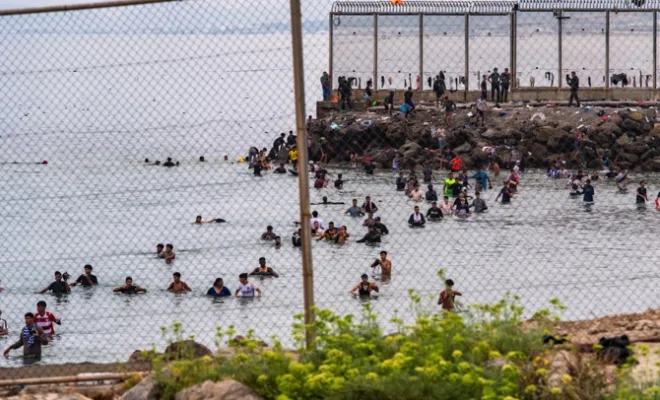
The royal visit is taking place after about 80,000 migrants crossed Ceuta’s border in July. More than 140 people died in the attempt to reach European soil.
Most of those who crossed quickly returned, but thousands remain in the Mediterranean coastal city of 84,000 residents. The exact number is unknown, though the mayor has estimated that as many as 15,000 remain.
Their presence has fueled social tensions in Ceuta and become a political issue across Spain, where opposition parties hope to use migration concerns to unseat the progressive government in next month’s elections.
The royal couple will travel on Wednesday to Melilla, Spain’s other North African exclave. The trip marks the first visit by a Spanish monarch to the two cities since Felipe’s father, Juan Carlos I, toured them in 2007.
Migrants from Morocco and sub-Saharan Africa regularly attempt to cross the border fences around Ceuta and Melilla, seeing the Spanish cities as gateways to mainland Europe.
During a recent visit to Ceuta, The Associated Press found many underage migrants still living on the streets.
Some migrants have also reported abuse. The Spanish government is investigating allegations detailed in an Amnesty International report of mistreatment and torture by Spanish soldiers. One migrant said soldiers beat him so badly he needed staples to close wounds to his head.
Residents, meanwhile, have felt abandoned by national authorities as the crisis remains visible on the city’s streets.
The official royal agenda says the king and queen want to “show the support of the Crown for Ceuta’s institutions and society.”
Large crowds gathered to greet the royals and shake their hands. As Felipe met residents, some broke into the familiar sports chant, “I am Spanish, Spanish, Spanish.” Church bells rang as people waved Spanish flags.
Felipe received the key to the city from Ceuta’s top elected official, Juan Jesús Vivas, who called for the expulsion of all migrants who remained after the mass crossing.
“Thank you for coming to boost our morale, to resist and to see the light at the end of the tunnel,” Vivas told the royals. “We are going through a difficult time, an invasion that caused the deaths of 141 people with the intention of putting our city on the brink.”
The royals will also visit a school in what their agenda describes as “a multicultural setting that respects different religions” and a cemetery to pay their respects to those who died attempting to cross the border on July 30 and 31. Dozens of unidentified migrants who died during the crossings were buried there.
The city has a history of religious coexistence, but the border crisis has strained relations between its Christian and Muslim communities.
Morocco does not recognize Spanish sovereignty over the two small territories, which have been under Spanish control for centuries. Diplomatic observers in Spain will be watching closely for Rabat’s response to Felipe’s visit. MDT/AP

Leave a reply
You must be logged in to post a comment.