
Vintage computers find new life as AI reshapes world

[AP Photo]
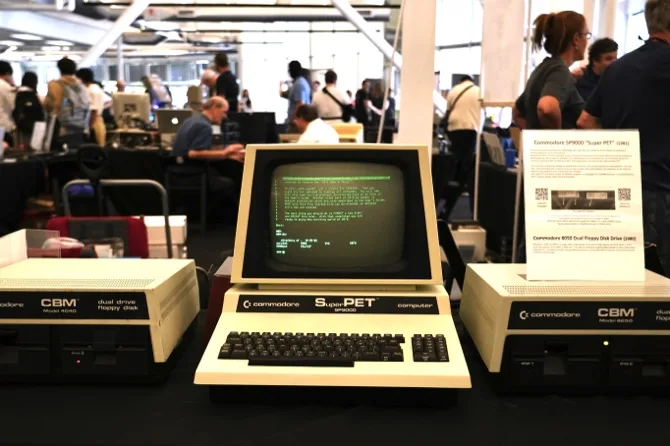
As Silicon Valley races toward an artificial intelligence-driven future, a growing community of enthusiasts is looking backward, restoring and preserving the computers that launched the digital revolution.
Software engineer Josh Dersch spends countless hours in his garage coaxing decades-old machines back to life. He estimates he owns more than 200 vintage computers and devices at his Seattle home.
“It’s always been fascinating to me to see the origins of things,” Dersch said. “It’s a fun challenge to debug and repair. You can understand the entire system from top to bottom.”
Collectors such as Dersch regard Atari, Commodore and IBM machines not as obsolete junk but as historical artifacts — ancestors of today’s laptops, smartphones and wearable devices. Part of the attraction is nostalgia: the familiar beeps and chimes and the chance to play early games such as “Pong” and “Space Invaders.”
“The enthusiasm for the history of computers and all the stuff around it is growing,” said Erik Klein, president of the Vintage Computer Federation.
More than 3,500 people attended the two-day Vintage Computer Festival in Mountain View in early August, held at the Computer History Museum. This year’s event celebrated Apple’s 50th anniversary and included a panel featuring co-founders Steve Wozniak and Ronald Wayne discussing the company’s beginnings under the late Steve Jobs.
More than a dozen similar gatherings have emerged across North America, South America and Europe. Klein said growing interest is also visible in online marketplaces, where rare machines can command extraordinary prices. An Apple-1, the company’s first product, can sell for hundreds of thousands of dollars.
At the festival, collectors displayed painstakingly restored machines and invited visitors to use computers built long before the internet, social media and AI transformed everyday life.
Dersch drove from Seattle to exhibit the pride of his collection: a Xerox Alto, developed at Xerox’s Palo Alto Research Center in the 1970s and often described as the “grandfather of the modern computer.”
The Alto pioneered technologies now taken for granted, including the mouse and graphical user interface, with windows, icons and cursors. Its innovations famously influenced Jobs and Microsoft co-founder Bill Gates.
Dersch’s fully functioning workstation included its distinctive vertical monitor, chunky keyboard and mouse, along with large spinning disks that stored minuscule amounts of data by today’s standards.
For some enthusiasts, however, collecting can become overwhelming. Klein once owned about 150 computer systems, with accessories, documents and original packaging filling closets and his garage. Eventually, he worried the collection had become an “albatross” for his family and sold or gave away most of it.
He now channels his enthusiasm into organizing festivals, repair workshops and swap meets.
Sellam Ismail, who organized the first Vintage Computer Festival in 1997 for about 150 hobbyists, said he has watched the community steadily expand. He later co-founded the Vintage Computer Federation and helped similar events get started internationally.
“The community grew up,” Ismail said. “More and more people started getting old computers, started collecting them.”
With the festival approaching its 30th anniversary next year, he expects the fascination with yesterday’s technology to keep growing. MDT/AP



Leave a reply
You must be logged in to post a comment.


