MACAU DAILY TIMES 澳門每日時報

Top Menu

  • Our Team
  • Editorial Statute
    • Code of Ethics
    • Privacy Policy
    • Terms and Conditions
  • Archive
    • PDF Editions
  • Contacts
  • Extra Times
    • Drive In
    • Book It
    • tTunes
    • Features
    • World of Bacchus
    • Taste of Edesia

Main Menu

  • Home
  • Macau
    • Photo Shop
    • Advertorial
  • Interview
  • Greater Bay
  • Business
    • Corporate Bits
  • China
  • Asia
  • World
  • Sports
  • Opinion
    • Editorial
    • Our Desk
    • Business Views
    • China Daily
    • Multipolar World
    • The Conversation
    • World Views
  • Our Team
  • Editorial Statute
    • Code of Ethics
    • Privacy Policy
    • Terms and Conditions
  • Archive
    • PDF Editions
  • Contacts
  • Extra Times
    • Drive In
    • Book It
    • tTunes
    • Features
    • World of Bacchus
    • Taste of Edesia
logo
FOUNDER & PUBLISHER Kowie Geldenhuys
EDITOR-IN-CHIEF Paulo Coutinho
Macau,

MACAU DAILY TIMES 澳門每日時報

  • Home
  • Macau
    • Photo Shop
    • Advertorial
  • Interview
  • Greater Bay
  • Business
    • Corporate Bits
  • China
  • Asia
  • World
  • Sports
  • Opinion
    • Editorial
    • Our Desk
    • Business Views
    • China Daily
    • Multipolar World
    • The Conversation
    • World Views
  • GEG Supports the Synergy of “Three Heritages”, Contributing to Macau’s Development as “One Base”

  • Fortune gambles: Macau’s take on tarot

  • Macau’s opportunity is to make payment differences invisible, says industry expert

  • Galaxy Stars of Gastronomy 2026: A five elements culinary journey

  • Macau’s ‘invisible builders’ brought into focus by colonial architecture research

  • Gov’t introduces eliminatory written exam for medical staff recruitment

China
Home›China›Analysis | For Beijing, smaller trade surplus OK. But tech concessions? No.

Analysis | For Beijing, smaller trade surplus OK. But tech concessions? No.

By -
Tuesday, June 5, 2018
127
0

Narrow our trade surplus with the United States? No problem, say Chinese negotiators. But change technology tactics that are China’s path to prosperity and its rightful place as a global leader? Absolutely not.

China highlighted the sensitivity of the issue with its threat Sunday to scrap deals aimed at settling a trade dispute with Washington if President Donald Trump’s tariff hike on USD50 billion of Chinese technology goods goes ahead.

It sheds more light on where President Xi Jinping’s government might compromise and where it rejects any challenge to a Communist Party-led model for technology development that it sees as hugely successful.

“Where China does not budge is in areas it considers to be its fundamental development strategy,” said Louis Kuijs of Oxford Economics, a former World Bank economist in Beijing. “If the U.S. is asking China to stop these industrial policies to become a global technology leader, that is where China says, ‘Look, that’s not possible.’”

The desultory end to weekend talks led by Commerce Secretary Wilbur Ross and China’s top economic official, Vice Premier Liu He, revived worries Beijing and Washington are sliding again toward open conflict.

The dispute is in two largely unrelated halves: American frustration with China’s overall trade surplus with the United States — a record $375.2 billion last year and forecast to grow — and more narrowly focused complaints about Beijing’s technology policy.

China already agreed to address the first with a May 19 pledge to buy more American farm goods, energy supplies and other products.

That is fairly easy, say private sector analysts. Beijing can buy more U.S. natural gas and soybeans and less from Russia and Brazil. Its overall trade balance would stay the same.

The focus on China’s trade surplus is politically appealing, economists say, but distracts from goals that matter more to American companies and that Washington’s European and Asian partners support. Those include gaining the same access to Beijing’s markets that its companies enjoy abroad and improving protection of intellectual property such as patents and trademarks.

“The Trump administration’s fixation on the trade deficit is exactly where I think the Chinese would prefer to have this,” said Paul Haenle, director of the Carnegie-Tsinghua Center for Global Policy in Beijing. “It kind of lets them off the hook on these bigger, more important issues.”

Technology is thornier. It strikes at the heart of plans the ruling Communist Party sees as critical to reducing poverty that remains widespread despite two decades of explosive economic growth.

The United States and other governments complain Chinese technology industries are built on know-how Beijing steals or pressures foreign companies to hand over.

Before Beijing joined the World Trade Organization in 2001, such “technology transfer” often was an explicit requirement for foreign companies that wanted access to China’s state-dominated economy.

Today, regulators say no one is obliged to give up technology. But foreign companies in autos, pharmaceuticals and other fields are required to operate through local partners. That forces them to share know-how with potential rivals or help them to create their own.

Xi’s government sees Chinese strength in technology as a path to restoring the country’s political and cultural greatness after two centuries of what nationalists see as humiliation by foreigners.

“Make no mistake about this: China aims to be the world’s largest economy, its advocate of free trade, its geopolitical leader,” Carl B. Weinberg of High Frequency Economics said in a report.

Beijing has staked out a role as defender of free trade in response to Trump’s support for import controls. That is despite China’s status as the most-closed major economy — a paradox some foreign businesspeople call, “free markets abroad, socialism at home.”

Trump’s tariff threat targeting technology goods reflects American alarm about China’s status as a potential competitor in profitable fields from solar power to electric cars to biotechnology.

After a lull in tensions following China’s May 19 pledge, the White House renewed its threat last week. It said details of goods targeted would be released June 15, but an earlier tentative list included telecoms, medical and other technology.

Beijing is ready to make concessions to avoid a real trade war with Washington, but worries about the economic and political costs, said Shi Yinhong, a professor at Renmin University’s School of International Studies in Beijing.

“The Chinese government believes that if the concessions are too huge and hasty, it might not be workable for the Chinese economy or the Chinese government may feel it is being placed in a vulnerable political and diplomatic position by easily making concessions,” said Shi. “It won’t be the case that the United States can get whatever they want.”

On Sunday, Ross said the two sides discussed specific exports Beijing might buy, but the meeting ended with no commitments.

An hour later, a statement carried by China’s official Xinhua News Agency said if tariff hikes or other U.S. sanctions go ahead, then “all the economic and trade achievements negotiated by the two parties will not take effect.”

Since November, China has announced plans to end limits on foreign ownership in its insurance and auto industries and to reduce import tariffs on autos and a range of consumer goods.

“China has shown flexibility in most areas where Washington is seeking greater market access,” said Rajiv Biswas of IHS Markit. “However, a major challenge for China will be to reduce the bilateral trade deficit by $200 billion per year over the medium term as requested by Washington, since that will be a mammoth task.”

Beijing has promised to give market forces the “decisive role” in allocating resources but also is building up state-owned companies that dominate fields including banking, telecoms and energy.

The Communist Party said in 2013 would increase its direct role in business decisions. That runs counter to the trend in economies such as Japan and South Korea that became more open and market-oriented as they developed.

Governments including Germany increasingly express concern Beijing is carrying out state-sponsored technology acquisition disguised as purchases by enterprises that officially are private.

They say Chinese leaders blur the lines between state and private by providing the money for deals such as automaker Geely’s 2010 purchase of Volvo Cars and appliance manufacturer Midea’s 2016 acquisition of German robotics maker Kuka.

In 2017, Trump vetoed the sale of a U.S. semiconductor manufacturer to a Chinese investor on national security grounds after Washington concluded the financing came from China’s government.

The White House and business groups cite Beijing’s “Made in China 2025” development strategy as an example of policies they say hamper market access and violate free-trade commitments.

It calls for China to develop global leaders in electric cars, renewable energy, robotics, artificial intelligence and other fields. Business groups say that inevitably will involve subsidies and protection against foreign competitors.

“It’s tantamount to a country competing with a company,” the chairman of the American Chamber of Commerce in China, William Zarit, said last week.

Kuijs of Oxford Economics said an extended conflict could lead to a “technological cold war” that would carve up the global market into isolated regions with different standards for mobile phones and other products.

“That will dampen productivity growth in the long term,” he said. Joe McDonald, Beijing, AP

Share this:

  • Share on Facebook (Opens in new window) Facebook
  • Share on X (Opens in new window) X
  • Share on LinkedIn (Opens in new window) LinkedIn
  • Share on WhatsApp (Opens in new window) WhatsApp
  • Print (Opens in new window) Print

Like this:

Like Loading…

Related

Previous Article

Trade War | Two sides harden their ...

Next Article

Corporate Bits | Sands China awards outstanding ...

Related articles More from author

  • China

    Residents of Lianyungang protest possible nuclear plans

    Wednesday, August 10, 2016
    By -
  • China

    Surveillance tycoons lose billions from threat of US sanctions

    Thursday, May 23, 2019
    By -
  • ChinaHeadlines

    US targets $300b of Chinese goods for new tariff hikes

    Wednesday, May 15, 2019
    By -
  • China

    China imposes export controls on 40 Japanese entities as tensions with Tokyo rise 

    Tuesday, June 30, 2026
    By MDT/AP
  • China

    Lawyer Pu Zhiqiang on trial in Beijing as police scuffle with protesters

    Tuesday, December 15, 2015
    By -
  • China

    Home prices fall as trends diverge among cities

    Monday, January 19, 2015
    By -

Leave a reply Cancel reply

You must be logged in to post a comment.
  • Daily Edition

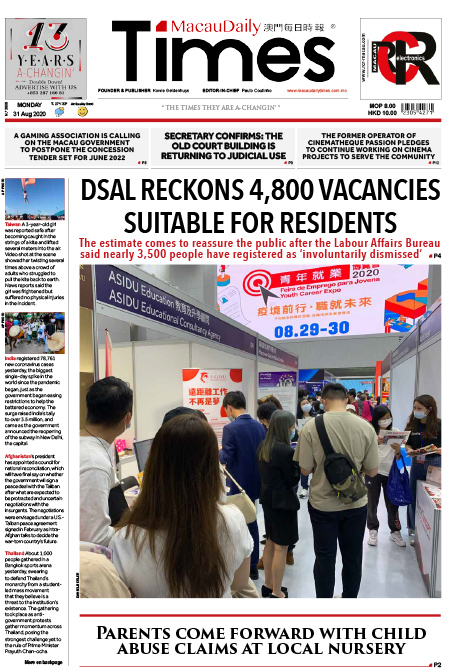
    Monday, August 31, 2020 – edition no. 3608

  • China

    Gov’t defends ‘zero-Covid’ after US envoy warns of costs

  • HeadlinesMacau

    Q&A | Sean Duca VP, Asia pacific, Palo Alto Networks: ‘Cyber risk is a real challenge’

DAILY EDITION

Friday, November 27, 2026 – edition no. 5084

Greater Bay

MDT MACAU GRAND PRIX SPECIAL

November 2026
M T W T F S S
 1
2345678
9101112131415
16171819202122
23242526272829
30  
« Oct    

Timeline

  • Friday, November 27, 2026

    GEG Supports the Synergy of “Three Heritages”, Contributing to Macau’s Development as “One Base”

  • Friday, November 27, 2026

    Fortune gambles: Macau’s take on tarot

  • Friday, November 27, 2026

    Macau’s opportunity is to make payment differences invisible, says industry expert

  • Friday, November 27, 2026

    Galaxy Stars of Gastronomy 2026: A five elements culinary journey

  • Friday, November 27, 2026

    Macau’s ‘invisible builders’ brought into focus by colonial architecture research

  • Friday, November 27, 2026

    Gov’t introduces eliminatory written exam for medical staff recruitment

  • Friday, November 27, 2026

    Gov’t to hold six job fairs, identify 1,000-plus positions in 2027

  • Friday, November 27, 2026

    Civil servants strong on public-interest commitment but weaker on collaboration: survey

  • Friday, November 27, 2026

    New public parking lot opens in Taipa

  • Friday, November 27, 2026

    Gov’t reviews food delivery rules with three platforms

Extra Times

HeadlinesTaste of Edesia

Galaxy Stars of Gastronomy 2026: A five elements culinary journey

Building on a successful three-year legacy of world-class culinary festivals, Galaxy Stars of Gastronomy 2026 debuts this November as Galaxy Macau’s eponymous signature gastronomy event. Set to be one of ...
  • Ariana Grande gives a moribund franchise a pair of shock paddles in ‘Focker In-Law’

    By MDT/AP
    Friday, November 27, 2026
  • Peter Gabriel contends with AI’s impact on being human in latest album

    By MDT/AP
    Friday, November 27, 2026
  • Jack’s Club debuts at The St. Regis Bar Macao with jazz elegance

    By -
    Friday, November 27, 2026
  • ‘Madden’ biopic can’t find a playbook to stick with

    By MDT/AP
    Friday, November 20, 2026
  • Recent

  • Popular

  • GEG Supports the Synergy of “Three Heritages”, Contributing to Macau’s Development as “One Base”

    By GEG PR
    Friday, November 27, 2026
  • Fortune gambles: Macau’s take on tarot

    By Nadia Shaw, MDT
    Friday, November 27, 2026
  • Macau’s opportunity is to make payment differences invisible, says industry expert

    By Renato Marques, MDT
    Friday, November 27, 2026
  • Galaxy Stars of Gastronomy 2026: A five elements culinary journey

    By Irene Sam, MDT
    Friday, November 27, 2026
  • Macau’s ‘invisible builders’ brought into focus by colonial architecture research

    By Nadia Shaw, MDT
    Friday, November 27, 2026
  • Gov’t introduces eliminatory written exam for medical staff recruitment

    By Renato Marques, MDT
    Friday, November 27, 2026
  • Gov’t to hold six job fairs, identify 1,000-plus positions in 2027

    By Yuki Lei, MDT
    Friday, November 27, 2026
  • Canidrome may have its days numbered, decision in ‘one or two months’

    By Paulo Coutinho, MDT
    Thursday, May 26, 2016
  • Animal Welfare | Macau: Anima slams Canidrome management for avoiding debate

    By -
    Wednesday, May 4, 2016
  • Editorial | Canidoomed

    By Paulo Coutinho, MDT
    Wednesday, June 1, 2016
  • Animal Welfare | Canidrome presented with ultimatum: close or move

    By Daniel Beitler, MDT
    Friday, July 22, 2016
  • Australia regulator cracks down on alleged exportation of dogs to Macau

    By Paulo Coutinho, MDT
    Friday, June 10, 2016
  • Animal rights | Canidrome: Anima in fresh airline negotiations as Canidrome closure looks more likely

    By Daniel Beitler, MDT
    Friday, May 27, 2016
  • USE OF ENGLISH IN MACAU | A ‘de facto’ official language

    By Catarina Pinto
    Monday, July 6, 2015
  • Contact our Administrator
  • Contact our Editor-in-Chief
  • Contacts
  • Our Team
  • Privacy Policy
  • Terms and Conditions
  • Editorial Statute
  • Code of Ethics
COPYRIGHT © MACAU DAILY TIMES 2008-2026. ALL RIGHTS RESERVED
MACAU DAILY TIMES
  • Home
  • Macau
    • Photo Shop
    • Advertorial
  • Interview
  • Greater Bay
  • Business
    • Corporate Bits
  • China
  • Asia
  • World
  • Sports
  • Opinion
    • Editorial
    • Our Desk
    • Business Views
    • China Daily
    • Multipolar World
    • The Conversation
    • World Views
  • Our Team
  • Editorial Statute
    • Code of Ethics
    • Privacy Policy
    • Terms and Conditions
  • Archive
    • PDF Editions
  • Contacts
  • Extra Times
    • Drive In
    • Book It
    • tTunes
    • Features
    • World of Bacchus
    • Taste of Edesia
Loading Comments...

You must be logged in to post a comment.

%d