Fortune gambles: Macau’s take on tarot

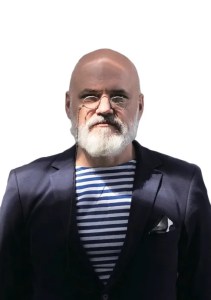
Konstantin Bessmertny
Macau- and Hong Kong-based artist builds candlelit
‘Arcana’ show around a full tarot deck,
with an Italian actor as fortune teller
Artist Konstantin Bessmertny, born in Blagoveschensk in the former Soviet Union, has painted a full 78-card tarot deck, and he wants visitors to draw their own cards with a little help from artificial intelligence. In an exclusive interview with
The Times before the opening of “Arcana,” the Macau- and Hong Kong-based artist outlined a show that treats the gallery as a candlelit playground.
The exhibition opens in Hong Kong with a reception at 2 p.m. Saturday, Nov. 28, at Gallery EXIT and runs on the third floor through Dec. 24.
A deck of impossible tasks
“Arcana” is described as a solo exhibition that brings works from different periods of Bessmertny’s career into a new constellation. Tarot serves as the framework for viewing, and, through the motifs of divination, fate and omens, the paintings are meant to speak to one another.
The project has a long history. Bessmertny, first tackled the major arcana, the cards such as Death, Lovers, Sun and Moon, in “Deity of Doubt” at Rossi & Rossi in Hong Kong in 2016. Two works from that show remain unsold and return here for “Arcana.” One is “Lovers,” in which an angel fires an arrow into the man’s head rather than his heart.
To see how far the artist departs from convention, it helps to look at the traditional card.
In the traditional tarot card, a man and a woman stand blessed by an angel overhead, in what appears to be the Garden of Eden. Behind the woman, a fruit tree entwined with a snake recalls the biblical story of humanity’s fall into temptation and into the realm of the flesh. The angel is Raphael, associated with the element of air, the same element as Gemini, the zodiac sign that governs the card.
Bessmertny’s version, however, turns that picture around. “At that time [in 2016], they were actually naked,” he said. “But now I see too much censorship. So, I put the stickers like parental guidance […] I adapted it from the music industry.”
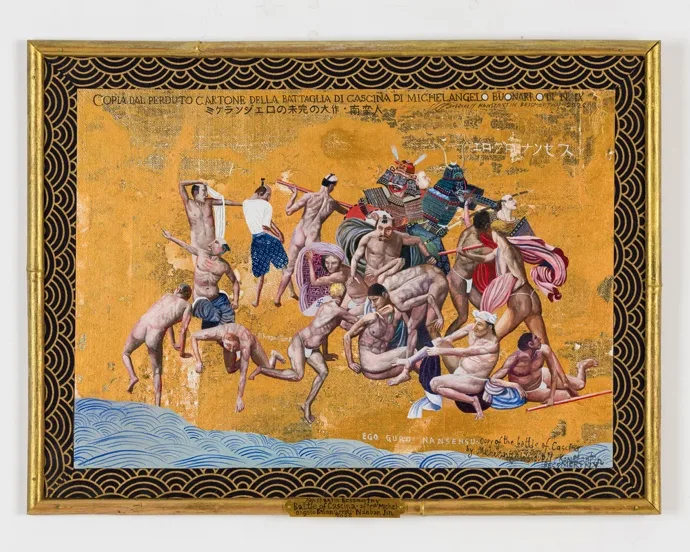
Three of Wands (Battle of Cascina after Michelangelo), 2026,
oil on canvas mounted on wood panel, 36.5 x 49.5 cm
Describe his “Lovers” scene in detail, Bessmertny said, “So, two people with the angel shooting arrow into the head of the man. Not to the heart, but to the head […] and she’s putting her finger into the ring,” he said. “But the painting is the same.”
Since then, Bessmertny has completed the minor arcana, and maintains that the works are not tarot illustrations. “I hate to illustrate tarot,” he said. “Most of the tarot you could see in the kiosks and the bookstores, it’s just illustration of like conventional ideas. But tarot themselves are not actually facts. It’s not absolute truth.”
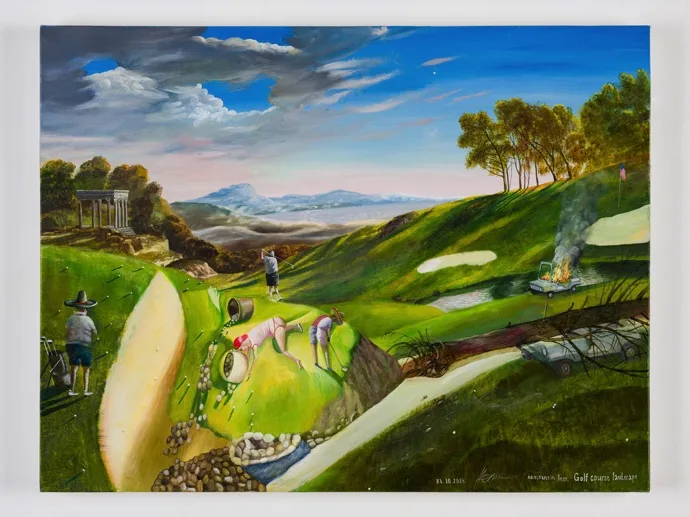
Page of Wands (Golf Course Emperor), 2024, oil on canvas, 45 x 59 x 3.5 cm
Instead, he tries to keep to each card’s general idea “but to bring my own life experience, my philosophical ideas and so on.”
“I always was dreaming […] I was sketching and so on. So, a few years ago, I decided, no, I have to do it,” he said. “I like this kind of big, almost impossible tasks. Like making 78 paintings.”
Cold War chips and wine-tasting cups
As a result, the works are playful and often political. The show includes new oil paintings from 2026, among them “Eight of Wands (The Persistence of Luck),” “Nine of Swords (Lord Shiva)” and “The Hanged Man.”
One casino-themed work, for example, shows Ronald Reagan beside an original dollar. “This is not gambling. This is Cold War,” Bessmertny said. “Reagan is the winner of Cold War.” Another borrows Salvador Dalí’s melting clocks for a roulette-style scene in which every bet lands on eight. “The bet is on 8. So, you’re a winner anyway. It’s a kind of absurd,” he said.
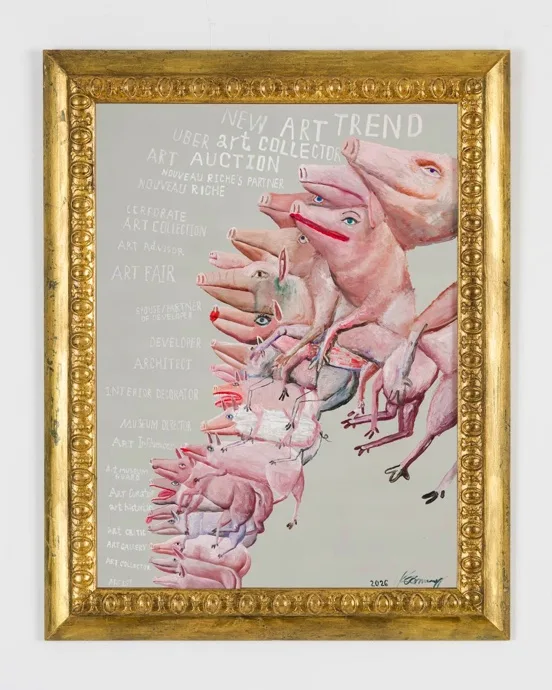
Hierophant (Art Pyramid) 2026, oil on mirror, 40 x 30 cm, 47.5 x 37.5 cm framed
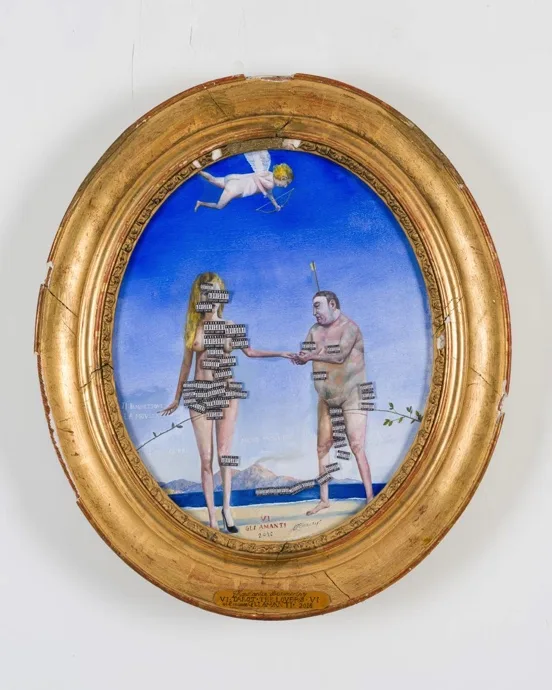
The Lovers (Gli Amanti) 2026, oil and mixed media on canvas, 32 × 26.5 cm, 42 × 37 cm framed
Meanwhile, the suit of cups becomes a tour of drinking cultures. The Irish card features Guinness, and the Seven of Cups is a wine tasting. “How pompous. It’s educational,” he said.
Elsewhere in the show, many works draw on his Japanese-influenced “Nanban-jin” series, shown in Tokyo last year. They use bamboo frames, washi paper and gold fabric. The title “Nanban-jin” 南蛮人 is the historical Japanese term for the first Europeans to arrive in Japan, “barbarians from the south.”
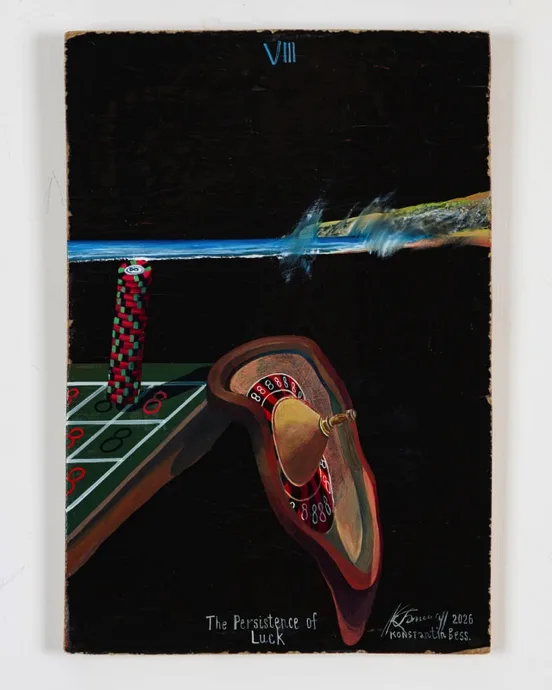
Eight of Wands (The Persistence of Luck), 2026, oil on found wood panel, 24.5 x 16.5 cm
The idea came from a conversation in Japan. Bessmertny told The Times that Japanese friends once explained the many names their language has for the Portuguese, and he found one especially funny. “My favorite was hairy Chinese,” he said. “They were thinking like, these people coming from China.”
He then took the idea as a subject. “I’m from Macau. I’m a barbarian in the south. I tried to kind of take this as a subject. And then develop it.”
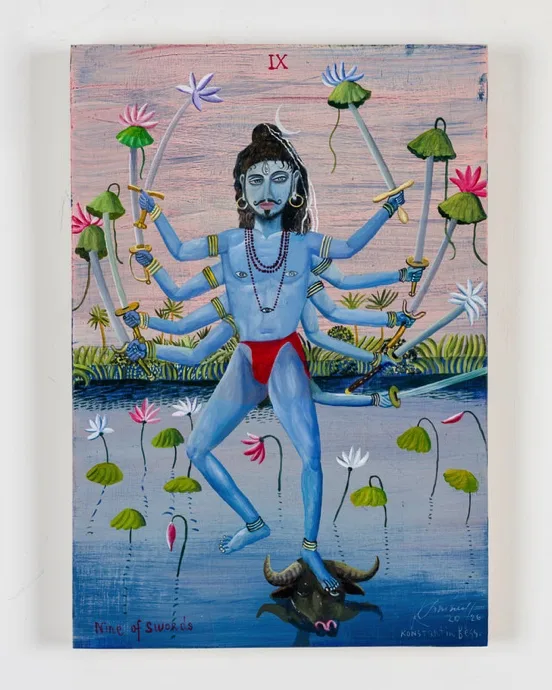
Nine of Swords (Lord Shiva), 2026, oil on wood panel, 24.5 x 17 cm
At the other end of the scale, the largest work in “Arcana,” a tower measuring 280 by 2 meters, began as an Escher-style labyrinth made for the Doha art fair. A buyer reserved it but never committed, and it was shipped back. “I brought it to studio. First, I destroy it,” Bessmertny said. “And then I started to paint. So now it’s full of characters.”
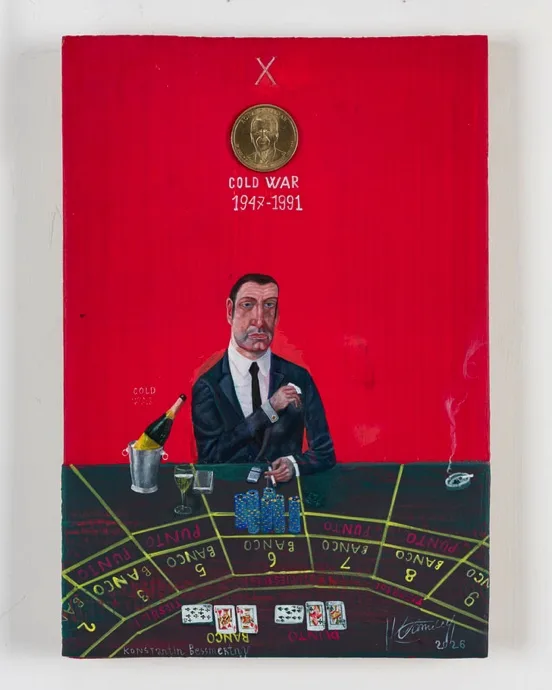
Ten of Pentacles, 2025, oil and mixed media on wood panel, 24.5 x 17 cm
Candles, actors and algorithms
Beyond the paintings, the show is also theater. Bessmertny has persuaded the gallery to dim the lights and use candles, mostly artificial, with one real flame. He cited Stanley Kubrick’s “Barry Lyndon” as inspiration. “Everything was filmed with the candlelight,” he said. “So I wanted to bring this feel into the sort of playground.”
To complete the effect, an Italian actor will play the tarot master at the opening. “He’s an actor. But he’s clever. He can improvise and so on,” Bessmertny said. The actor read cards for him almost 15 years ago in Dresden, Germany.
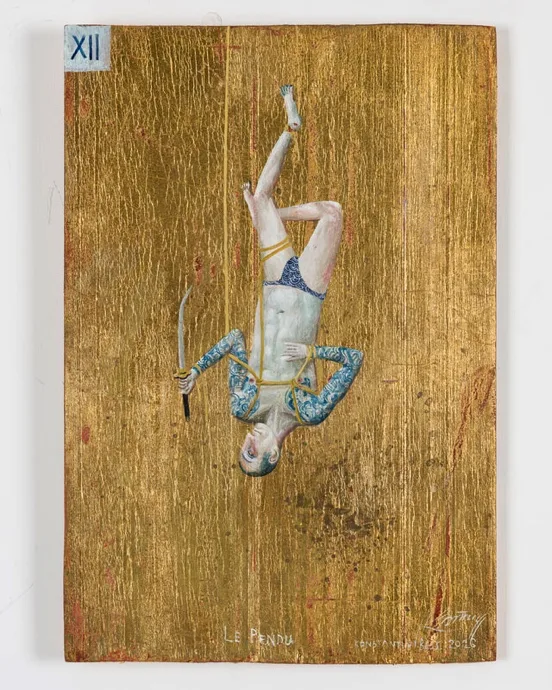
The Hanged Man, 2026,oil and gold leaf on wood panel, 24.5 x 16.5 cm
After the opening, however, visitors will work alone. An old mahjong table with drawers will hold the cards. “What you need is three cards,” Bessmertny said. “Draw three cards and mention upright or upside down.” Technology can then take over. “Or even surely with AI, you can take a photo,” he said. “Actually, you don’t need tarot card master now with AI.”
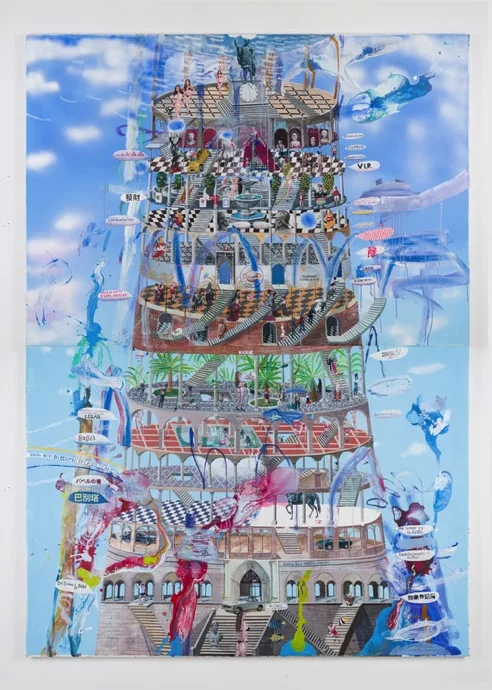
The Tower, 2025 / 2026, acrylic and mixed media on canvas, 280 x 200 cm, 2 panels
Ultimately, the aim is to pull people from their phones. “I want them to be dragged out of screen,” he said. “And even people will find it out, oh my God, I want to be there. I want this feeling. Fear of missing something. FOMO.”
A Greater Bay Area lens
Read through a Greater Bay Area lens, Bessmertny’s tarot framework turns the gallery into a space where fate is not fixed but negotiated. His work also speaks to Macau’s particular position.
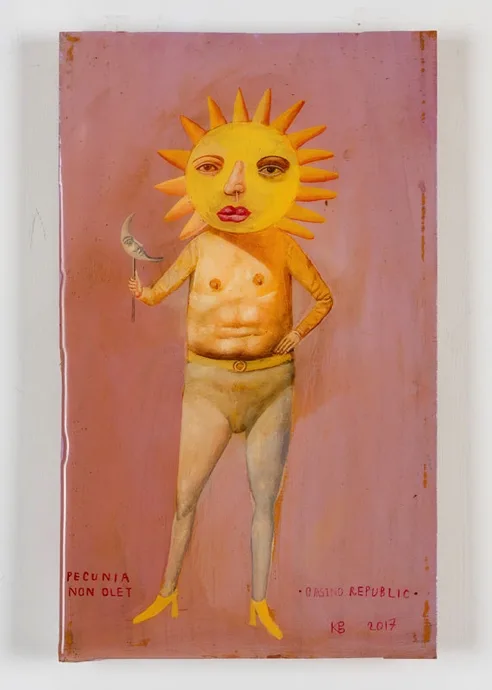
The Sun, 2017, oil and mixed media on wood panel, 16 x 26.5 cm
As a Russian-born artist working between Macau and Hong Kong, he draws on European art history, Japanese Nanban-jin imagery, casino culture and Cold War politics—precisely the layered encounters that have made the Pearl River Delta a site of East–West exchange.
The region’s cultural plans position Macau as a base for multicultural exchange, while Hong Kong serves as a platform for dialogue between Chinese and international cultures.
Most importantly, Bessmertny refuses a single, polished narrative. His paintings move from classical drawing to performance, video and installation, treating art as an open system rather than a fixed category.
Looking ahead, Bessmertny told The Times he does not expect to revisit the tarot project soon. “Unless it comes like a different stage,” he said. “But, for now I feel like what I wanted is complete.”
INTERVIEW By Nadia Shaw

Leave a reply
You must be logged in to post a comment.