ExCo backs bill proposing tougher oversight and new dissolution powers for associations
[Photo: Nadia Shaw]
The government is proposing tighter oversight of associations, including new procedures to address inactive organizations and powers to dissolve groups in specified circumstances, under a bill whose discussion has been completed by the Executive Council (ExCo).
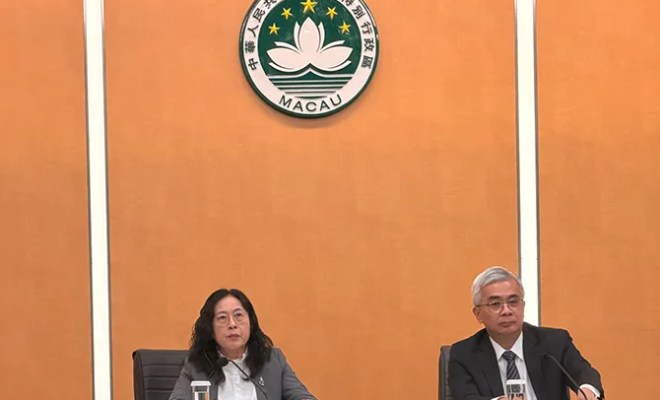
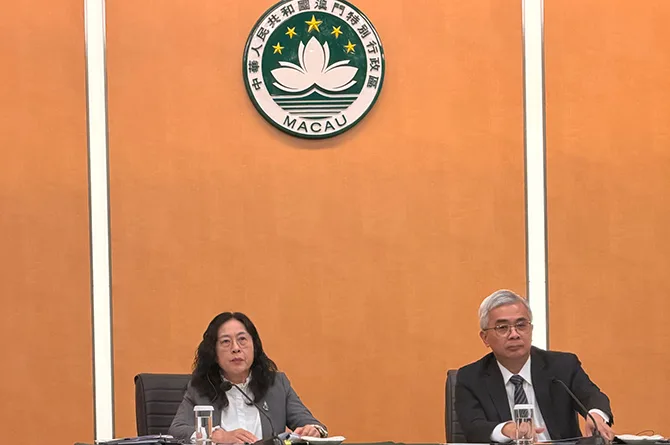
Wong Sio Chak, Secretary for Administration and Justice and the council’s spokesperson, announced at a press conference Thursday that the proposed overhaul to the Legal Regime of Associations would be submitted to the Legislative Assembly (AL) for scrutiny and approval.
The bill would make the Identification Services Bureau (DSI) the principal authority responsible for registering and supervising associations.
It would also introduce rules for branches of overseas organizations, associations of non-local people and declarations concerning membership of organizations outside Macau.
DSI director Sonia Chan said, “In the bill, each [association] will be required, when carrying out its functions, to submit contact reports, activity reports, accounts, assets and other documents,” adding that the government considered document-retention requirements necessary.
Wong added that the Civil Code and Law No. 2/99/M, which currently govern association procedures and operations, had been in force for many years.
The proposal follows a 45-day public consultation held from Aug. 10 to Sept. 23, 2026. The government said it had considered the responses and Macau’s circumstances when drafting the legislation, and had recently published its consultation summary.
Alongside centralized supervision, the bill would regulate the qualifications and numbers of founders and office-holders, as well as the use of association names and premises.
It would also establish mechanisms requiring associations to correct irregularities, introduce administrative penalties and revise procedures for ending an association’s legal existence.
Questions over security and dissolution
Chan described three circumstances in which the bureau could act under the proposed framework. These concerned national security, the continued eligibility of an overseas association’s Macau branch and the failure to correct irregularities within a legally prescribed period.
Discussing the security provision, Chan referred to the “review opinion of the Macau SAR Committee for Safeguarding National Security.”
She also explained that an overseas branch could be affected if its parent organization ceased to exist or the required relationship between the parent and branch no longer existed.
“As everyone may have seen, among our current 2,400 associations, about 40% are dormant. It cannot be ruled out that a large proportion of those dormant associations may eventually be dissolved. If none of their names could be used again, this may not necessarily be beneficial to the development of the community,” Chan said.
Inactive associations face transition deadline
Reporters also questioned whether existing associations would have enough time to regularize their position.
Asked whether the proposed 180-day period following notification would be sufficient, Chan said the transitional arrangement concerned associations already in existence before the legislation took effect, including organizations that had gone five years or more without providing updated information to the bureau.
Notifications would be issued in batches, she said, allowing the affected associations 180 days to address the outstanding matters. Chan said, “We will notify these associations in batches and give them 180 days to deal with the required matters.”
“If they provide the relevant documents within 180 days of receiving the bureau’s notice, they can resume normal operations.”
Chan said the longer transition period was intended to give dormant associations, many of which had been inactive for a considerable time, an opportunity to comply. For associations established after the law takes effect, she said the arrangements would be different because they would have sufficient time to comply from the outset.
When questioned about whether allowing a new association to adopt the name of a dissolved organization after three years could cause public confusion, Wong said proposed names would remain subject to government examination and statutory criteria intended to prevent misunderstandings.
Chan added that permanently reserving names previously used by organizations that had ceased to exist could unnecessarily restrict future associations, citing hometown groups as an example.
She said applications to reuse a name would face the same assessment standards as other applications.
“The standard for reusing a name will be the same as for any other association’s name. I would not say that because a name was used before, we would not carry out any other review.” However, she said names of associations dissolved because of national-security concerns would be unlikely to be reused.
The bill now moves to the AL, where its detailed provisions will be examined.

Leave a reply
You must be logged in to post a comment.