Security sector to expand AI policing, upgrade border controls in 2027

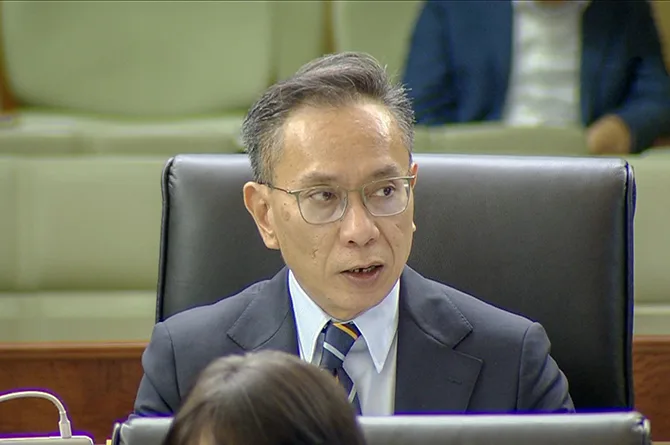
Chan Tsz King
Secretary for Security Chan Tsz King said security policies next year will be aligned with the Third Five-Year Plan, focusing on national security, smart policing, border integration and civil protection.
Speaking at the Legislative Assembly (AL) Wednesday in response to lawmakers’ questions about the specific measures under the plan, Chan reiterated that preliminary work would begin next year to amend the Cybersecurity Law, optimize regulations on Internet data security, advance anti-money laundering legislation and strengthen counterterrorism efforts, including drills and emergency response exercises.
On smart policing, Chan said the government would continue using technology to support police operations, including expanding and upgrading the “Eyes in the Sky” surveillance system, deploying drones, using 3D scanning for traffic and border control, and applying AI tools to predict crowd movements and manage flows.
Regarding “Eyes in the Sky,” Phase Six is expected to bring the total number of cameras to more than 2,400 by 2027, covering new locations such as the public housing estate at the former CEM power plant on Avenida de Venceslau de Morais, Zone A, Barra Light Rapid Transit (LRT) station and the Islands Healthcare Complex.
On border control and integration with Hengqin, Chan said authorities on both sides would introduce a contactless identification system using facial and iris recognition in the vehicle One-Stop lanes at the Hengqin Port by the end of 2027.
The system, described as the most advanced of its kind and the first in China to receive this upgrade, will allow drivers to cross the border without leaving their vehicles.
He also noted that the government plans to build a new checkpoint at Hengqin Port on the University of Macau campus.
According to Chan, the checkpoint will allow residents to cross using a single identification document, with the system applying to both Macau and Hong Kong residents.
Tackling cybercrime a priority
Several lawmakers expressed concern over the high number of cybercrime and online fraud cases, particularly phishing schemes that have resulted in substantial financial losses.
Chan said tackling cybercrime would be one of next year’s priorities. To strengthen efforts against phishing, his secretariat will work with the Judiciary Police (PJ) to launch new anti-fraud software.
According to the secretary, the software will use AI to detect images, videos and messages associated with emerging phishing schemes, allowing authorities to identify new forms of fraud as early as possible and prevent them from reaching residents.
He said the initiative would also require the participation of the financial and banking sectors, as well as telecommunications operators, to strengthen loss prevention.
The use of AI tools and drones will also be expanded to support border control and Customs Service operations, including border monitoring and maritime surveillance.
Retirements expected to reduce workforce
During the discussion between the secretary, security force representatives and lawmakers, officials also acknowledged that a significant number of officers are expected to reach retirement age next year. Some lawmakers expressed concern about staffing levels and the potential for increased workloads.
In response, Chan said the services were aware of the situation and were recruiting and training new personnel as quickly as possible. He added that better technology and more advanced equipment would help support officers’ work and address staffing needs.
Asked about suggestions from lawmakers to introduce supplementary remuneration for officers on duty to attract more residents to join the security forces, Chan said he was open to studying the possibility, including adjustments to existing allowances.
He said he would take into account suggestions from lawmakers and personnel before introducing an optimization plan at an appropriate time, but did not provide a timeline.
Private security suggested as alternative
Returning to a topic raised on Tuesday with Secretary for Economy and Finance Dora Ng, lawmaker Song Pek Kei suggested that the government consider using private security personnel hired by gaming concessionaires and event organizers to handle some crowd-control duties during large-scale events.
Song said police officers should focus on more important law enforcement responsibilities rather than crowd management, adding that event organizers should recruit and pay for their own security personnel.
In response, Chan said that while the growing number of large-scale events in Macau benefited the city’s economic development, it also placed additional pressure on the security sector.
However, he noted that the government’s security arrangements for large-scale events had become more sophisticated and efficient through accumulated experience, with interdepartmental discussions and assessments conducted before each event.
Unlicensed transport services under scrutiny
Asked about the presence and alleged expansion of illegal passenger transport services in Macau, Chan said authorities were aware of some cases and had been gathering intelligence through multiple channels to address the issue.
According to Chan, enforcement efforts include deploying plainclothes police officers to patrol hotel areas, casinos, tourist attractions and large event venues, as well as stepping up inspections.
He also said police regularly meet with Zhuhai authorities to discuss cross-border activities of this kind, involving not only passenger transport but also the movement of undeclared goods.
Authorities on both sides of the border are also conducting joint inspections to curb illegal passenger transport operations.
The number of such cases has reportedly increased significantly following the introduction of measures facilitating the entry of single-plated Macau vehicles into the mainland. In many cases, residents and visitors hire private vehicles to provide cross-border pick-up and drop-off services, an activity subject to strict restrictions and permitted only for certain vehicles registered with travel agencies.
Expanding fire detection through telecare service
One of the few new initiatives announced by Chan at the AL was a pilot project with the Social Welfare Bureau (IAS) to integrate home fire detectors into the “Peng On Tung” telecare service.
Chan said the initiative aims to identify fire hazards, trigger alerts and provide additional support for elderly people living alone, particularly those in older districts and buildings classified as “three-nil” buildings – those without a property management entity, a designated person responsible for environmental cleaning or a security service.




Leave a reply
You must be logged in to post a comment.