Surveillance camera network to reach 1,751 by year end

[Photo: Lynzy Valles]
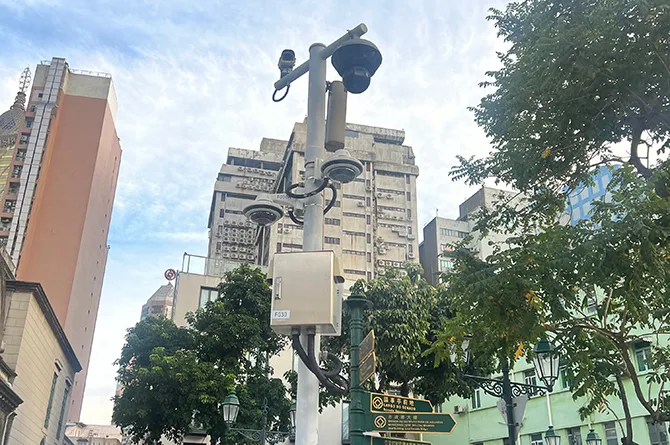
Macau aims to have 1,751 surveillance cameras citywide by the end of this year, with 40 more to be installed in New Urban Zone A in addition to the 10 already operating, the police chief’s office said.
Speaking on public broadcaster TDM’s radio program Monday, acting assistant to the commissioner-general of the Unitary Police Service (SPU) Lei Iat Meng said the sixth phase of the Macau Public Spaces Video Surveillance System, also known as “Eyes in the Sky,” is progressing in line with infrastructure planning in Zone A, including the installation of conduits and fiber-optic cables and equipment testing.
A further 680 cameras are planned for 2027, covering locations including the Morais social housing estate, Barra Light Rapid Transit (LRT) station and the Macau Medical Center of Peking Union Medical College Hospital.
Lei said the systems help police deter crime and improve investigative efficiency. In the first half of this year alone, the network assisted with 6,178 investigations, an increase of 1,180 cases, or 23.6%, from the same period last year.
The expansion has prompted questions over privacy and procurement costs. The security authorities have stressed that all camera locations require review and approval by the Personal Data Protection Bureau (PDPB), pledging that the program will proceed “on the basis of safeguarding residents’ legitimate privacy rights.”
Lawmakers have also questioned the wide variance in costs between phases, with the government responding that technical specifications, site conditions and supporting systems differ, making direct cost comparisons inappropriate.
On border clearance, acting deputy commissioner of the Public Security Police Force (PSP) Wong Kim Hong said facial and iris recognition testing is under way at the Hengqin joint one-stop vehicle lane, with the aim of introducing the technology by the end of 2027, when drivers will no longer need to leave their vehicles or present documents.
The facial recognition system has also been extended this year to self-service channels at Qingmao and the Hong Kong-Zhuhai-Macao Bridge’s Zhuhai-Macau hall, while document-free clearance at the Hengqin vehicle lane has improved efficiency by about 10%. The 52 new passenger channels at Hengqin are now fully open for trial operation, increasing processing speed by 65%.
From the first quarter of next year, the force plans to offer free checks of personal immigration records through the Macao One Account platform, allowing residents to calculate the number of days they have spent in Macau themselves. Since the electronic application service launched late last year, 3,250 people had used the service as of the end of October – 71% of all applications – and the force aims to shorten its current three-working-day processing time through automation.
On traffic enforcement, Wong said the traffic department has used drones to improve monitoring accuracy, deploying them for nighttime aerial surveillance and to track speeding vehicles during an operation against night racing and illegally modified cars that began on Oct. 31. As of Sunday, the operation had resulted in 14 cases involving speeding and 22 involving suspected illegal vehicle modifications.
Lei said the force will continue refining security arrangements for major events, monitor changing disaster conditions and review the civil protection master plan and contingency plans as needed. Next year, it plans to introduce artificial intelligence into its command center dispatch system to assist with emergency call handling.





Leave a reply
You must be logged in to post a comment.