
Guangzhou: Where ancient soul meets avant-garde edge
[Photo: Irene Sam]
Travelog
Guangzhou, a metropolis with more than 2,200 years of continuous history, is undergoing a remarkable transformation. The city masterfully stitches together profound historical depth with cutting-edge contemporary culture, forging a singular urban character. For travelers seeking the most dynamic destination in China, Guangzhou currently claims the top position – and the most compelling point of entry into this world is Dongshankou.
Heritage villas meet avant-garde chic
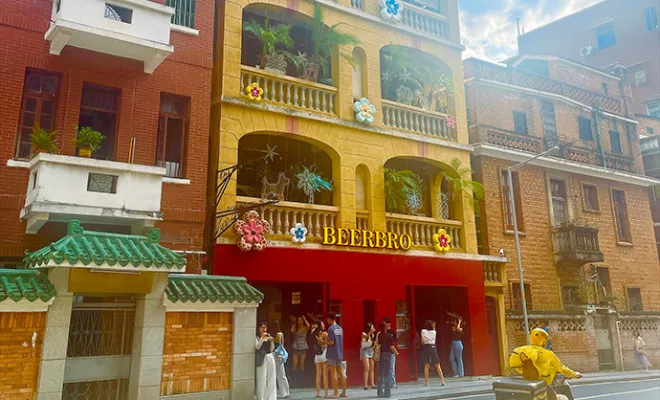
Dongshankou’s narrative begins during the late Qing dynasty and early Republican era, when wealthy overseas Chinese and military officials established grand residences in this enclave, giving rise to the legendary “Dongshan Young Masters” culture. Today, the district preserves 493 red-brick Western-style villas – yet far from becoming a dusty museum, time has transformed these heritage structures into a living, breathing trend incubator.
What renders Dongshankou so undeniably chic? The answer lies in a symbiotic ecosystem where street life converges with cutting-edge fashion. Along Miaoxian West Street alone, within a 300-meter stretch, more than 20 designer boutiques and specialty coffee shops have established themselves. The local streetwear brand Badmarket, for instance, operates adjacent to a wet market and kindergarten, creating a deliberately jarring dialogue between everyday neighborhood life and avant-garde style.
The district pulses with creative energy through its homegrown fashion labels. Chief among these is PersonSoul, a clothing brand that perfectly embodies Dongshankou’s design ethos. The fall/winter 2026 collection, WEATHERED ORDER, draws inspiration from Qin-dynasty military forms – ancient armor and structures “weathered and rebuilt around the contemporary body.” The guiding philosophy – “Weathered Order. Reconstructed Identity” – and the design principle of “Structure over Ornament” speak to a brand that excavates Chinese heritage while maintaining strikingly modern silhouettes. Housed in a restored red-brick villa, PersonSoul’s flagship store functions as a community hub where fashion, art, and neighborhood life intersect.
[Photo: Irene Sam]
A complementary vision emerges from Weekend Hub, an apparel label specializing in the “Shoujo and Coquette” aesthetic, which blends youthful, romantic feminine fashion with Korean style trends.
The collections feature lace-trimmed flared jeans, polka-dot bow tops, and floral halter dresses – a soft, playful counterpoint to PersonSoul’s structured minimalism. Born in China with a robust physical retail presence nationwide, Weekend Hub has commenced global expansion, and its boutique, nestled within a leafy Dongshankou villa courtyard, operates as a creative gathering place for the city’s fashion-forward residents.
Beyond these local labels, the designer boutique SND occupies a heritage villa beside the site of the Third National Congress of the Communist Party of China, pairing futuristic fashion with revolutionary history. The perfume brand White Poetic has transformed another villa into a fragrant museum of olfactory art. Each space contributes its distinct verse to Dongshankou’s creative symphony.
Coffee culture attains legendary status here. SEED DOWN has earned affection for its community warmth – staff extend umbrellas to customers on rainy days.
Fastfoot playfully fuses Cantonese herbal tea with coffee, creating tongue-in-cheek concoctions such as “Soy Sauce Chicken Iced Coffee.” Most notably, Hope & Sesame (Miaqian Bingshi) – recently crowned Asia’s No. 1 bar on the 2026 “Asia’s 50 Best Bars” list – conceals itself behind a fake retro ice-cream parlor façade. This speakeasy infuses Cantonese flavors into world-class cocktails, a rebellious alchemy refined over a decade.
Double artistic revelation at the museum
If Dongshankou represents the city’s fashionable skin, the Guangzhou Museum of Art embodies its cultural ambition – and two extraordinary exhibitions currently command attention.
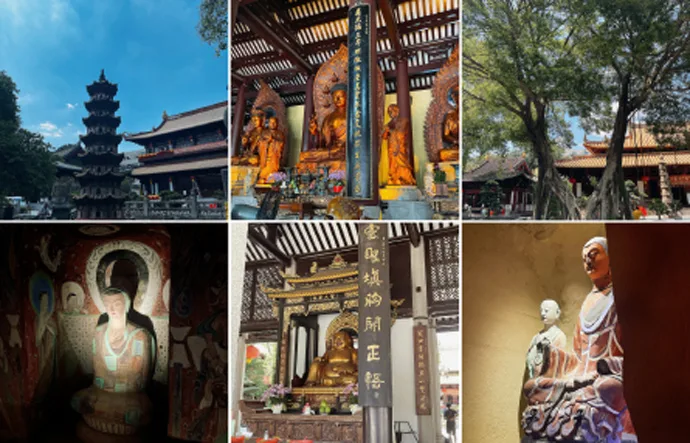
“One Thought Dunhuang” marks Guangzhou’s first large-scale exhibition of the Dunhuang grottoes. It presents seven life-sized replica caves, including several never before opened to the public, and debuts a complete reconstruction of Cave 172. Visitors step directly into the Gobi Desert, experiencing the devotional intensity of artisans from a millennium past.
Running alongside it is “The Qingzhou Smile” – an exhibition of 62 ancient Buddhist sculptures spanning 500 years, from the Northern Wei to the Northern Song dynasty. These statues, bearing their iconic “eternal smiles,” are appearing in the Greater Bay Area for the first time. Together, the two shows stage a remarkable dialogue: the Silk Road meets the Maritime Silk Road, here in Guangzhou. This convergence testifies to the city’s emergence as a cultural powerhouse capable of gathering world-class heritage under a single roof.
Guangxiao Temple: The historical origin
After absorbing such creative energy and artistic grandeur, taking a step further back in time proves essential. Guangxiao Temple represents Guangzhou’s oldest soul. As the proverb declares: “Before there was Guangzhou, there was Guangxiao.” Dating to the Three Kingdoms period (A.D. 220–280), this temple constitutes the city’s living origin story.
The grounds contain the Mahavira Hall from the Eastern Jin dynasty, the stupa where the Sixth Patriarch Huineng received ordination, and the well where Bodhidharma reportedly washed his bowl. For a mere 5 yuan, visitors can wander among these national heritage treasures and sense the unbroken historical thread that runs through the city.
A city in dialogue with itself
What renders Guangzhou so exhilarating at this moment is not simply the juxtaposition of antiquity and novelty – it is the active conversation unfolding between them. A walk through Dongshankou reveals this everywhere: a Qin-dynasty-inspired jacket displayed beside a Korean-style floral dress; a thousand-year-old Buddha sharing museum space with contemporary art; a 1,700-year-old temple casting its shadow just blocks from Asia’s best cocktail bar.
This is not a city that preserves its heritage behind glass or demolishes it for progress. Instead, Guangzhou permits its layers to overlap, collide, and remix. The weathered bricks of colonial villas become backdrops for fashion revolutions. Ancient military forms are “reconstructed” to shape modern identity. Romantic “Shoujo” aesthetics find their home in heritage courtyards. The city breathes – and in doing so, invites every visitor to breathe with it.
This constitutes the genius of Guangzhou’s evolution: it refuses to choose between history and modernity. It deploys one to energize the other. The result is a city that feels simultaneously deeply rooted and wildly forward-looking – a place where one can trace millennia of civilization in the morning and savor a herbal-tea cocktail at night, all within a few city blocks.
Come for the Dunhuang caves. Come for the Qingzhou smiles. Come for the red-brick villas, the lace-trimmed jeans, and the cocktails that taste like Cantonese memory. But remain for the unexpected harmony – the sense that in Guangzhou, everything belongs, and everything is still being written. That is why this ancient city feels so utterly, irresistibly new.


Leave a reply
You must be logged in to post a comment.


