Concerts alone won’t draw visitors into communities: Dora Ng
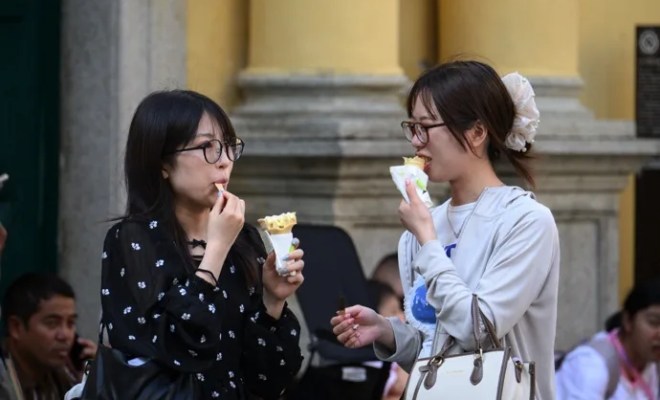

The government has acknowledged that staging concerts does not automatically bring visitors into local communities and will explore new ways to link events, museums and districts to the “ticket-root economy,” Secretary for Economy and Finance Dora Ng said Monday.
Speaking at the Legislative Assembly during a debate on the 2027 economic and finance policy guidelines, Ng stressed that the government would seek to develop the “ticket-root economy” and “fan economy” further and step up efforts to direct visitors into local communities. In her policy speech, she pledged to “tap the potential of the ‘ticket-root economy’ and ‘fan economy’” by improving transport arrangements, offering consumption discounts, supporting different types of community activities and directing visitors into districts more effectively.
The government will also upgrade facilities and infrastructure across the six districts, introduce more diverse business formats and gradually develop distinctive district identities to stimulate community business activity.
Responding to lawmakers’ repeated questions about the ticket-root economy, Ng acknowledged that the initiative had room for further development but required more consideration, including whether incentives should be linked to purchases made before or after an event, as suggested by lawmaker Chui Sai Peng.
“Frankly, in the past we very simply thought that if so many people bought tickets, they would automatically go into the community – but it is not like that,” Ng admitted. She explained that the expectation that concertgoers would visit local communities after performances had proved largely ineffective because their travel routes did not naturally take them there.
“So we felt the economy there might need to be rethought from other paths,” she said.
Ng said the government had been testing different approaches, including a pilot program linked to the WTT Macau Champions table tennis event, with support from the social affairs portfolio. The initiative offered transport arrangements, ticket-related benefits and coupons to encourage visitors to spend time in the Nape area.
“Overall, the effect of this performance-linked economy was better than the earlier concert-linked efforts,” Ng said, although she cautioned that redirecting visitors between locations required extensive supporting arrangements.
“It is not simply that if I give them a red packet, they will be willing to go over,” she added.
Ng said there was further potential to expand the ticket-root economy through Macau’s museums and other attractions.
“Macau has dozens of museums, and museums have tickets too. A visitor has already gone into that community to see that museum – so why can’t we offer discounts nearby after they finish looking?” she asked, adding that she hoped to develop the initiative around visitors’ actual travel patterns.
On the fan economy, Ng said its potential was considerable, with some artists attracting crowds large enough to fill entire streets. Much of the existing activity is organized by fan clubs or through agreements between shops and fans to display promotional photo boards. Such arrangements avoid image-rights complications because they are initiated by the fans themselves.
However, government-organized fan activities could raise intellectual property and image-rights concerns.
“We will continue to study how to do this well and channel the power of fans into different communities to generate economic benefits – this is an area we attach great importance to,” she said.
Consumer schemes and public-private collaboration
Ng said this year’s consumer reward and chain-consumption schemes, together with the consumer voucher program launched in April, involved nearly MOP1 billion in combined government and private-sector resources. The government contributed more than MOP400 million, while enterprises provided a comparable amount through vouchers and discount coupons.
She said the public-private partnership had delivered better-than-expected results. Under the arrangement, participating companies showcase their products on a platform, giving residents a wider range of choices rather than having the government simply distribute consumption subsidies that recipients could use at one of 10 participating enterprises.
Nearly 20,000 enterprise vouchers have been redeemed, Ng said, describing each redemption as an additional spending opportunity. She argued that combining government and private-sector resources made the approach more effective than relying solely on publicly funded consumption subsidies.
SME support and livelihood measures
Ng also outlined measures to support small and medium-sized enterprises (SMEs) through consumption promotion, customer attraction, branding, publicity and financial assistance.
She pledged to encourage integrated tourism and leisure enterprises to open up their supply chain resources to local businesses, helping SMEs “grow big with small.” The government will also introduce a subsidy scheme to support upgrades at catering businesses, encourage the adoption of energy-efficient electrical equipment and study financial assistance for eligible SMEs seeking trademark registration to help them expand into new markets.
Ng reiterated that the government would continue implementing measures to support residents and businesses next year under the principle of prudent financial management.
These include the cash handout scheme and reductions in business tax, various stamp duties, tourism tax, professional tax and complementary income tax, alongside electricity and water subsidies. The measures are intended to ease residents’ living costs and reduce business operating expenses.




Leave a reply
You must be logged in to post a comment.