MACAU DAILY TIMES 澳門每日時報

Top Menu

  • Our Team
  • Editorial Statute
    • Code of Ethics
    • Privacy Policy
    • Terms and Conditions
  • Archive
    • PDF Editions
  • Contacts
  • Extra Times
    • Drive In
    • Book It
    • tTunes
    • Features
    • World of Bacchus
    • Taste of Edesia

Main Menu

  • Home
  • Macau
    • Photo Shop
    • Advertorial
  • Interview
  • Greater Bay
  • Business
    • Corporate Bits
  • China
  • Asia
  • World
  • Sports
  • Opinion
    • Editorial
    • Our Desk
    • Business Views
    • China Daily
    • Multipolar World
    • The Conversation
    • World Views
  • Our Team
  • Editorial Statute
    • Code of Ethics
    • Privacy Policy
    • Terms and Conditions
  • Archive
    • PDF Editions
  • Contacts
  • Extra Times
    • Drive In
    • Book It
    • tTunes
    • Features
    • World of Bacchus
    • Taste of Edesia
logo
FOUNDER & PUBLISHER Kowie Geldenhuys
EDITOR-IN-CHIEF Paulo Coutinho
Macau,

MACAU DAILY TIMES 澳門每日時報

  • Home
  • Macau
    • Photo Shop
    • Advertorial
  • Interview
  • Greater Bay
  • Business
    • Corporate Bits
  • China
  • Asia
  • World
  • Sports
  • Opinion
    • Editorial
    • Our Desk
    • Business Views
    • China Daily
    • Multipolar World
    • The Conversation
    • World Views
  • Multiple flights in Europe diverted because of bomb threats after earlier hoaxes

  • Delivery riders consider return to petrol bikes over EV reliability concerns

  • Woman in critical condition after bus hits wheelchair user

  • Bus operators renewed for six years with LRT transfer requirements

  • LVS chief Dumont and wife take controlling 69% stake in Mavericks

  • DSAL reports 3,897 workplace accident victims, four deaths

Greater Bay
Home›Greater Bay›How Macau’s second world war experience shaped the territory
History

How Macau’s second world war experience shaped the territory

By -
Friday, July 4, 2025
307
0

Macau’s giant casinos and malls have earned the territory its nickname: the ‘Las Vegas of the east’

Analysis

This year marks the 80th anniversary of the end of the second world war, a conflict that left few corners of the globe untouched. In east Asia, the small Portuguese-administrated territory of Macau in southern China stood out as a rare neutral territory. But, despite its neutrality, Macau could not escape the war’s far-reaching impact.

In fact, Macau saw its population treble in the period between 1937 and the end of the second world war, reaching around half a million people. The newcomers, most of whom had fled the Japanese occupation of China, exceeded the existing residents and influenced all facets of life in Macau.

Japanese troops launching an assault on Hong Kong in 1941

Some went on to shape the territory well beyond the end of the second world war, helping Macau earn its later status as one of the leading gambling hubs in the world. These people included the late Stanley Ho, the “casino tycoon” in Macau and one of the key architects of its post-war economy.

In his testimony for the 1999 book, Macao Remembers, Ho noted how Macau’s wartime atmosphere had inspired him. “Macao was tiny, and yet a bit like Casablanca – all the secret intelligence, the murders, the gambling – it was a very exciting place”, he said.

Ho was referring to the fictional version of the French-controlled wartime city of Casablanca in the 1942 Hollywood film, also called Casablanca. As a neutral enclave, Macau was a site of multinational refuge, smuggling of goods and people, espionage, danger and opportunities.

Site of refuge

Japan’s invasion of China began in the 1930s. As Japanese forces took control of most of the eastern coast from 1937 onward, the Chinese nationalist government moved inland to resist from its relocated capitals, first Wuhan and then Chongqing. By the end of 1940, the most important political, economic, educational and cultural urban centres in China had been occupied.

Surrounded by occupied areas, territories under foreign rule in China such as the Shanghai foreign concessions, Macau and Hong Kong became “lone islands”. Their neutral status attracted many thousands of refugees, resistance activists and relocated businesses. Lone islands became supply lifelines for the Chinese resistance and propaganda battlegrounds for opposing sides.

They experienced periods of economic boom fuelled by the influx of refugees. And they were prime locations for the transfer of information and funds, as well as intelligence collection. Lone islands were also sites of humanitarian relief, connected to diaspora networks and organisations designed to support the Chinese war effort.
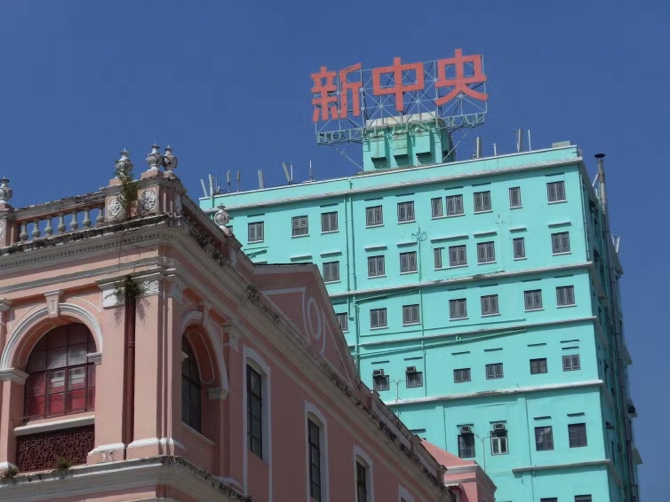
Hotel Central, one of the leading hotels in 1940s Macau

By the end of 1941, these spaces of neutrality were disappearing. The Shanghai foreign concessions were taken over by Japan and later handed over to a Chinese collaborationist administration, and the British colony of Hong Kong was occupied and placed under Japanese military rule. French-ruled Guangzhouwan, also in south China, was under de facto Japanese control by 1943.

Macau, which remained neutral throughout the war, stood as the last lone island – if always subject to Japanese influence. Macau’s neutrality drew many from opposing camps.

In the late 1930s, most refugees to Macau had come from Shanghai and Guangdong province. The occupation of Hong Kong in late 1941 then brought another wave of displaced persons to Macau.

A gamble on Macau

Stanley Ho was among the refugees who arrived in Macau from the neighbouring British colony. He joined his uncle Robert Ho Tung, a renowned businessman who also relocated to Macau during the occupation of Hong Kong.

According to Ho’s own accounts, his wartime activities were the foundation of a fortune. Several other figures who would become important economic players in Macau’s post-war economy, such as businessman Ho Yin, also cut their teeth during the second world war’s climate of contingency and opportunity.

Working for the Macau Co-operative Company, established by the Japanese to manage trade between Japan and the government in Macau, Ho was involved in bartering materials in exchange for food supplies with Japanese interlocutors. He also had an English-Japanese language exchange with the Japanese intelligence chief in Macau, Colonel Sawa.

Through these activities, Ho made important contacts among the different communities who found themselves in Macau during the war. This included powerful intermediaries such as Pedro José Lobo, the head of the economic services in Macau. These connections exposed Ho to the popularity of gambling in Macau and the potential to take it to a different level.

Gambling had been legal in Macau since the mid-19th century. But it was during the war that we would see the origins of the casino-hotel model that is now prevalent in the territory.

The leading hotels of 1940s Macau, such as Hotel Central and Grande Hotel Kuoc Chai, offered employment to refugee musicians and dancers and were sites of entertainment for those with funds to spend.

After the end of the second world war, Ho set up a company called Sociedade de Turismo e Diversões de Macau (STDM) with partners including Henry Fok, Teddy Yip and Yip Hon. These were businessmen with links to Hong Kong, mainland China and Indonesia.

In 1962, the same year STDM was founded, it earned the exclusive concession to run casinos in Macau, replacing pre-existing magnates who were more prominent during the second world war.

One of the key innovations brought by their company’s casinos was the popularisation of western-style games. They were also involved in philanthropic activities, much like the wartime gambling tycoons had been, with Macau again seeing the arrival of many destitute displaced persons during the cold war.

Gambling has been liberalised in Macau since the early 2000s, and the territory has now surpassed Las Vegas to become the largest casino market in the world. By Helena F. S. Lopes, Cardiff University, MDT/The Conversation

Share this:

  • Share on Facebook (Opens in new window) Facebook
  • Share on X (Opens in new window) X
  • Share on LinkedIn (Opens in new window) LinkedIn
  • Share on WhatsApp (Opens in new window) WhatsApp
  • Print (Opens in new window) Print

Like this:

Like Loading…

Related

TagsGreater Bay
Previous Article

The dark reality behind wartime Macau’s neutrality: ...

Next Article

Oxfam Rice Event 2025 raises over MOP635,000 ...

Related articles More from author

  • Greater Bay

    Notes On Academic Research

    Friday, March 15, 2024
    By -
  • Greater Bay

    Booming cross-border travels in China in 2023

    Wednesday, January 31, 2024
    By -
  • Greater Bay

    Guangdong Trade hits record high in 2023

    Thursday, January 18, 2024
    By -
  • Greater Bay

    China extends visa exemptions until 2025

    Friday, May 10, 2024
    By -
  • Greater Bay

    Expansion of ‘Bay Area Standards’

    Friday, May 23, 2025
    By -
  • Greater Bay

    Businesses in GBA view tariff pause with caution and uncertainty

    Friday, May 16, 2025
    By -

Leave a reply Cancel reply

You must be logged in to post a comment.

  • Macau

    Gov’t to launch ‘consumption carnival’ in Northern District to boost spending

  • China

    Trump suggesting Beijing will ‘take down’ its trade barriers

  • tTunes

    The Killers return with complex and brilliant angst

DAILY EDITION

Thursday, November 5, 2026 – edition no. 5068

Greater Bay

MDT MACAU GRAND PRIX SPECIAL

November 2026
M T W T F S S
 1
2345678
9101112131415
16171819202122
23242526272829
30  
« Oct    

Timeline

  • Thursday, November 5, 2026

    Multiple flights in Europe diverted because of bomb threats after earlier hoaxes

  • Thursday, November 5, 2026

    Delivery riders consider return to petrol bikes over EV reliability concerns

  • Thursday, November 5, 2026

    Woman in critical condition after bus hits wheelchair user

  • Thursday, November 5, 2026

    Bus operators renewed for six years with LRT transfer requirements

  • Thursday, November 5, 2026

    LVS chief Dumont and wife take controlling 69% stake in Mavericks

  • Thursday, November 5, 2026

    DSAL reports 3,897 workplace accident victims, four deaths

  • Thursday, November 5, 2026

    Democrats win House and Senate as voters rebuke Trump and Republicans

  • Thursday, November 5, 2026

    Two passport stories, one question of belonging

  • Thursday, November 5, 2026

    Four universities improve in QS Asia rankings

  • Thursday, November 5, 2026

    IAS increases number of family mediators to 57

Extra Times

Extra TimesHeadlinesTaste of Edesia

A Symphony of Heritage: Reviving the Imperial Feast at Chai Jia Chai

In the heart of modern dining, where fusion often threatens to overshadow tradition, an evening at Chai Jia Chai stands as a resolute testament to the enduring majesty of Chinese ...
  • Nickelback is in familiar form on cameo-heavy album

    By MDT/AP
    Friday, October 30, 2026
  • TUMI Debuts “Gifts for the Journey” Holiday Edit

    By -
    Friday, October 30, 2026
  • Toast to the Tropics: The Macallan “Coconut Dreams” Dinner

    By -
    Friday, October 23, 2026
  • ‘Clayface’ arrives as a pretty good R-rated revenge thriller-horror romance

    By MDT/AP
    Friday, October 23, 2026
  • Recent

  • Popular

  • Multiple flights in Europe diverted because of bomb threats after earlier hoaxes

    By MDT/AP
    Thursday, November 5, 2026
  • Delivery riders consider return to petrol bikes over EV reliability concerns

    By Renato Marques, MDT
    Thursday, November 5, 2026
  • Woman in critical condition after bus hits wheelchair user

    By -
    Thursday, November 5, 2026
  • Bus operators renewed for six years with LRT transfer requirements

    By Yuki Lei, MDT
    Thursday, November 5, 2026
  • LVS chief Dumont and wife take controlling 69% stake in Mavericks

    By Nadia Shaw, MDT
    Thursday, November 5, 2026
  • DSAL reports 3,897 workplace accident victims, four deaths

    By Lynzy Valles, MDT
    Thursday, November 5, 2026
  • Democrats win House and Senate as voters rebuke Trump and Republicans

    By MDT/AP
    Thursday, November 5, 2026
  • Canidrome may have its days numbered, decision in ‘one or two months’

    By Paulo Coutinho, MDT
    Thursday, May 26, 2016
  • Animal Welfare | Macau: Anima slams Canidrome management for avoiding debate

    By -
    Wednesday, May 4, 2016
  • Editorial | Canidoomed

    By Paulo Coutinho, MDT
    Wednesday, June 1, 2016
  • Animal Welfare | Canidrome presented with ultimatum: close or move

    By Daniel Beitler, MDT
    Friday, July 22, 2016
  • Australia regulator cracks down on alleged exportation of dogs to Macau

    By Paulo Coutinho, MDT
    Friday, June 10, 2016
  • Animal rights | Canidrome: Anima in fresh airline negotiations as Canidrome closure looks more likely

    By Daniel Beitler, MDT
    Friday, May 27, 2016
  • USE OF ENGLISH IN MACAU | A ‘de facto’ official language

    By Catarina Pinto
    Monday, July 6, 2015
  • Contact our Administrator
  • Contact our Editor-in-Chief
  • Contacts
  • Our Team
  • Privacy Policy
  • Terms and Conditions
  • Editorial Statute
  • Code of Ethics
COPYRIGHT © MACAU DAILY TIMES 2008-2026. ALL RIGHTS RESERVED
MACAU DAILY TIMES
  • Home
  • Macau
    • Photo Shop
    • Advertorial
  • Interview
  • Greater Bay
  • Business
    • Corporate Bits
  • China
  • Asia
  • World
  • Sports
  • Opinion
    • Editorial
    • Our Desk
    • Business Views
    • China Daily
    • Multipolar World
    • The Conversation
    • World Views
  • Our Team
  • Editorial Statute
    • Code of Ethics
    • Privacy Policy
    • Terms and Conditions
  • Archive
    • PDF Editions
  • Contacts
  • Extra Times
    • Drive In
    • Book It
    • tTunes
    • Features
    • World of Bacchus
    • Taste of Edesia
Loading Comments...

You must be logged in to post a comment.

%d