
Same names, different rides for two World Cups

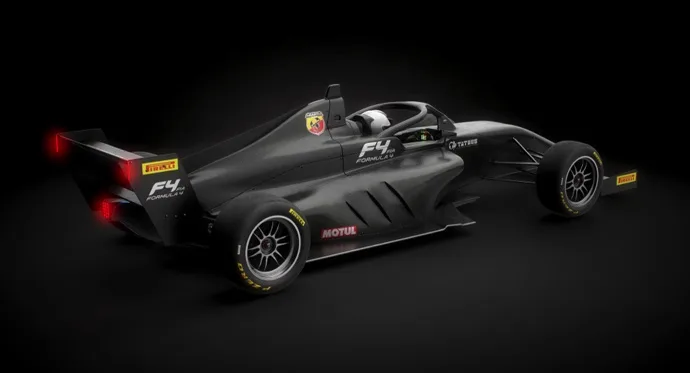
F4 new car
Although the 73rd Macau Grand Prix continues to feature two formula racing World Cups, F4 and FR, as its main attractions, the cars taking to the Guia Circuit from Nov. 19 differ significantly from those used last year.
In 2025, the FIA F4 World Cup used the Ligier-branded Mygale M21-F4 chassis and a 1.3-liter Alpine turbocharged inline-four engine, a specification that, as the Times reported, was used only in the French, Chinese and Indian championships.
Oreca prepared the Renault/Alpine-based engine, which was reported to produce about 160 horsepower on average.
This year, the same racing category will use the Tatuus F4-T421 (F1A) chassis, paired with a 1.4-liter turbocharged Abarth engine prepared by Italian company AutoTecnica Motori (ATM). ATM will supply all engines for the FIA FR World Cup and the FIA F4 World Cup.
According to ATM, this engine delivers 174 horsepower, unless restricted by championship regulations.
The engine is based on the Abarth (Fiat) 500 road car unit but has been specifically tuned for racing in this category.
On paper, although the cars are from the same generation, this year’s F4 cars could be faster than last year’s, with a higher top speed potentially giving them an advantage on the long straight from the R Bend, the last turn before the start-finish line, to the Lisboa Bend, as well as on the uphill section from São Francisco to the Maternity Bend.
As for the chassis, the F4-T421 is the same model used in several F4 championships this year, as well as in the FIA Motorsport Games.
FR, but different
For the FR category, ATM has also announced plans to bring its new ATM163T engine to Macau this year. The FR Gen2 engine is the first three-cylinder engine used in a formula racing category.
It debuted this year in the FR European Championship alongside the new Tatuus T-326 chassis, which will also make its Macau debut.
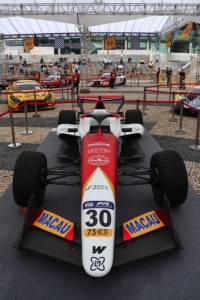
[Photo: Renato Marques]
The ATM163T is based on Toyota’s G16E engine, originally developed by Toyota’s Gazoo Racing (GR) division and first introduced in a road car in January 2020 in the GR Yaris.
ATM developed the ATM163T for FR racing in collaboration with Japan’s renowned TOM’S Racing.
According to the company, the 1.6-liter engine delivers 270 horsepower, replacing the first-generation 1.75-liter turbocharged Alfa Romeo engine, which could produce between 280 and 350 horsepower, depending on the championship specifications.
In summary, both the F4 and FR World Cups will feature different chassis and engines this year, with the new packages expected to offer improved performance.
According to Tatuus, the T-326 “brings a major step forward in terms of performance, aerodynamics and safety.” The new chassis is designed to be lighter, more stable and more responsive.
The car also features an updated chassis architecture and revised suspension intended to improve steering precision and overall balance through corners. Its aerodynamics have also been revised to maximize downforce while reducing drag.
The boost button
The new Gen2 FR car also has a technical feature that produces an effect similar to a system introduced in Formula 1 several years ago.
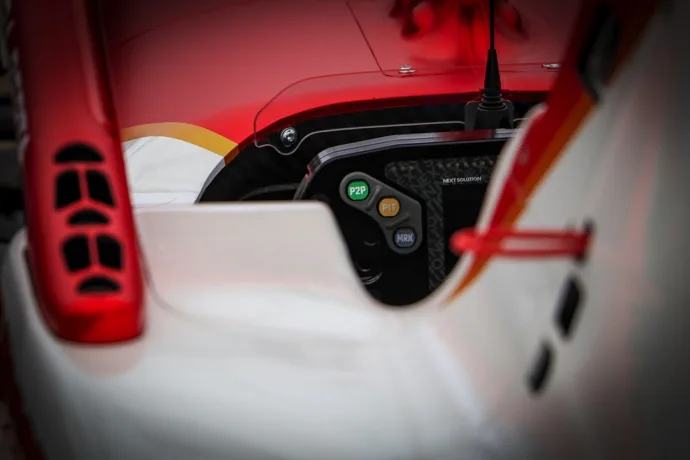
FR ‘push-to-pass’ button [Photo: Renato Marques]
Known as the Drag Reduction System (DRS), it was used in Formula 1 between 2011 and 2025. The system allows a driver to press a button on the steering wheel to open a hinged flap on the rear wing when attempting to overtake.
Opening the flap reduces aerodynamic drag and downforce, giving the car a straight-line speed boost, typically of 4 to 12 km/h or more, to help with overtaking. Although F1 replaced the system this year, DRS is still used in F2 and F3.
While not exactly a DRS system, the push-to-pass (P2P) feature used in FR allows drivers to press a button to boost their cars’ performance by temporarily increasing engine power.
The system gives drivers a limited number of activations per race, typically five, with a maximum of 15 seconds per activation, to access additional engine performance. Its use is restricted during qualifying and subject to specific rules covering race starts and safety car periods.
According to available information, each activation provides about 20 to 25 additional horsepower for 10 to 15 seconds. Drivers must therefore decide when and where to use the extra power to maximize its effectiveness during a race.


Leave a reply
You must be logged in to post a comment.
