Wedding photography exempt from new ‘travel photography’ rules

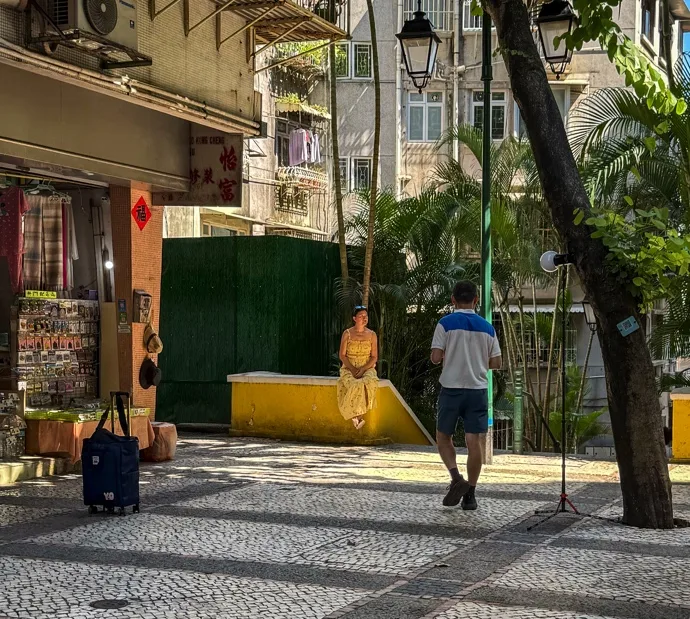
[Photo: Renato Marques]
The Legislative Assembly (AL) passed, in the first reading, the bill that, among other things, regulates the so-called “travel photography business.”
During the debate, authorities clarified that the activity will generally be limited to residents, while wedding photography companies may hire non-local workers for shoots not classified as travel photography.
The AL addressed the bill for the Regulation of Specific Businesses and Activities in general terms on Friday, as it resumed activities after the legislative holidays.
The bill proposes a registration system for activities in which people reach on-the-spot agreements in public places to provide paid photography services, with the authorities allocating and managing locations, periods, and quotas.
Addressing lawmakers’ concerns about the enforcement boundary between travel photography and other photoshoots, the fairness of quota allocation, and whether restricting participation to residents would affect the business environment, the Secretary for Administration and Justice, Wong Sio Chak, said that travel photography would be limited to local workers, reflecting existing hawker management rules and aimed at protecting local employment.
Regarding wedding photography companies and similar businesses, they may hire non-local workers for photo shoots in accordance with the law, he said. However, such shoots do not fall under travel photography. Wong said that opening travel photography to non-residents in the future would require social consensus.
According to the authorities, travel photography registration will proceed in two stages: a first “eligibility registration” stage, in which eligible Macau residents may register through a unified electronic platform. Afterward, the Municipal Affairs Bureau (IAM) will set quotas and periods based on registration numbers, locations, and festivals before opening the second-stage application. Those who miss out are proposed to receive priority in the next round.
The authorities added that the travel photography system is based on hawker legislation. Given the difficulty of operating continuously for 240 days at fixed locations such as the Ruins of St. Paul’s, the government has proposed creating a new system with quotas, locations, and activity rules, to be further regulated by administrative regulation.
Unregistered travel photography operators would face fines of up to MOP100,000 under the bill the Assembly passed.
Operating without registration would result in penalties ranging from MOP5,000 to MOP100,000, while registered operators working outside designated scenic areas would face fines of MOP5,000 to MOP20,000. The authorities plan to issue vests or identification cards as part of the registration system to help identify legitimate operators and crack down on illegal work.
Under-16s barred from karaoke in principle
The bill also sets rules for karaoke venues and internet cafes, consistent with the consultation document. Under-16s and people in school uniforms remain barred from karaoke venues in principle. However, under-16s may enter with a parent or adult relative during morning sessions from 8 a.m. to 8 p.m.
Internet cafes remain off-limits to under-12s and those in school uniforms, and permitted stays before holidays are now limited to 10 p.m. instead of midnight.
The tourism office oversees karaoke venues, and the municipal affairs bureau oversees internet cafes. Both must continue inspections and enforcement once the law takes effect, a shift from prior approval to in-process and post-hoc supervision.
Film production and directing would be regulated in two categories: shoots on public streets involving more than 10 people, or six special filming situations that require prior permission, while smaller shoots fall under registration. The authorities stressed that tourists filming their own souvenir videos are unaffected and said applicants must be Macau residents or locally established companies. This means that overseas teams must partner with local industry.
The new provisions also affect beauty salons, which must meet two conditions: massage therapists and customers must be the same sex, and the premises may offer massage only to one sex. The requirements apply only to massage, not to facial treatments, and reflect an industry in which customers and staff are predominantly women.




Leave a reply
You must be logged in to post a comment.