ExCo finalizes activity regulation overhaul, easing licensing for low-risk activities

The Executive Council (ExCo) has completed its discussion of the “Regime of Regulation for Specific Businesses and Activities”, easing registration requirements for dozens of low-risk activities, relaxing rules for small film crews and health clubs, and establishing a permit system for tourist photographers.
Wong Sio Chak, Secretary for Administration and Justice and ExCo spokesperson, announced at a press conference yesterday that the bill will be submitted to the Legislative Assembly (AL) for further discussion and approval.
The long-awaited legislation replaces Decree-Law No. 47/98/M, which has governed the administrative conditions for specific economic activities for more than 27 years.
Wong says the old prior-approval model can no longer keep pace with socioeconomic development and public demands for simplified procedures and greater administrative efficiency.
The bill reorganizes the regulatory system into three categories.
Under the first, businesses and activities that pose no threat to public order and safety—and whose risks are already covered by general legislation—will no longer need registration, permission, or a license.
Citizens “will no longer need to apply for registration or a license for specific activities,” officials said. Examples include nonprofit traditional dance and Chinese opera performances, auctions, garden parties, markets, bowling alleys, barbershops, and hair salons.
The second category covers lower-risk businesses—such as billiard rooms, beauty salons, laundries, dyeing and bleaching shops, gyms, charity walks, fundraising and lottery activities, and film production not involving specific circumstances—that will need only to register with authorities and submit the required information before commencing operations.
The third category maintains or streamlines regulation for higher-risk activities that require oversight on public safety, market order, and public morals grounds. These include film production under specific circumstances, such as the use of public roads or streets; vehicle repair workshops; venues with large-scale amusement facilities; venues selling pornographic materials; massage parlors; health clubs; amusement game centers; internet cafes; and karaoke venues.
New rules for tourist photography
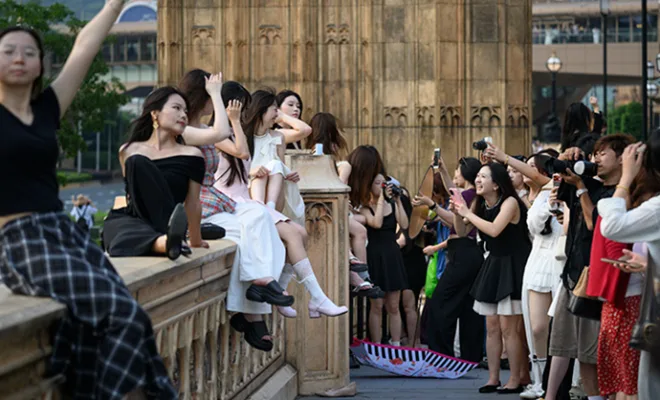
In response to growing demand for photography and filming services at tourist attractions, the bill introduces a registration system for paid photography or filming services agreed to on-site with individuals in public places. Authorities will manage and allocate locations, periods, and quotas.
Residents wishing to provide such services must first register with the Municipal Affairs Bureau (IAM), which will announce the number of photographers and locations. Registered photographers with an IAM permit may then shoot commercially at designated times and locations.
Officials stressed that tourists are not permitted to work in Macau by taking paid photographs for other tourists.
The government will publish details on quotas and designated tourist spots—accounting for different times and seasons—through dispatches or guidelines. The system will also cover wedding photography.
Key revisions after public consultation
At the press conference, officials outlined three major amendments to the initial draft, which they noted were made in response to public comments.
First, film production rules have been relaxed. Crews of fewer than 10 people will only need to register through a simplified procedure and will not require prior approval before filming. Productions on a larger scale or involving hazardous elements, such as explosions, will still require prior approval.
Second, health clubs will be allowed to operate both inside and outside hotels. The consultation document had proposed restricting them to hotels, but the government reverted to the existing arrangement after hearing from operators.
Third, the tourist photography registration system was revised to a two-step process in which local photographers register with IAM before receiving permits.
Non-profit performances clarified
Addressing questions about nonprofit activities, such as Chinese opera, officials clarified that these events remain regulated by general legislation covering fire safety, public health, and order, but require no prior approval or licensing.
However, performances in public areas still require a permit from IAM.
Also speaking at the press conference, acting director of the Legal Affairs Bureau (DSAJ), Ng Chi Kin, explained that the new law will not limit the scope or nature of performances as long as they are not profit-making, unlike the previous law, which specifically named traditional dances and Chinese opera. “This is what we mean by simplifying the procedures,” he said.
Stricter oversight and penalties
The bill strengthens interim and ex-post supervision, empowering authorities to adopt precautionary measures—including ordering venue closures and terminating activities—against operators without required registration, authorization, or licenses.
Authorities may also cancel a registration, authorization, or license if the holder seriously endangers public health, safety, or interests; severely violates public order or good customs; or repeatedly breaches obligations under the bill. Penalties for illegal acts in specific businesses and activities will also be adjusted to reflect social and economic changes.
Online application methods and a one-stop, cross-departmental application platform will be introduced to reduce paperwork and shorten approval times.
Criminal activity remains separate matter
When asked about saunas and beauty parlors that are said to offer sexual services, as well as others that raise public safety concerns, Ng emphasized that the bill addresses only administrative procedures.
“Criminal cases are criminal cases,” he said, noting that illegal activities, such as the exploitation of prostitution, remain governed by criminal law regardless of the type of establishments involved or whether they are licensed.
He warned that venues found to be engaging in criminal activity could face license revocation in the most severe circumstances.
Police, fire services, and health authorities will continue to oversee business operations.
“The ultimate idea is that we are trying to offer this kind of convenience so that we can diversify our economy,” Ng said. “All kinds of safety, health, and order issues have to be addressed.”


Leave a reply
You must be logged in to post a comment.