IMF holds Macau growth forecast at 3.3%

[Photo: Xinhua]
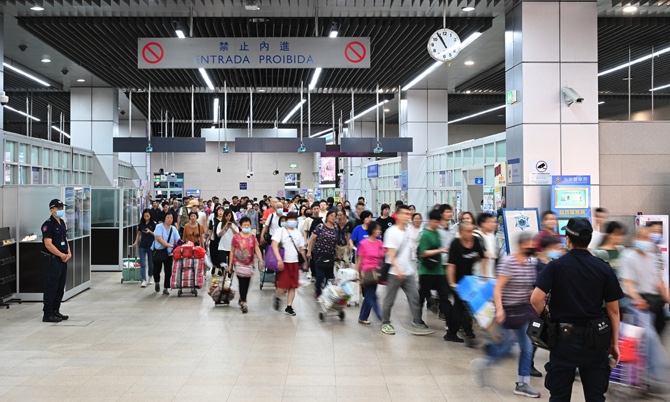
The International Monetary Fund (IMF) has maintained its forecast for Macau’s economic growth at 3.3% this year, with expansion expected to slow to 3.1% in 2027, according to projections released Tuesday.
The latest World Economic Outlook points to slower growth after Macau’s economy expanded by 4.7% in 2025. The forecasts suggest continued expansion, though the IMF has warned that the city remains heavily dependent on gaming and tourism.
In its recent assessment, the IMF’s Executive Board said Macau’s economy “remained resilient despite obstacles.” However, it added that growth continued to be driven by “a strong external sector in a context of weak domestic demand.”
The IMF also left its 2026 inflation forecast for Macau unchanged at 1.8%. It expects inflation to rise to 1.9% next year, up from 0.3% in 2025.
Unemployment is projected to remain at 1.7% this year and next, matching the IMF’s 2025 projection.
The fund also forecasts 3.8% growth for Hong Kong this year, followed by a slowdown to 2.8% in 2027. The economy grew by 3.6% last year. Inflation is projected at 1.9% in both forecast years.
The IMF places Macau and Hong Kong in its Advanced Asia category.
Mainland China’s economy is forecast to expand by 4.5% in 2026 and 4% in 2027, down from 5% last year. Inflation is expected to reach 1% this year and 1.4% next year.
Globally, the IMF expects economic growth of 3.1% in 2026, accelerating to 3.4% next year, in contrast to Macau’s projected slowdown.
Georgieva warns resilience is ‘reaching its limits’
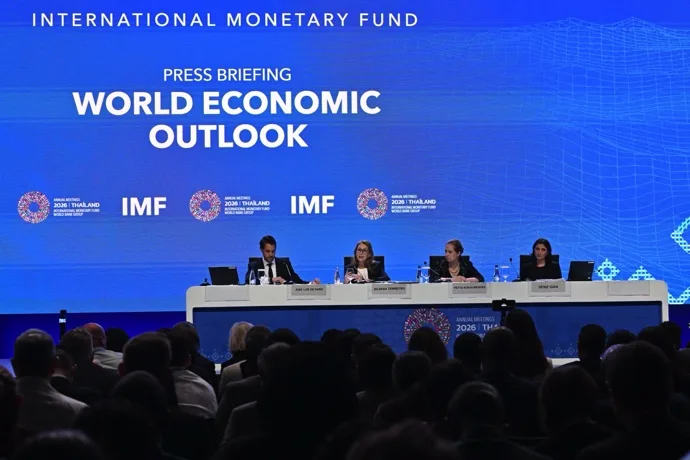
IMF Managing Director Kristalina Georgieva presented the global outlook at the fund’s annual meetings in Thailand yesterday, saying the world economy has remained resilient despite repeated shocks and uncertainty.
“But this resilience is reaching its limits. Buffers, both energy and fiscal, are being depleted. Inflation in many places is stubbornly high,” Georgieva said. She added that higher inflation was contributing to rising interest rates and increasing debt-service pressures in countries where repeated shocks had already raised debt levels.
Georgieva said global growth was being pulled in opposite directions by a negative energy supply shock linked to the war in the Middle East and a positive demand shock associated with artificial intelligence. She said the result was global growth of about 3.1% in 2026, unchanged from the fund’s April projection but lower than the 3.4% recorded last year.
“Behind these numbers, there are wide divergences among countries,” she said. Georgieva said that economies closely integrated into the artificial intelligence supply chain, including Thailand, Malaysia, South Korea, and Singapore, were generally performing better, as were energy exporters unaffected by wars.
By contrast, Georgieva said that low-income countries and fragile and conflict-affected states, particularly energy importers or those excluded from the technology boom, were taking the biggest hit.
“To put it very simply, China needs to spend more; the US has to save more; and Europe has to invest more,” Georgieva stated.


Leave a reply
You must be logged in to post a comment.