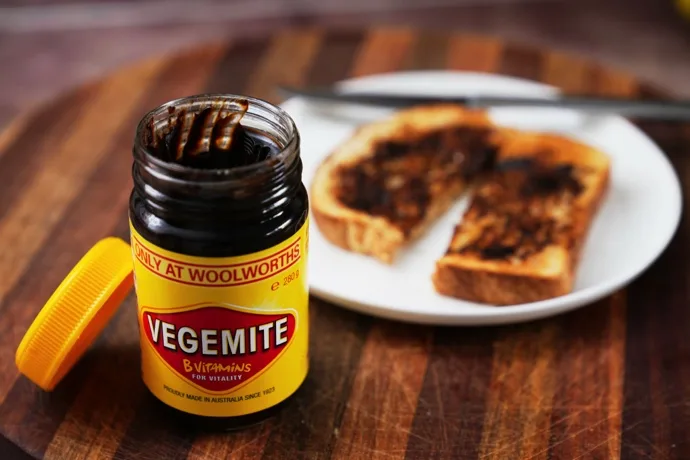
Judge rejects prisoner’s human rights challenge to Vegemite ban

[AP Photo]
A prisoner on Monday lost his challenge to an Australian state’s ban on inmates eating Vegemite after he argued in court that withholding the polarizing yeast-based spread breached his human right to “enjoy his culture as an Australian.”
Andre McKechnie, 55, who is serving a life sentence for murder, took his battle for the salty, sticky, black-brown byproduct of brewing beer to the Supreme Court of the state of Victoria last year.
He had argued being refused Vegemite denied him his right under the Charter of Human Rights and Responsibilities Act to “enjoy his culture as an Australian in the community with other persons of Australian background,” court documents showed.
Justice Claire Harris accepted prison authorities’ refusal to allow McKechnie Vegemite “limited his cultural rights” under the charter.
But she found the ban was justified in meeting authorities’ goals of removing illicit drugs and alcohol from the prison system.
“The limitation on Mr. McKechnie’s ability to enjoy Vegemite in community with other persons of Australian background is primarily that he is a prisoner,” Harris wrote in her 47-page judgment.
Prison officials testified at a trial in July that Vegemite had been banned throughout the state’s 12 prisons for the past 20 years because it could potentially impair sniffer dogs’ ability to detect narcotics and could be used to brew alcohol because of its yeast content.
McKechnie, who represented himself in court by video link from maximum security Barwon Prison west of Melbourne, argued that the fact that neighboring New South Wales state did not ban Vegemite from its prisons was evidence that there were “less restrictive means reasonably available” to achieve such drug and alcohol outcomes.
Most Australians revere Vegemite as an unfairly maligned culinary icon, and more than 80% of Australian households are estimated to have a jar in their pantries. Vegemite is typically considered an acquired taste at best by those who weren’t raised on it.
The last U.S. president to visit Australia, Barack Obama, once said: “It’s horrible.”
McKechnie had initially testified that the lack of Vegemite had contributed to his thiamine deficiency.
He said both Vegemite and pork were sources of thiamine, also known as vitamin B1. As a Jew who observed kosher law, he told the court he couldn’t eat pork either and took daily doses of the vitamin.
Vegemite has long been marketed as a source of B vitamins thiamine (B1), riboflavin (B2), niacin (B3) and folate (B9) which are promoted as healthy additions to the diets of growing children.
But McKechnie dropped the thiamine issue as “not important,” after lawyers for the prison authorities objected to his evidence.
McKechnie said not eating Vegemite made him feel “deprived of being able to practice my Australian culture, sad and disconnected from my family and community.”
The judge responded that “it is difficult to accept that the inability to consume Vegemite, rather than the fact of his imprisonment, is a material cause of his sadness and disconnection from his family and community.”
McKechnie cited an article published in the food studies journal “Gastronomica” in 2003 that said, “Vegemite may be the best predictor of national identity of any food in the world.” ROD McGUIRK, MELBOURNE, MDT/AP





Leave a reply
You must be logged in to post a comment.