Macau, Hengqin launch China’s first Earth system data exchange center

[Photo: Renato Marques]
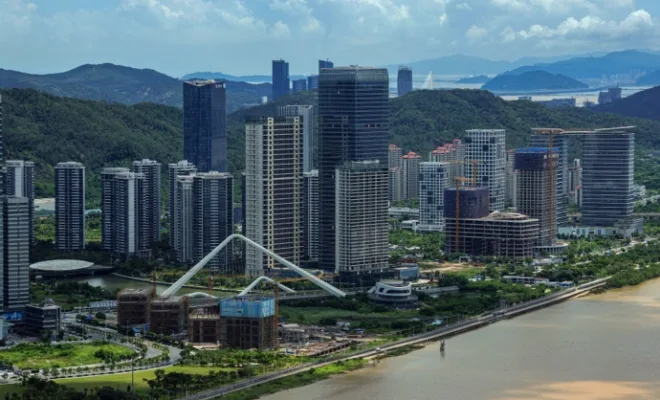
China’s first international exchange center for Earth system data has begun construction in Hengqin under a three-way agreement involving the China Meteorological Administration (CMA), the SAR government and the Guangdong-Macao In-Depth Cooperation Zone in Hengqin.
The partners signed a framework agreement Wednesday to build the Earth System Data International Exchange Center (Macau), with a three-year construction phase followed by a three-year operating period.
The center is intended to become a cross-border hub for exchanging meteorological, environmental and other Earth system data, while also supporting Macau’s economic diversification and Hengqin’s digital economy development.
Chen Zhenlin, director of the CMA, said the Hengqin project is the first data exchange center established under the agency’s broader national plan. He said the initiative would support national development priorities, Macau’s industrial diversification and the overseas application of China’s Mazu intelligent meteorological early-warning system.
Earth system data covers information generated by meteorological, environmental and geospatial observation systems. It can support weather forecasting, disaster prevention, transport planning, agriculture, marine safety and environmental management, according to the CMA.
The center is expected to combine the meteorological administration’s data resources and technical capabilities with Macau’s international links, particularly its networks in Portuguese- and Spanish-speaking countries. Hengqin is intended to serve as a testing ground for cross-border data-flow rules, digital-trade infrastructure and international cooperation.
Officials said the project has four main functions: acting as a data exchange node, supporting the international deployment of Chinese data products and services, serving as a cooperation hub for Portuguese- and Spanish-speaking markets, and facilitating research exchanges between domestic and overseas institutions.
The agreement also seeks to help create a more unified market for Earth system data across the Guangdong-Hong Kong-Macao Greater Bay Area.
The partners said the initiative will strengthen “hard connectivity” through technical infrastructure and “soft connectivity” through rules and policy mechanisms governing how data are exchanged, used and managed.
The Mazu system, whose name stands for Multi-hazard, Alert, Zero-gap and Universal, integrates meteorological observations, satellite products, forecasting models and artificial intelligence tools to support earlier and more targeted warnings.
CMA has already used customized versions of the platform in international meteorological cooperation, including disaster-response work with Nepal and Pakistan.





Leave a reply
You must be logged in to post a comment.