
For Palestinians in Lebanon, 69 years of despair

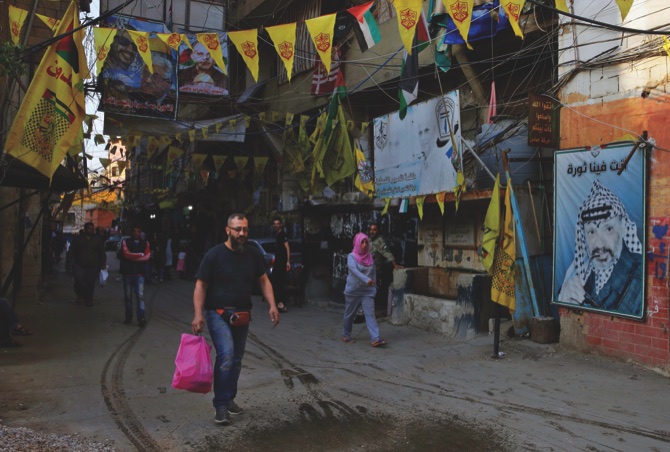
People walk underneath the banners of Fatah and the Palestinian flags inside the Bourj al-Barajneh Palestinian refugee camp in Beirut, Lebanon
Ahmad Dawoud recalls the day 10 years ago when a Lebanese soldier asked to search his taxi. Then 17, the Palestinian didn’t wait for the soldier to find the weapons hidden in the trunk.
He jumped from the car and fled into the nearby Palestinian refugee camp, where the Lebanese army has no authority.
But it was not long afterward that Dawoud, who once admired the radical groups that have sprouted in the camps in Lebanon, decided he was tired of running. That same year, in 2007, he surrendered to authorities and spent 14 hard months in jail.
Although he was released without a conviction, he couldn’t erase the biggest strike against him: As a Palestinian in Lebanon, he is a stateless, second-class resident in the only country where he’s ever lived.
Today Palestinians mark 69 years since hundreds of thousands of them were forced from their homes during the 1948 war that led to the creation of Israel. Many settled in the neighboring West Bank, Gaza, Jordan, Syria and Lebanon.
As refugees, various U.N. charters entitle them and their descendants to the right to work and a dignified living until they can return to their homes or such settlement is reached.
But Palestinians in Lebanon suffer discrimination in nearly every aspect of daily life, feeding a desperation that is tearing their community apart. Many live in settlements officially recognized as refugee camps but better described as concrete ghettos ringed by checkpoints and, in some cases, blast walls and barbed wire. The U.N. runs schools and subsidizes health care inside.
In Lebanon, there are 450,000 refugees registered in 12 camps, where Lebanese authorities have no jurisdiction inside. “Our lot is less than zero,” Dawoud said in a recent interview outside Ein el-Hilweh, the crowded camp in Sidon that is one of the most volatile.
On peaceful days, children play in the damp alleys and merchants park their carts of produce along the camp’s main streets. But the place feels hopelessly divided along factional and militant lines, and it frequently breaks down into fighting between Palestinian security forces and militants or gangs that capitalize on the general despair.
Last month, 10 people were killed in a flare-up that drove out thousands of the camp’s estimated population of 75,000. Palestinians are prohibited from working in most professions, from medicine to transportation. Because of restrictions on ownership, what little property they have is bought under Lebanese names, leaving them vulnerable to embezzlement and expropriation.
They pay into Lebanon’s social security fund but receive no benefits. Medical costs are crippling. And they have little hope for remediation from the Lebanese courts.
Doctors are prohibited from working in the Lebanese market, so they find work only in the camps or agree to work for Lebanese clinics off the books, and sign prescriptions under Lebanese doctors’ names. That leaves them open to employer abuse, a condition normally associated with low-skill work.
“If a young boy gets in trouble because he is Palestinian, the prosecutor writes in his note to the judge, ‘He is Palestinian,’ meaning: ‘Do what you wish to him. Be cruel to him. Forget about his rights,’” said Sheikh Mohammad Muwad, a Palestinian imam in Sidon.
The crush of war refugees from Syria has made it even harder for Palestinians here to find work. Nearly six in 10 under age 25 are unemployed, according to the U.N.’s Palestinian relief agency UNRWA, and two-thirds of all Palestinians here live below the poverty line.
UNRWA country director Claudio Cordone said they feel trapped in political limbo and see an “almost total lack of meaningful political prospects of a solution” to their original displacement from Palestine.
Lebanese politicians say that assimilating Palestinians into society would undermine their right to return. But Palestinians say they are not asking for assimilation or nationality, just civil rights.
“They starve us, so we go back to Palestine. They deprive us, so that we go back to Palestine. Well, go ahead, send us back to Palestine! Let us go to the border, and we will march back into Palestine, no matter how many martyrs we must give,” Muwad said.
For those in the camps, the line between hustling and criminality is often blurred. Unemployed and feeling abandoned by the authorities, many turn to gangs for work.
Adding to this is a widely shared disaffection with the Palestine Liberation Organization, which many Palestinians now see as having sold out their rights with the failed Oslo Accords of 1994.
This has helped fuel the rise of radical Islam — a shift in the occupied Palestinian territories that is reflected by Hamas’ rising popularity, and one outside the territories in the meteoric trajectory of militant groups such as Fatah al-Islam in the volatile and deprived Nahr al-Bared camp.
Growing up in Nahr al-Bared, a camp much like Ein el-Hilweh, Dawoud felt a strong affiliation for Fatah al-Islam, his gateway to radical extremism. “They were the only ones who seemed honest,” he said. “Of course, later I figured out they were just like everyone else, too.”
In 2007, the Lebanese army razed most of Nahr al-Bared to crush Fatah al-Islam.
By that time, Dawoud already was in Ein el-Hilweh, and his arrest was the beginning of a slow falling out with the gangs that once sheltered him and treated him like a brother. After his stint in prison, they began to feel they couldn’t trust him, and he was chased out of Ein el-Hilweh in 2013. Now, he can only enter the parts of the settlement firmly under PLO control.
With no job, no prospects and little wealth, Dawoud now runs errands for others in his white 1980s-era BMW — all done under the table, of course. Palestinians cannot apply for the red license plates that identify taxis and other commercial vehicles.
“I don’t even think about marrying and getting into those situations,” he said, waving off starting a family at age 27. His ambition now is to apply for a visa to leave Lebanon. But first he needs a travel document, and for that he needs to be on good terms with the Lebanese authorities.
Not all Palestinians live in camps, but even the most privileged among them endure discrimination. At a panel on Palestinian labor rights at the American University of Beirut, Muhammad Hussein asked a Lebanese Labor Ministry official why he was denied work even in sectors that are formally open to Palestinian employment.
The 22-year-old graduate showed the official an email he received from a marketing firm in Dubai refusing his job application on the grounds that the Lebanese office had to give priority to Lebanese workers.
“The problem isn’t finding vacancies,” Hussein said. “It’s getting the job.” Philip Issa, AP


Leave a reply
You must be logged in to post a comment.

