MACAU DAILY TIMES 澳門每日時報

Top Menu

  • Our Team
  • Editorial Statute
    • Code of Ethics
    • Privacy Policy
    • Terms and Conditions
  • Archive
    • PDF Editions
  • Contacts
  • Extra Times
    • Drive In
    • Book It
    • tTunes
    • Features
    • World of Bacchus
    • Taste of Edesia

Main Menu

  • Home
  • Macau
    • Photo Shop
    • Advertorial
  • Interview
  • Greater Bay
  • Business
    • Corporate Bits
  • China
  • Asia
  • World
  • Sports
  • Opinion
    • Editorial
    • Our Desk
    • Business Views
    • China Daily
    • Multipolar World
    • The Conversation
    • World Views
  • Our Team
  • Editorial Statute
    • Code of Ethics
    • Privacy Policy
    • Terms and Conditions
  • Archive
    • PDF Editions
  • Contacts
  • Extra Times
    • Drive In
    • Book It
    • tTunes
    • Features
    • World of Bacchus
    • Taste of Edesia
logo
FOUNDER & PUBLISHER Kowie Geldenhuys
EDITOR-IN-CHIEF Paulo Coutinho
Macau,

MACAU DAILY TIMES 澳門每日時報

  • Home
  • Macau
    • Photo Shop
    • Advertorial
  • Interview
  • Greater Bay
  • Business
    • Corporate Bits
  • China
  • Asia
  • World
  • Sports
  • Opinion
    • Editorial
    • Our Desk
    • Business Views
    • China Daily
    • Multipolar World
    • The Conversation
    • World Views
  • GEG Donates MOP700,000 to Tung Sin Tong to Support Its Annual Fundraising Campaign for the 23rd Consecutive Year

  • 300 restaurants sought for elderly healthy-meal program

  • Over 18,700 childcare subsidy cases approved, MOP546 million paid out

  • Private tutoring center bill passed with patriotism requirement for operators

  • Database of 31,000 elderly residents living alone or in two-person households established

  • Lawmakers call for prevention-first approach as fatal accidents surpass 2025 total

Arts & Culture
Home›Arts & Culture›The Quina of Longtan
Archaeology

The Quina of Longtan

By -
Thursday, April 3, 2025
210
0

Stone tool discovery in China shows people in East Asia were innovating during the Middle Paleolithic, like in Europe and Middle East

New technologies today often involve electronic devices that are smaller and smarter than before. During the Middle Paleolithic, when Neanderthals were modern humans’ neighbors, new technologies meant something quite different: new kinds of stone tools that were smaller but could be used for many tasks and lasted for a long time.

Archaeologists like me are interested in the Middle Paleolithic – a period spanning 250,000 to 30,000 years ago – because it includes the first appearance of our species, our arrival into many parts of the world for the first time, and our invention of many new kinds of stone tools.

In our study just published in the Proceedings of the National Academy of Sciences, a team of international collaborators and I describe our discovery in China of the first complete example of a Middle Paleolithic technology previously seen only in Europe and the Middle East.

Archaeologists have thought that ancient people in East Asia completely skipped the Middle Paleolithic. Our discovery challenges the long-standing notion that while ancient people in Europe and Africa were inventing new tools during this period, people of East Asia stuck to only the most basic tools that remained unchanged for thousands of years.

Quina scrapers helped hunters process kills

The tool we’ve identified is called a Quina scraper. This type of stone tool is well known from archaeological sites in Europe and the Middle East.

Quina scrapers are typically quite thick and asymmetrical, with a broad and sharp working edge that shows clear signs of being used and resharpened multiple times. This shape results in durable cutting edges, ideal for long cycles of use followed by resharpening.

People used Quina scrapers to scrape and cut soft materials, such as meat and animal skins, and medium-hard materials, such as wood. We know this from tiny scratches and chips on the scrapers that match traces caused by working these materials in experiments using contemporary stone tools.

European archaeologists believe that Quina scrapers were invented to meet the needs of highly mobile hunters living in cool and dry climates. These hunters were focused on seasonal migratory prey such as reindeer, giant deer, horse and bison. Quina scrapers would have helped them process their kills into food and other resources – for example, to extract marrow.

First find of a Quina tool in East Asia

Our team, led by Hao Li of the Institute of Tibetan Plateau Research and Qijun Ruan of the Yunnan Provincial Institute of Cultural Relics and Archaeology, excavated Quina scrapers and related stone tools from the Longtan archaeological site in southwest China.

Our colleague Bo Li at the University of Wollongong used optical luminescence dating methods on the layers of earth that contained the artifacts. This technique can identify how much time has passed since each individual sand grain was last exposed to the Sun. Dating many individual grains in a sample is important because tree roots, insects or other animals can mix younger sediments down into older ones.

After we identified and removed intrusive younger grains, we found the layers containing the artifacts were 50,000 to 60,000 years old. This is roughly the same time Quina scrapers were being used in Europe at Neanderthal sites.

Keliang Zhao from China’s Institute of Vertebrate Paleontology and Paleoanthropology looked at pollen grains from the Longtan excavations. He found that the Middle Paleolithic people of Longtan lived in a relatively open forest-grassland environment and a dry and cool climate. This environment is similar to that of Quina sites in Europe.

Davide Delpiano, Marco Peresani and Marie-Hélène Moncel, experts on European Middle Paleolithic tools, joined our team to help with the comparison of the Chinese and European specimens and confirm their similarities.

Hélène Monod, from Universidad Rovira i Virgili in Spain, looked at our Quina scrapers under the microscope and found traces on them from scraping and scratching bones, antlers and wood. She also found polish from using the tools on meat, hides and soft plants.

Who lived in East Asia during this period?

Our new discovery of Quina scrapers joins another recent find of a different kind of Middle Paleolithic technology in East Asia: Levallois tools from Guanyindong Cave in Guizhou Province in south-central China. Levallois tools result from a distinctive multistep sequence that efficiently produces lots of useful cutting tools, with minimal wasted stone. Taken together, these two finds make a strong case that Middle Paleolithic technologies were present in East Asia.

But why are we only just finding this Quina tool kit now, when it has been known in Europe for such a long time?

One reason is that archaeologists have been looking in Europe for longer than almost anywhere else in the world. Another reason Middle Paleolithic evidence appears rare in East Asia is because what now seem to be less typical variations of the Quina tool kit previously found in China had been overlooked, likely due to archaeologists’ narrow definitions based on European examples.

The Quina tools at Longtan are among the earliest artifacts from that site, which makes it hard for researchers to determine the origins of this new technology. Was it introduced by visitors from Europe? Or did local people in East Asia independently invent it?

To answer these questions, we hope to find more Quina scrapers at sites with deeper – meaning older – layers than Longtan. If older layers hold what look like the remnants of experiments in stone toolmaking that would eventually result in Quina tools, it suggests Quina tools were invented locally. If deeper layers have dissimilar tools, that suggests Quina technology was introduced from a neighboring group.

We also hope future work will reveal who made these tools. Our excavations at Longtan did not find any human bone or DNA that could help us identify the toolmakers.

During the Middle Paleolithic, there were multiple human species that could make tools like this. It could have been modern humans like us. But it could also have been Neanderthals. Considering that the Quina technology in Europe is directly associated with Neanderthals, this seems likely. But it could also have been Denisovans, an extinct species similar to modern humans found during this time in Siberia, the Tibetan Plateau and Laos, or even a new human species that hasn’t been seen before.

Whoever was making and using these Quina scrapers, they were able to be inventive and flexible with their technology, adapting to their changing environment. Ben Marwick , University of Washington, MDT/THE CONVERSATION

Share this:

  • Share on Facebook (Opens in new window) Facebook
  • Share on X (Opens in new window) X
  • Share on LinkedIn (Opens in new window) LinkedIn
  • Share on WhatsApp (Opens in new window) WhatsApp
  • Print (Opens in new window) Print

Like this:

Like Loading…

Related

TagsArchaeology
Previous Article

Tax evasion trial for Real Madrid coach ...

Next Article

1996 ‘Unabomber’ suspect arrested

Related articles More from author

  • Arts & Culture

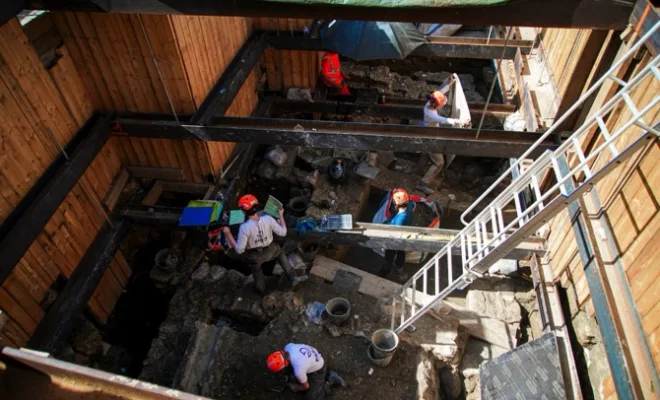
    Under Notre Dame cathedral, a ‘dig of the century’ unearths 1,700 years of history

    Wednesday, June 3, 2026
    By MDT/AP
  • Arts & CultureBuzzWorld

    The Rolling Stones will release their first studio album in 18 years, ‘Hackney Diamonds’

    Wednesday, September 6, 2023
    By -
  • Arts & Culture

    Underwater show in the Florida Keys promotes awareness of coral reef protection

    Tuesday, July 11, 2023
    By -
  • Patrick-James-University-of-Southern-California
    Arts & CultureOpinionThe Conversation

    Trudeau taps out: How Trump’s taunts and tariff threats added to domestic woes confronting Canada’s long-standing PM

    Wednesday, January 8, 2025
    By -
  • Arts & CultureWorld

    In public domain, early Mickey Mouse version will star in horror movies

    Thursday, January 4, 2024
    By -
  • Arts & Culture

    Lionel Richie, Katy Perry sing for royal coronation concert

    Tuesday, May 9, 2023
    By -

Leave a reply Cancel reply

You must be logged in to post a comment.

  • Business

    Corporate Bits | BNU and Asia Miles launch co-brand credit card

  • Asia-Pacific

    Philippines | Marine murder suspect guarded by US in camp 

  • Macau

    Portuguese premium products tour Macau

DAILY EDITION

Thursday, November 12, 2026 – edition no. 5073

Greater Bay

MDT MACAU GRAND PRIX SPECIAL

November 2026
M T W T F S S
 1
2345678
9101112131415
16171819202122
23242526272829
30  
« Oct    

Timeline

  • Thursday, November 12, 2026

    GEG Donates MOP700,000 to Tung Sin Tong to Support Its Annual Fundraising Campaign for the 23rd Consecutive Year

  • Thursday, November 12, 2026

    300 restaurants sought for elderly healthy-meal program

  • Thursday, November 12, 2026

    Over 18,700 childcare subsidy cases approved, MOP546 million paid out

  • Thursday, November 12, 2026

    Private tutoring center bill passed with patriotism requirement for operators

  • Thursday, November 12, 2026

    Database of 31,000 elderly residents living alone or in two-person households established

  • Thursday, November 12, 2026

    Lawmakers call for prevention-first approach as fatal accidents surpass 2025 total

  • Thursday, November 12, 2026

    Singles’ Day shopping festival struggles to shake off weak consumer spending

  • Thursday, November 12, 2026

    IAM puts 22 Iao Hon market stalls up for tender

  • Thursday, November 12, 2026

    Gov’t expands automated immigration clearance to Swiss, Belgian nationals

  • Thursday, November 12, 2026

    Beijing’s top prosecutor meets Macau counterpart to discuss legal cooperation

Extra Times

Extra TimesHeadlines

A fiery milestone: Feng Wei Ju’s 20th anniversary tribute to Starworld Macau

To celebrate the 20th anniversary of the iconic Starworld Macau, a special commemorative dinner was hosted at its crown jewel, Feng Wei Ju. Holding two Michelin stars, this esteemed restaurant ...
  • In ‘I Play Rocky,’ a middleweight crowd-pleaser about the making of a classic

    By MDT/AP
    Friday, November 6, 2026
  • Daddy Yankee’s first concept album is a reggaeton love letter

    By MDT/AP
    Friday, November 6, 2026
  • MGM Macau hosts Bocuse d’Or Gala

    By -
    Friday, November 6, 2026
  • A Symphony of Heritage: Reviving the Imperial Feast at Chai Jia Chai

    By Irene Sam, MDT
    Friday, October 30, 2026
  • Recent

  • Popular

  • GEG Donates MOP700,000 to Tung Sin Tong to Support Its Annual Fundraising Campaign for the ...

    By GEG PR
    Thursday, November 12, 2026
  • 300 restaurants sought for elderly healthy-meal program

    By Nadia Shaw, MDT
    Thursday, November 12, 2026
  • Over 18,700 childcare subsidy cases approved, MOP546 million paid out

    By Yuki Lei, MDT
    Thursday, November 12, 2026
  • Private tutoring center bill passed with patriotism requirement for operators

    By Yuki Lei, MDT
    Thursday, November 12, 2026
  • Database of 31,000 elderly residents living alone or in two-person households established

    By Yuki Lei, MDT
    Thursday, November 12, 2026
  • Lawmakers call for prevention-first approach as fatal accidents surpass 2025 total

    By Yuki Lei, MDT
    Thursday, November 12, 2026
  • Singles’ Day shopping festival struggles to shake off weak consumer spending

    By -
    Thursday, November 12, 2026
  • Canidrome may have its days numbered, decision in ‘one or two months’

    By Paulo Coutinho, MDT
    Thursday, May 26, 2016
  • Animal Welfare | Macau: Anima slams Canidrome management for avoiding debate

    By -
    Wednesday, May 4, 2016
  • Editorial | Canidoomed

    By Paulo Coutinho, MDT
    Wednesday, June 1, 2016
  • Animal Welfare | Canidrome presented with ultimatum: close or move

    By Daniel Beitler, MDT
    Friday, July 22, 2016
  • Australia regulator cracks down on alleged exportation of dogs to Macau

    By Paulo Coutinho, MDT
    Friday, June 10, 2016
  • Animal rights | Canidrome: Anima in fresh airline negotiations as Canidrome closure looks more likely

    By Daniel Beitler, MDT
    Friday, May 27, 2016
  • USE OF ENGLISH IN MACAU | A ‘de facto’ official language

    By Catarina Pinto
    Monday, July 6, 2015
  • Contact our Administrator
  • Contact our Editor-in-Chief
  • Contacts
  • Our Team
  • Privacy Policy
  • Terms and Conditions
  • Editorial Statute
  • Code of Ethics
COPYRIGHT © MACAU DAILY TIMES 2008-2026. ALL RIGHTS RESERVED
MACAU DAILY TIMES
  • Home
  • Macau
    • Photo Shop
    • Advertorial
  • Interview
  • Greater Bay
  • Business
    • Corporate Bits
  • China
  • Asia
  • World
  • Sports
  • Opinion
    • Editorial
    • Our Desk
    • Business Views
    • China Daily
    • Multipolar World
    • The Conversation
    • World Views
  • Our Team
  • Editorial Statute
    • Code of Ethics
    • Privacy Policy
    • Terms and Conditions
  • Archive
    • PDF Editions
  • Contacts
  • Extra Times
    • Drive In
    • Book It
    • tTunes
    • Features
    • World of Bacchus
    • Taste of Edesia
Loading Comments...

You must be logged in to post a comment.

%d