MACAU DAILY TIMES 澳門每日時報

Top Menu

  • Our Team
  • Editorial Statute
    • Code of Ethics
    • Privacy Policy
    • Terms and Conditions
  • Archive
    • PDF Editions
  • Contacts
  • Extra Times
    • Drive In
    • Book It
    • tTunes
    • Features
    • World of Bacchus
    • Taste of Edesia

Main Menu

  • Home
  • Macau
    • Photo Shop
    • Advertorial
  • Interview
  • Greater Bay
  • Business
    • Corporate Bits
  • China
  • Asia
  • World
  • Sports
  • Opinion
    • Editorial
    • Our Desk
    • Business Views
    • China Daily
    • Multipolar World
    • The Conversation
    • World Views
  • Our Team
  • Editorial Statute
    • Code of Ethics
    • Privacy Policy
    • Terms and Conditions
  • Archive
    • PDF Editions
  • Contacts
  • Extra Times
    • Drive In
    • Book It
    • tTunes
    • Features
    • World of Bacchus
    • Taste of Edesia
logo
FOUNDER & PUBLISHER Kowie Geldenhuys
EDITOR-IN-CHIEF Paulo Coutinho
Macau,

MACAU DAILY TIMES 澳門每日時報

  • Home
  • Macau
    • Photo Shop
    • Advertorial
  • Interview
  • Greater Bay
  • Business
    • Corporate Bits
  • China
  • Asia
  • World
  • Sports
  • Opinion
    • Editorial
    • Our Desk
    • Business Views
    • China Daily
    • Multipolar World
    • The Conversation
    • World Views
  • Macau faces slower growth as gaming revenue and spending weaken

  • Gov’t plans to divest CTM stake to avoid market conflict

  • Three chefs. One horizon. Six Michelin stars

  • Red Market former post office quarters to be rebuilt at owners’ expense from 2027

  • ExCo backs bill proposing tougher oversight and new dissolution powers for associations

  • Lawmaker urges insurance reform as compensation delays disrupt treatment

Asia-Pacific
Home›Asia-Pacific›Feature | Chinese power over North Korea? It’s more myth than reality

Feature | Chinese power over North Korea? It’s more myth than reality
By -
Monday, October 23, 2017
116
0

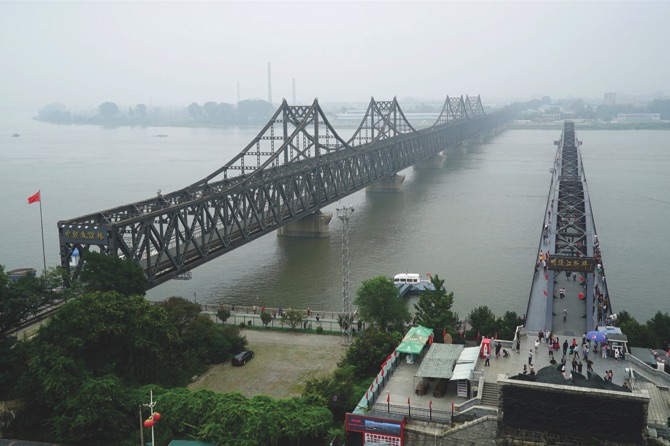
Visitors walk across the Yalu River Broken Bridge (right) next to the Friendship Bridge connecting China and North Korea in Dandong

At first glance, it seems the perfect solution to the world’s most dangerous standoff: Find a way to get China to use its enormous influence to force North Korea to abandon its nuclear bombs.

The countries, after all, share a long, porous border, several millennia of history and deep ideological roots. Tens, and possibly hundreds, of thousands of Chinese soldiers, including Mao Zedong’s son, died to save North Korea from obliteration during the Korean War, and China is essentially Pyongyang’s economic lifeline, responsible for most of its trade and oil.

The notion of Chinese power over the North — that the countries are as “close as lips and teeth,” according to a cliche recorded in the 3rd century — is so tantalizing that Donald Trump has spent a good part of his young presidency playing it up.

The reality, however, is that the complicated, often exasperating, relationship is less about friendship or political bonds than a deep and mutually uneasy dependency. Nominally allies, the neighbors operate in a near constant state of tension, a mix of ancient distrust and dislike and the grating knowledge that they are inextricably tangled up with each other, however much they might chafe against it.

This matters because if China is not the solution to the nuclear crisis, then outsiders long sold on the idea must recalibrate their efforts as North Korea approaches a viable arsenal of nuclear-tipped missiles capable of reaching the U.S. mainland, something the CIA chief this week estimated as only a matter of months away.

“The North Koreans have always driven China crazy,” says John Delury, an expert on both countries at Seoul’s Yonsei University, “and, for their part, the North Koreans have always felt betrayed by China. But both sides need each other in elemental ways.”

THE VIEW FROM CHINA: ʻKIM FATTYʼ

One clue about how Chinese see the North can be seen in two widespread nicknames for the overweight, third-generation North Korean leader, Kim Jong Un: Kim Fatty The Third and Kim Fat Fat Fat.

As China rises as an economic, military and diplomatic heavyweight whose reach extends from the Americas to Asia, many here resent being dragged down by an impoverished, stubborn, Third World dictatorship that allows its people to go hungry while its leader lives in luxury and expands a nuclear arsenal that could lead to war with Washington.

North Korean missile tests hurt trade and tourism and strengthen the U.S. presence in a region that China believes it should dominate. North Korean nuclear tests set off earthquakes near the Chinese border and raise fears of radioactive contamination.

There’s also scorn for the North’s brutal, nepotistic brand of socialism, and displeasure that North Korean aggression led South Korea to allow on its territory a U.S. anti-missile system that Beijing says can be used to spy on its operations.

This growing disdain is reflected in China’s willingness to permit criticism of the North in the press, and to allow tougher sanctions at the U.N. Beijing has suspended coal, iron ore, seafood and textiles from the North.

Although North Korea takes pride in its ability to absorb pain, be it war, famine, sanctions or condemnation, China’s tougher line will rob Pyongyang of key sources of foreign currency.

Still, nothing China has done offsets its underlying fear that too much external pressure could collapse the government in Pyongyang. The nightmare scenario for Beijing is North Korean refugees flooding into its northeast after Seoul takes power in Pyongyang and U.S. and South Korean troops occupy lands that were once considered a buffer zone.

“It is true that China loathes North Korea and vice versa — at the societal level, the leadership level and the governmental level,” Van Jackson, a North Korea specialist and lecturer at Victoria University of Wellington in New Zealand, wrote earlier this year. “But China’s ‘emotions’ toward North Korea don’t drive its policy.”

Beijing has also argued that it has less power over North Korea than people think. Some observers question whether China could force a change in the North, short of military intervention, even if it wanted to.

North Korea relies on China for most of its oil, and outsiders have long argued that the best way to cripple the North’s economy and force it to submit would be to persuade Beijing to cut that flow.

But even this may not work.

North Korea gets its oil from China out of convenience, not necessity, according to Pierre Noel, an energy security specialist at the International Institute for Strategic Studies think tank.

“Would it be good news for North Korea if the oil stopped flowing? No. Is it likely to cripple the economy and force the government to change course on their foremost strategic priority? No. There are ample hydrocarbons in North Korea to substitute for those it imports from China.”

THE VIEW FROM N. KOREA: ‛PROFOUND MISTRUST’

One way to gauge Pyongyang’s feelings for Beijing is to consider that Kim Jong Un has yet to visit his only major ally, a country that accounts for 90 percent of North Korean trade, since taking power in December 2011.

His late father, Kim Jong Il, hated to travel but went to China eight times during his rule, and Chinese leaders reciprocated with trips to Pyongyang.

Since communication at the highest levels has now virtually disappeared, Kim Jong Un feels little need to pay attention when Beijing calls on him to stop testing nukes and missiles.

In fact, North Korea has seemingly sought to humiliate Beijing by timing some of its missile tests for major global summits in China.

Last month, North Korean state media accused Chinese state-controlled media of “going under the armpit of the U.S.” by criticizing Pyongyang. In May, the North vowed to “never beg for the maintenance of friendship with China [or risk North Korea’s] nuclear program which is as precious as its own life, no matter how valuable the friendship is.”

It can be argued that the North Korea-China relationship never really recovered from Beijing’s decision in 1992 to establish formal diplomatic relations with Seoul.

But a big part of North Korea’s “profound sense of mistrust” and “long-term effort to resist China’s influence” stems from the 1950-53 Korean War, according to James Person, a Korea expert at the Wilson Center think tank in Washington. The war is often seen as the backbone of the countries’ alliance, he said, but the North blamed the failure to conquer the South on Beijing, which had seized control of field operations after the near-annihilation of North Korean forces.

In the 1970s, with North Korea pushing the United States for a peace treaty to replace the Korean War cease-fire that continues today, Washington chose to work through China.

By so doing, U.S. officials failed to see the limits of Chinese influence in the North, Person wrote last month on the 38 North website.

“Yet, nearly four decades later, asking China to solve the North Korean problem remains Washington’s default policy for dealing with Pyongyang.” This, he said, is “a recipe for continued failure.” By Foster Klug, Beijing, AP

Share this:

  • Share on Facebook (Opens in new window) Facebook
  • Share on X (Opens in new window) X
  • Share on LinkedIn (Opens in new window) LinkedIn
  • Share on WhatsApp (Opens in new window) WhatsApp
  • Print (Opens in new window) Print

Like this:

Like Loading…

Related

Previous Article

USA | Trump has no plans to ...

Next Article

Egypt | 54 policemen killed in ambush, ...

Related articles More from author

  • Asia-Pacific

    Woman charged with assaulting senator who shouted at the king

    Tuesday, October 29, 2024
    By -
  • Asia-PacificWorld

    Offbeat | Tokyo Disney sees visitors boost

    Thursday, July 14, 2016
    By -
  • Asia-Pacific

    Philippines | Typhoon Koppu leaves 11 dead, villagers saved from flood 

    Tuesday, October 20, 2015
    By -
  • Asia-Pacific

    Vietnam | Japan emperor’s visit a sign of improved ties

    Tuesday, February 28, 2017
    By -
  • Asia-Pacific

    New Zealand to send military, police to Solomon Islands

    Thursday, December 2, 2021
    By -
  • Asia-Pacific

    Malaysia | ‘I am not a thief,’ Razak says

    Tuesday, July 7, 2015
    By -

Leave a reply Cancel reply

You must be logged in to post a comment.

  • Macau

    15th National Games receives donations for development of green sports

  • HeadlinesMacau

    MUST hosts job fair offering 2,000 vacancies

  • BusinessCorporate Bits

    Sands Resorts Macao upgrades Alipay Tap! membership service

DAILY EDITION

Friday, November 13, 2026 – edition no. 5074

Greater Bay

MDT MACAU GRAND PRIX SPECIAL

November 2026
M T W T F S S
 1
2345678
9101112131415
16171819202122
23242526272829
30  
« Oct    

Timeline

  • Friday, November 13, 2026

    Macau faces slower growth as gaming revenue and spending weaken

  • Friday, November 13, 2026

    Gov’t plans to divest CTM stake to avoid market conflict

  • Friday, November 13, 2026

    Three chefs. One horizon. Six Michelin stars

  • Friday, November 13, 2026

    Red Market former post office quarters to be rebuilt at owners’ expense from 2027

  • Friday, November 13, 2026

    ExCo backs bill proposing tougher oversight and new dissolution powers for associations

  • Friday, November 13, 2026

    Lawmaker urges insurance reform as compensation delays disrupt treatment

  • Friday, November 13, 2026

    Further analysis with legal application in the case of Au Kam San

  • Friday, November 13, 2026

    Gov’t bets on sports events to drive tourism and community spending

  • Friday, November 13, 2026

    Sai Van free sports ground to reopen today

  • Friday, November 13, 2026

    IAM to expand colorful public waste bin makeover project

Extra Times

Extra TimesHeadlinesTaste of Edesia

Three chefs. One horizon. Six Michelin stars

There are moments when separate culinary philosophies align so precisely that the result transcends mere menu-making. At Chef Tam’s Seasons, Wynn Palace, three two-Michelin-starred titans—each ranked among Asia’s 50 Best ...
  • James Gray delivers a milestone crime drama in ‘Paper Tiger’

    By MDT/AP
    Friday, November 13, 2026
  • The Twelve25 × La Vie exchange

    By -
    Friday, November 13, 2026
  • A fiery milestone: Feng Wei Ju’s 20th anniversary tribute to Starworld Macau

    By Irene Sam, MDT
    Friday, November 6, 2026
  • In ‘I Play Rocky,’ a middleweight crowd-pleaser about the making of a classic

    By MDT/AP
    Friday, November 6, 2026
  • Recent

  • Popular

  • Macau faces slower growth as gaming revenue and spending weaken

    By Lynzy Valles, MDT
    Friday, November 13, 2026
  • Gov’t plans to divest CTM stake to avoid market conflict

    By Lynzy Valles, MDT
    Friday, November 13, 2026
  • Three chefs. One horizon. Six Michelin stars

    By Irene Sam, MDT
    Friday, November 13, 2026
  • Red Market former post office quarters to be rebuilt at owners’ expense from 2027

    By Yuki Lei, MDT
    Friday, November 13, 2026
  • ExCo backs bill proposing tougher oversight and new dissolution powers for associations

    By Nadia Shaw, MDT
    Friday, November 13, 2026
  • Lawmaker urges insurance reform as compensation delays disrupt treatment

    By Nadia Shaw, MDT
    Friday, November 13, 2026
  • Further analysis with legal application in the case of Au Kam San

    By -
    Friday, November 13, 2026
  • Canidrome may have its days numbered, decision in ‘one or two months’

    By Paulo Coutinho, MDT
    Thursday, May 26, 2016
  • Animal Welfare | Macau: Anima slams Canidrome management for avoiding debate

    By -
    Wednesday, May 4, 2016
  • Editorial | Canidoomed

    By Paulo Coutinho, MDT
    Wednesday, June 1, 2016
  • Animal Welfare | Canidrome presented with ultimatum: close or move

    By Daniel Beitler, MDT
    Friday, July 22, 2016
  • Australia regulator cracks down on alleged exportation of dogs to Macau

    By Paulo Coutinho, MDT
    Friday, June 10, 2016
  • Animal rights | Canidrome: Anima in fresh airline negotiations as Canidrome closure looks more likely

    By Daniel Beitler, MDT
    Friday, May 27, 2016
  • USE OF ENGLISH IN MACAU | A ‘de facto’ official language

    By Catarina Pinto
    Monday, July 6, 2015
  • Contact our Administrator
  • Contact our Editor-in-Chief
  • Contacts
  • Our Team
  • Privacy Policy
  • Terms and Conditions
  • Editorial Statute
  • Code of Ethics
COPYRIGHT © MACAU DAILY TIMES 2008-2026. ALL RIGHTS RESERVED
MACAU DAILY TIMES
  • Home
  • Macau
    • Photo Shop
    • Advertorial
  • Interview
  • Greater Bay
  • Business
    • Corporate Bits
  • China
  • Asia
  • World
  • Sports
  • Opinion
    • Editorial
    • Our Desk
    • Business Views
    • China Daily
    • Multipolar World
    • The Conversation
    • World Views
  • Our Team
  • Editorial Statute
    • Code of Ethics
    • Privacy Policy
    • Terms and Conditions
  • Archive
    • PDF Editions
  • Contacts
  • Extra Times
    • Drive In
    • Book It
    • tTunes
    • Features
    • World of Bacchus
    • Taste of Edesia
Loading Comments...

You must be logged in to post a comment.
%d