
Gov’t vows improvements to pedestrian zones to balance benefits

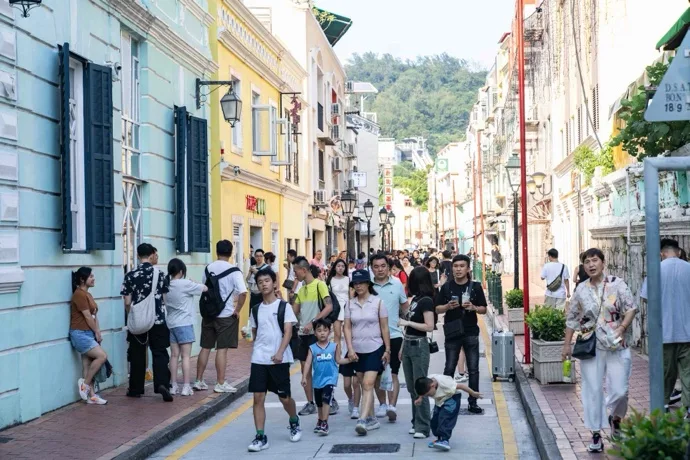
The government has set up temporary pedestrian zones in Taipa Village and Rua de Nossa Senhora do Amparo during major holidays.
Officials have said that a series of improvements to these pedestrian zones will follow “to balance the needs of residents, businesses and visitors” and to draw foot traffic into the old districts.
The temporary pedestrian zones in these two districts coincide with major festive holidays, including Chinese New Year, the May Day break and National Day holidays, to boost community spending and the festive atmosphere.
During the recent National Day Golden Week, the pedestrian zone opened on October 1 and operated for six consecutive days. Earlier, a May Day holiday pedestrian zone operated from May 1 to 4, daily from noon to 7 p.m.
Notably, the pedestrian zones aim to improve crowd and traffic management, ensure pedestrian and vehicle safety, and minimize disruption to residents, school commutes, and business operations. They also work with community groups to organize activities that attract visitors and residents to the old districts and showcase local heritage and merchants’ offerings.
The Central District Community Service Consultative Committee recently held a regular closed-door meeting, inviting representatives of the Economic and Technological Development Bureau (DSEDT) to brief members on the operation of the recently ended pedestrian zone and measures to revitalize the old districts.
According to committee representatives at a post-meeting press briefing, officials acknowledged that the holiday pedestrian zone operated well overall and was widely welcomed by visitors, merchants, and residents. They said a series of improvements would follow to balance the needs of residents, businesses, and visitors while continuing to draw foot traffic and revitalize the economy.
Officials said these measures would include sharing information with merchants and residents earlier about pedestrian zones and festive activities, and stepping up cross-district publicity to avoid overlapping events that cause congestion. The authorities will also continue to publicize temporary traffic, bus diversions and parking arrangements through posters, banners, electronic platforms and the media, guiding the public to plan routes in advance. The measures follow residents’ complaints that activities held in neighboring districts beyond the pedestrian zone have caused confusion over traffic diversions due to insufficient information.
Leaders flag weak spending in historic core
Meanwhile, ahead of the committee meeting, several members raised concerns that core historic districts such as Rua da Felicidade, Barra, and the Inner Harbor still face “ample visitor flow but low spending conversion.” They called for a systematic boost to the central district’s community economy across three dimensions — creating consumption scenes, tapping historical and cultural resources, and improving transport and leisure facilities — so that visitor traffic translates into business opportunities that drive community livelihoods.
Committee member Chan Hio Teng proposed developing experience-based consumption scenes tailored to each area’s characteristics, such as street performances, light music, and themed markets, and planning themed walking routes linking heritage nodes and distinctive shops at Doca do Lamau, Rua da Felicidade, the Inner Harbour piers, and Kun Iam Temple, supported by a central-district consumption reward scheme and a dual “daytime historical roaming, nighttime leisure consumption” model.
She also urged the government to work with local universities and community groups to compile the district’s architectural history, old shop stories, and collective memories into an authoritative historical database, improve online guide resources, and accelerate the waterfront historical tourism belt — connecting continuous walking routes, improving landscaping, and developing water buses and night sightseeing routes to retain visitors through the district’s cultural appeal.
On transportation, she called for improved bus and shuttle links between checkpoints, major hotels, and the Inner Harbour, Barra, and Rua da Felicidade; alignment with the planned Wanzai cross-border pedestrian tunnel; use of idle parking spaces; multilingual directional signs at key junctions during peak periods; more frequent public toilet cleaning; and additional mobile rest facilities.
Committee members also proposed refining the old districts through fine-grained micro-improvements, including extending greening and landscaping to outdoor or temporary parking lots — such as vertical greening on fences, modular planters, and raised trellises for drought-tolerant plants — to provide shade and cooling without sacrificing parking spaces.
They suggested adding light display boards and interactive installations at busy hubs such as Nam Van Lake, Largo do Matadouro, and the western section of Avenida de Almeida Ribeiro, drawing on local heritage, festivals, or intangible cultural heritage to tell the story of Macau’s fishing village past and community development, and inviting local creative industries to set up lightweight “community tourism and cultural creative information stations” that offer municipal advice, community information, guided tours, and creative showcases.
On the night economy, members called for stronger cross-departmental nighttime enforcement and regular patrols targeting noise, littering, and public hygiene offenses, combining education with enforcement; multilingual signage at attractions, rest areas, and hawker zones, along with nighttime outreach and volunteer guidance to promote responsible tourism; and better-planned night economy layouts and tourist routes away from residential areas, alongside improved nighttime cleaning, toilet facilities, and waste collection to balance night economy development with residents’ quality of life.




Leave a reply
You must be logged in to post a comment.


