Positive organisations and human flourishing in the GBA

Analysis
Workplace mental health is a shared concern across the Greater Bay Area. A public forum held on 9th October to mark International Mental Health Day in Macau explored the issue under the theme “It is Time to Prioritise Mental Health in the Workplace,” a collaboration between the University of Saint Joseph’s Faculty of Health and Environmental Sciences and the Macau Institute for Corporate Social Responsibility in Greater China.
Dr Tiffany Leung, president of MICSRGC, opened the forum, bringing together leaders, professionals, educators, researchers and community representatives to discuss workplace well-being and responsible organisational practices. Mental health is now recognized as a critical social and economic issue as governments, international organisations, businesses and civil society organisations struggle to address it. It is fundamental to organisational resilience, sustainable development and long-term societal well-being, and is now understood to be no longer an individual concern but a shared responsibility.
A shared responsibility
The argument for a shared responsibility comes from an understanding of how organisational performance and individual-level outcomes rely on the net resources available to employees. The positive or negative balance between demands placed on employees and the resources available for them to draw upon determines how people cope: too many demands drain their personal resources, leading to dissatisfaction, thoughts of quitting, exhaustion, disengagement, burnout and absenteeism. At the extreme end is the Japanese phenomenon of karoshi – or death from work fatigue – creating awareness globally of the human cost of overwork.
For the GBA, the question is how workplaces across different industries and jurisdictions can provide the resources employees need to meet those demands.
The resources people bring to work
Individuals bring to their jobs their own personal resources, such as experience, skills, personal characteristics, strengths and virtues. The four dimensions of know-how, know-why, know-what and know-who describe these individual resources.
Know-what is about knowing facts and information that can be stored digitally but also reside in the minds of workers to refer to during their workday. Know-how refers to the ability to do tasks and what methods and techniques to use. Know-why is about principles, laws of nature, how the world works and being able to predict outcomes. People with this knowledge can explain to others why things work the way they do. Know-who allows people to relate to and collaborate with other people to access the other forms of resources and for social support.
Each of these resource dimensions, along with personal characteristics, strengths and virtues, can help balance a lack of other resources or the demands of the work. If you can work out how to do a novel task by asking someone, working it out from basic principles or drawing from transferable skills, then you will not feel so encumbered by it. Experienced workers generally have more capacity to draw on than employees new to a role.
Organisations now also understand that providing resources to employees helps minimize the strains of work and encourages deeper engagement, achievement and performance. Careful selection for capacities, along with training, job rotation, team-bonding exercises, and work-life balance initiatives, among many others, all go towards building those resources. It does not always take big budgets: careful workplace systems design and an understanding of human motivation can achieve better workplace well-being.
The pressures of round-the-clock work
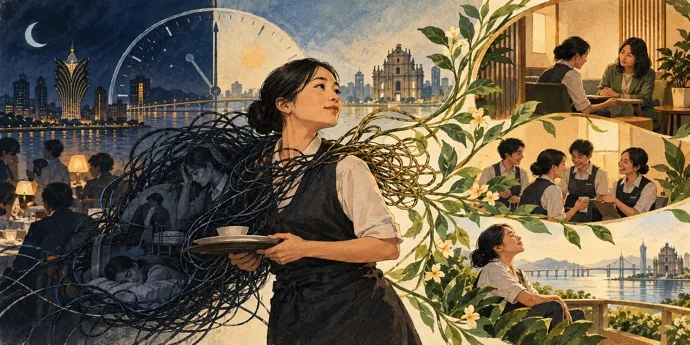
Dr Hughie Tao of the Macao University of Tourism spoke at the forum about some of the psychosocial hazards in Macau’s 24/7 service industry. The main psychosocial hazards he reported were working hours, shift work, emotional labour and digital risks.
The downsides of shift work for individuals and the pressures on families are well documented. Short rests between shifts mean little recovery time, and poor sleep is a common outcome of disruption to the body clock. Emotional labour in the service industry refers to workers always having to “put on a pleasant face” even when tired or demotivated, or when dealing with very difficult customers. Having to constantly control one’s genuine responses is another strain on personal resources in service and public-facing roles. More recently, constant digital surveillance has become recognized as another form of psychosocial hazard.
The depletion of personal resources in the workplace is not simply a mental health risk but has now been designated as a workplace safety issue. Tao presented international standards as part of the response, suggesting that work systems themselves need to change. ISO 45003, published in 2021, provides guidelines for managing psychological health, safety and psychosocial risks in the workplace. Psychological health is now included alongside physical safety in ISO 45001, a standard with more of a business rationale for building safe workplaces.
Even if individual worker safety and well-being are not the primary concern for companies, the link with business performance provides another incentive for organisations across the GBA to invest in well-being.
Designing workplaces where people can thrive
Rachel Wong, a senior human resources manager in integrated tourism and leisure enterprises, and an organisational psychologist lecturing in the University of Saint Joseph’s master’s program in organisational psychology, offered some insight into corporate practice in Macau’s 24/7 service industry.
Organisational behaviour and organisational psychology are about designing organisational systems that focus on motivations, collective strengths and positive organisational dynamics to cultivate both individual and organisational performance, resilience and sustainability. Or, to offer a less laudable justification, “making employees happy, makes customers happy, which makes money.”
Corporate wellness programs may include volunteer work. Such work brings a powerful sense of purpose into the workplace, a major contributor to well-being. Employee assistance programs are also a useful provision to reduce risks from workplace stress and help enhance communication skills. Buddy systems during onboarding introduce new staff to organisational structures, networks and their unique culture.
Within this shift-based industry, Wong introduced the audience to practices such as predictable shifts so that families can plan events and outings. Working couples might be placed on the same roster to help with work-life balance.
Problems with mental health in the workplace are often first detected by managers and colleagues. Awareness training on detection, what to do and how to seek help is critical – and training is being offered in this area.
The discussion suggested a new stage of enlightenment with a shift in focus from mental health problems to prevention. Companies are experiencing the benefits from employees thriving in the workplace. Breakrooms with cafes, sleep-rooms, snooker tables and other options for relaxation and socialisation are being provided. Establishing wellness performance indicators embed well-being into organisational structures: what gets measured gets managed.
Even with such organisational offerings, however, many employees cannot or do not take advantage of them in Macau. Some prefer to spend as little time as possible in the work environment they see as the main stressor and return home to their families.
KEY TAKEAWAYS• Workplace well-being is a shared responsibility. Employers need to balance job demands with adequate resources, manageable workloads and time to recover. • Support must be accessible and trusted. Privacy concerns and stigma can discourage employees from seeking help, making confidential external services particularly valuable. • Prevention requires changes to everyday work. Predictable shifts, supportive managers and stronger social connections can help address workplace pressures before they lead to burnout. |
Due to the stigma associated with mental health problems, exacerbated by Macau’s close-knit community, where people do not want others to know their business, work does not always feel like a safe space to discuss problems. Additionally, some are simply unaware that they are on the cusp of burnout; they overestimate their capacity to cope, or they hang on waiting for the day when resources are delivered or work demands decrease.
Conversations in GBA organisations are evolving from focus on physical risks towards workload management, stress and psychosocial support. Even when employers recognise the benefits of mental health programs, and start to provide innovative forms of support and assistance, there is no guarantee of employee uptake.
Trust, privacy and the regional challenge
The heightened requirement for privacy in Macau was a theme repeated by Lori Lei In Ieng, deputy unit-in-charge, and Miguel Lai Hou Pong, a registered social worker from the Sheng Kung Hui Macau Social Services Coordination Office.
Reporting on a survey conducted in Macau in 2024 with responses from 1,070 people, they found that workplace mental health remained a concern after Covid-19. The proportion of respondents showing troubling levels of anxiety and depression reached 33%. Average psychological resilience was at the threshold of the normal range. The age group with the worst scores for stress, anxiety, depression and poorer work-life balance was 25–30.
One antidote was stronger social support, but even this is marred by work demands. A key observation was loneliness among respondents, which leads to diminished help-seeking behaviour and a diminished sense of purpose, alongside prolonged, unresolved problems.
According to the World Health Organization, depression and anxiety account for an estimated 12 billion lost working days globally each year, amounting to close to US$1 trillion in lost productivity. This occurs in the context of 15% of the working population living with mild forms of mental disorders. Macau’s figures highlight an uncomfortable comparative reality.
The Macau findings and global figures would suggest similar conditions might be expected across the GBA. Indeed, general population results from a study done on community residents in Shenzhen published in 2025 showed rates of depression at 32.6% and anxiety symptoms at 23.5%, indicating an urgency for organisations to provide services to alleviate distress.
Employee assistance programs, such as those offered by the Sheng Kung Hui Macau Social Services Coordination Office, have a long history in Macau and Hong Kong to deliver assistance to businesses for both employee well-being and productivity. The speakers reported that uptake is better when services are offered by external providers than by in-house staff, partly because of concerns for privacy and the guaranteed confidentiality external providers can give.
Organisations are being called upon to create environments where individuals can thrive both professionally and personally. Reflections and dialogue at the forum suggest that Macau still has a long way to go to view work as a public health asset.
The wider GBA has reason to consider the same challenge. With appropriate positive organisational design, work need not be a place of stress or dysfunction but can be a place of purpose, meaning, engagement, achievement and connection. Positive organisations and “Good Work” can become tools for human and social flourishing.



Leave a reply
You must be logged in to post a comment.