Gov’t expands e-services and cross-border access, officials say

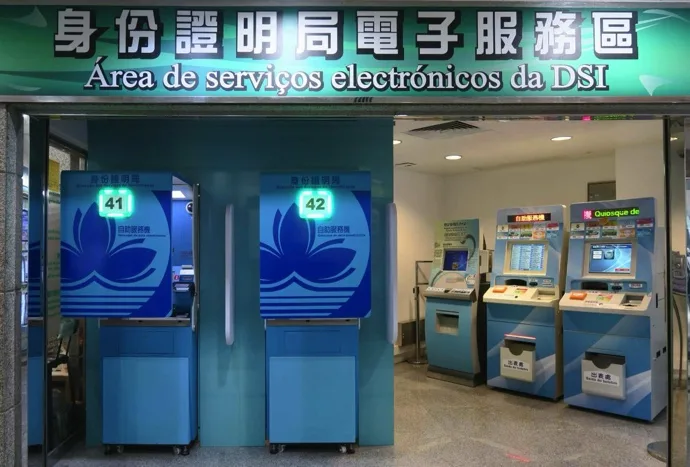
Self-service machines offering Macau government services now cover 12 service points across eight mainland cities in the Guangdong-Hong Kong-Macau Greater Bay Area (GBA), two mainland towns and Hengqin, with a dedicated government services station opening in the cooperation zone in September, the Identification Services Bureau (DSI) said.
Appearing on public broadcaster TDM’s radio program Wednesday to discuss the Macao One Account platform and electronic identity applications, bureau director Sonia Chan said the government had added functions this year allowing users to check the progress of identity document applications, submit supplementary documents and take identification photos. It had also increased the number of financial institutions accepting electronic identity.
Notably, a dedicated Macau public services zone opened in September at the government services center of the Guangdong-Macao In-depth Cooperation Zone in Hengqin.
It offers 63 services from four Macau departments covering identification, economy and technology, finance and pharmaceutical supervision. Macau officials are stationed there regularly, while cooperation zone staff handle enquiries and document collection outside those hours.
Separately, self-service machines providing Macau government services have been extended to Shenzhen, Foshan, Dongguan and two towns in Zhongshan, bringing coverage to 12 service points across eight mainland GBA cities, two mainland towns and Hengqin.
The machines now connect to 11 government departments and offer 38 services, including new identity document applications. Residents can receive electronic certificates through Macao One Account or authorize others to collect documents in Macau or the cooperation zone.
Chan said the Macau Special Administrative Region (SAR) passport’s anti-counterfeiting features rank among the world’s best, with no forgeries detected since the second edition was introduced. Responding to a listener’s suggestion that passports for children under 18, which are valid for five years, be priced differently from adult passports, as is the case with Home Return Permits, she said fees are the same for children and adults, cover only the cost of production and are comparable to those in neighboring regions.
Public Administration and Civil Service Bureau (SAFP) director Leong Weng In said 18 departments had completed organizational restructuring this year, while work was ongoing on Macao One Account 3.0 and the Business & Associations platform 2.0. The upgrades aim to move government services beyond individual electronic applications toward one-stop processing.
Responding to a listener’s suggestion that elderly residents be allowed to authorize their children to handle e-government matters, Leong said the bureau was studying a family-linking function that would allow children to access services such as My Health on behalf of their parents. Voice search would also be added.
Legal Affairs Bureau (DSAJ) director Ng Chi Kin said the government had established a legal coordination working group covering different policy areas and shared technically complex draft bills with the Legislative Assembly’s technical team before submission to save time.
He said 13 bills had been submitted and 15 laws enacted this year, including amendments to the Labor Relations Law and Advertising Law, alongside 35 administrative regulations.
The eighth GBA legal departments joint meeting will be held in Macau on November 25 to discuss legislative coordination mechanisms and the development of a GBA commercial mediation and arbitration platform. Meanwhile, rules governing social security and the central provident fund have been revised to facilitate living and business activities in Hengqin. Online applications for post-nuptial agreements accounted for 65% of eligible applications, he added.
Municipal Affairs Bureau (IAM) president Chou Wai Ieng said a new municipal management and inspection department was established during the bureau’s restructuring in June to coordinate urban appearance management and community hazard inspections.
The second phase of the second zone of the waterfront green corridor has opened, while outdoor cafe operating hours have been extended to 10 p.m. The bureau has also issued 58 new licenses, compared with 73 currently valid licenses, more than tripling the number before the relaunch.
The bureau has also conducted citywide cleaning campaigns, inspected “three-nil” buildings and addressed overhead cabling issues. A design scheme for compressed refuse-bin facades will also be extended to refuse rooms where conditions permit.



Leave a reply
You must be logged in to post a comment.