
Gov’t to add ‘AI chat’ to One Account for faster inquiry processing

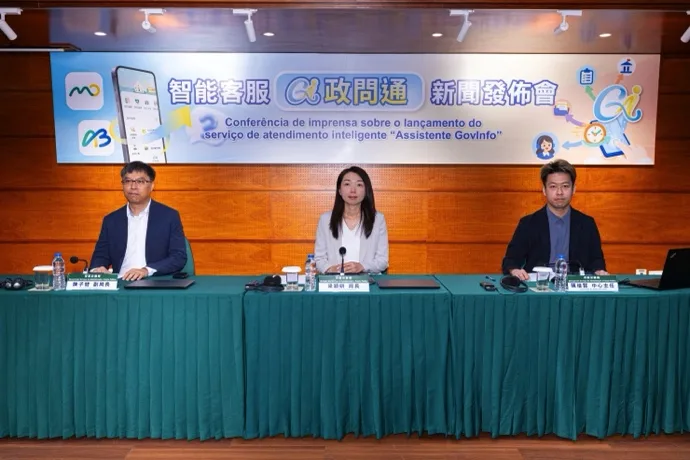
From Monday (Oct. 5), the Macao One Account and the Platform for Businesses and Associations will include a new function to replace the current inquiry system, the Public Administration and Civil Service Bureau (SAFP) announced Tuesday at a press conference.
The new “Government Inquiry Service” is an artificial intelligence (AI) tool that works like similar chatbots, opening a conversation window where a chatbot interprets questions and provides answers as quickly as possible.
According to government officials at the press conference, the goal is to respond to all citizens’ inquiries within two days, even if some matters require more time for further analysis.
As SAFP director Leong Weng In said, the main priority is to give citizens an initial response acknowledging the inquiry and outlining the steps being taken to provide the most accurate answer.
Leong also noted that when the AI tool cannot analyze an inquiry because of its complexity, it will be forwarded to SAFP staff assigned to receive and process inquiries.
For now, she said about 20 SAFP workers are being deployed to operate the system, alongside the existing methods – including in-person inquiries, phone calls and email – that will remain available.
As the same director remarked, the ultimate goal is to reduce the maximum response time to a public inquiry from 45 days to 15 days, according to the new regulations approved on administrative reform and the digitization of the administration.
From Oct. 5, an updated version of the government electronic accounts will display a “GovInfo” logo instead of the current “Enquiry” button, from which the chat will be launched.
Officials noted that to use the new function, users must download the latest version of the Macao One Account or the Platform for Businesses and Associations.
Another advantage of this new system, director Leong said, is that it enables cross-departmental collaboration: different departments can access inquiries at the same time to respond, and different services can also access the conversation and responses to avoid overlap. The idea is that the service can provide citizens with a “one-stop” comprehensive response to an inquiry, without needing to forward the same questions and doubts to different departments, saving time and resources.
Responding to media inquiries, Leong said that, for now, SAFP has been training the system through several rounds of tests involving around 7,000 different inquiries and matters. She said SAFP is confident the chatbot can respond almost immediately to around 2,000 frequently asked questions.
In addition, deputy director Chan Chi Kin noted that besides the official languages (Portuguese and Chinese), the AI tool can also respond to inquiries in English, covering almost the entire population.
Chan noted that the English responses are generated through AI translation, which, in some cases, may have flaws. Still, he said the system can provide accurate, efficient responses to a wide range of common questions and formalities, such as application requirements, necessary documents and service locations.
He also noted that the system can immediately provide precise, standardized answers and other information, including links to websites, forms and instructions for submitting requests, significantly improving processing efficiency.
In response to media questions, Leong noted that although the services have used some AI tools internally, this is the first time the government has made one available to the general public. She said the services had previously used AI assistants for internal procedures such as writing meeting minutes and taking notes.
Number of inquiries to gov’t averaged 50,000 since 2023
The number of inquiries received by the government information center through different channels has declined in the past three years, SAFP director Leong Weng In said in response to an inquiry from the Times.
According to Leong, inquiries averaged 50,000 per year over the past three years, but she said the trend has been declining.
“Back in 2023, the average number of inquiries was around 56,000, a figure that dropped to around 50,000 in 2025. There is a clear downward trend,” she said, suggesting this reflects the greater availability of information and citizens becoming more proficient at researching what they need on their own using the tools now available.
She also added that the vast majority of these inquiries or opinions submitted to the government are complaints, followed by about 20% being suggestions and a small percentage being praise.
Leong also added, “In over 90% of the cases, we have been able to solve the cases within 30 days. Our goal now is to reduce this period to a maximum of 15 days,” adding that 95% of the cases have been resolved within the 45-day limit.
She added that, in most cases, they are not very complex and do not require long processing, except when they involve legal cases that require court procedures and similar matters. RM





Leave a reply
You must be logged in to post a comment.


