
Lawmaker calls for broader barrier-free access across the city

[Photo: Renato Marques]
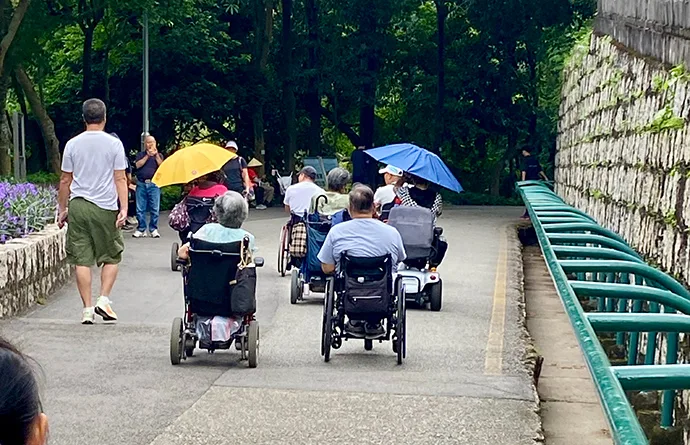
Lawmaker Ho Ion Sang is calling for broader barrier-free access across the city, including greater participation from private businesses and improved cross-border arrangements for people with disabilities.
In a written inquiry, Ho welcomed the government’s newly announced 2026-2035 10-Year Action Plan for Rehabilitation Services, which sets out 66 strategies and 83 implementation plans for the first two years.
The plan covers physical and mental rehabilitation, development of potential, support and protection for people with disabilities, with smart technology, barrier-free infrastructure and an inclusive social environment identified as key development priorities.
Among the measures are a preliminary study on accessibility legislation, plans to develop Zone A of the New Urban Zone as a model barrier-free mobility community, and pilot projects using artificial intelligence for simultaneous interpretation and indoor navigation robots.
However, Ho said creating a barrier-free environment should not rely solely on government-funded public facilities and should involve greater participation from private businesses.
He proposed expanding the government’s Barrier-Free Restaurant Award Scheme, launched in 2025, to other types of businesses, including retail stores, hotels and cultural venues. The restaurant program recognized 61 establishments in its first year based on evaluations by people with visual, hearing, speech, physical and intellectual disabilities.
Ho said expanding the initiative could gradually establish more “barrier-free friendly commercial areas” and encourage businesses to improve accessibility.
He also called for better accessibility features at border checkpoints, citing concerns from people with visual impairments that automated clearance machines do not provide sufficient voice prompts.
Ho asked authorities to consider adding audio notifications to automated clearance equipment, such as instructions to retrieve travel documents or alerts that a gate has opened, allowing visually impaired travelers to better understand the status of the clearance process.
Meanwhile, the lawmaker was also concerned on cross-border transportation.
Ho noted that people with disabilities traveling in noncommercial vehicles can already use vehicle-based clearance procedures at the Hong Kong-Zhuhai-Macau Bridge and Hengqin checkpoints without leaving their vehicles.
However, he said the arrangements primarily apply to light vehicles carrying fewer than nine people and often require travelers to make an on-site request to border inspection officers.
For people with moderate or severe disabilities who rely heavily on wheelchairs or medical equipment, transferring between vehicles can be difficult, Ho said.
The lawmaker also pointed out that Macau’s larger rehabilitation buses, which are classified as commercial vehicles, currently lack a standardized cross-border clearance arrangement.
He urged authorities to study Hong Kong’s experience and gradually establish a dedicated system for Macau-registered rehabilitation buses, including cross-border permits, vehicle specifications and medical equipment standards.
He also proposed designated procedures at border checkpoints, such as prearranged passenger inspections and dedicated clearance channels, allowing people with disabilities to cross the border without leaving their wheelchairs or medical equipment.
Such arrangements, Ho said, would allow people with disabilities to benefit more fully from the Greater Bay Area’s growing integration.





Leave a reply
You must be logged in to post a comment.


