
Macau pitches itself as ASEAN’s gateway to GBA

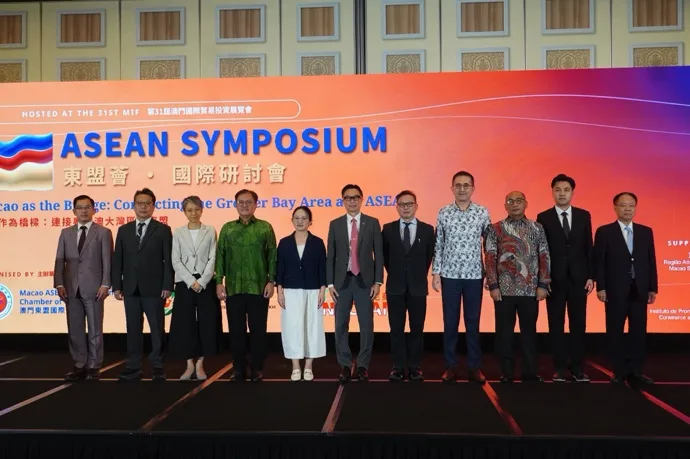
Macau can bridge ASEAN and the Guangdong-Hong Kong-Macau Greater Bay Area (GBA) by improving certification services and connectivity, business and diplomatic leaders said during a panel at the 31st Macau International Trade and Investment Fair (MIF).
Speaking at the ASEAN Symposium, Kelvin Tan, chairman of the Macau ASEAN International Chamber of Commerce (MAICC), said Macau’s future is “increasingly intertwined with ASEAN’s.”
“We are not simply a point of transit; we are a platform. A connector. A place where ASEAN and Chinese businesses can meet, build trust, and grow together,” Tan added.
The symposium, titled “Macau as the Bridge: Connecting the Greater Bay Area and ASEAN,” took place weeks after Chief Executive Sam Hou Fai led an eight-day official visit to Singapore, Indonesia, and Malaysia from Aug. 29 to Sept. 5. The mission to those three countries produced more than 370 business-matching sessions and 189 cooperation agreements, according to the government.
Tan highlighted that the results of the official’s visit spanned trade, conventions and exhibitions, traditional Chinese medicine, halal products, and tourism.
“These are not just numbers,” Tan said. “They represent real opportunities for ASEAN businesses seeking a gateway to GBA, and for GBA enterprises looking to expand into Southeast Asia.”
Alex Che, president of the Macau Trade and Investment Promotion Institute (IPIM), said ASEAN’s diverse markets and industrial strengths could complement Macau’s free-port status and its position linking the GBA with Portuguese- and Spanish-speaking markets.
Che proposed two priorities for businesses. First, Macau’s economic diversification could offer ASEAN firms opportunities in investment, technology, and professional services. Second, the GBA and Hengqin could help companies expand their research, technology transfer, and market-entry strategies.
Tan told delegates to look beyond Macau’s established strengths in tourism, entertainment, and business events. “Our potential as a connector runs deeper,” he added, noting that the role is rooted in more than five centuries of maritime trade and cultural exchange, as well as Macau’s institutional framework and access to the GBA.
“And increasingly, we are a triadic bridge — linking ASEAN, the GBA, and the Portuguese-speaking world in ways no other city can replicate,” he said.
From paper to practice
During the discussion, the ASEAN consular generals agreed that implementation would be the central challenge ahead. When addressing bottlenecks, Halal certification emerged as one of the most immediate commercial issues for ASEAN businesses.
Andi Ardiansyah, the consul general of the Republic of Indonesia in Hong Kong, said Indonesian halal requirements will apply more broadly starting Oct. 18, 2028, providing businesses with a transition period to prepare.
“We still have two years to go before the company in Indonesia should have trade deals,” Ardiansyah said.
He advised that companies in this sector should use Malaysia as an early gateway to the Indonesian market.
“You can use these two years as an opportunity to come to Malaysia first and then come to Indonesia,” he said. “That is the way that we can approach the halal community.”
Ardiansyah also said that awareness remained limited among businesses.
“Our community is still small because of the awareness,” he said. “I invite all halal companies to come to Indonesia and Malaysia.”
On the topic, Muzambli Markam, Malaysia’s consul general in Hong Kong, added that halal should be understood as more than a religious standard. “Halal doesn’t mean religion,” Markam said. “It’s not just a religious requirement. It’s beyond that.”
“For food, for example, for now, you can take halal as something which is good, clean, hygienic, and safe,” he said.
Markam also noted that Macau has made visible progress in becoming more welcoming to Muslim travelers, with increased arrivals from the Middle East and South Asia since the Covid-19 pandemic.
“When I first arrived in Macau, I didn’t see that a lot,” he said. “Two years after Covid-19, I see more visitors” from non-traditional markets.
Certification hub
Markam also proposed that Macau could develop a niche role in halal testing and certification support for products manufactured in China.
“What is missing in Hong Kong, in the GBA, in China as a whole, is a lab that can provide certification for halal,” he said.
He said a facility in Macau, in coordination with relevant authorities, could help Chinese-made products reach wider markets.
“If Macau government and traditional authorities can facilitate the setup of this lab, I think it will be a game changer for Macau,” Markam said.
He added that the opportunity extended beyond exports to Muslim-majority countries.
“China has one of the largest Muslim communities,” he said. “We have many more Chinese Muslims than in Malaysia basically.”
Trade rules and regional access
Tan asked panelists how Macau could help align rules across regional trade agreements, including the Comprehensive and Progressive Agreement for Trans-Pacific Partnership (CPTPP) and the Regional Comprehensive Economic Partnership (RCEP).
Markam said ASEAN’s diversity makes convergence difficult, but Macau’s role depends on clear policy and practical support.
“You can’t just ask Macau to play its role,” he said. “It also depends on the policies being implemented by the Macau government.”
Markam added that Hengqin could give Macau additional room to support businesses seeking access to both CPTPP and RCEP markets. “You can leverage Hengqin to play an important role not just for CPTPP but also for RCEP if you choose,” he said.
Competitive proposition
Macau’s appeal for ASEAN companies lies in its combination of free-port status, distinct customs arrangements, professional services and access to the GBA, Markam remarked.
“I think the Macau platform offers ASEAN countries a technical entry point in the GBA,” he said.
But he cautioned that registering a business was only a first step. Companies would also need staff, professional advice, and introductions to potential customers and partners.
Markam also emphasized the importance of talent in supporting investment, drawing on Hong Kong’s experience with international graduates.
“To complement this investment, you need also talents,” he said.
The Malaysian consul general also suggested that creating more opportunities for foreign graduates to apply their skills could help businesses grow while fostering healthy competition with local graduates.
Universities, he added, could do more to connect international talent with employers.


Leave a reply
You must be logged in to post a comment.


