Community leaders call for smarter school traffic measures
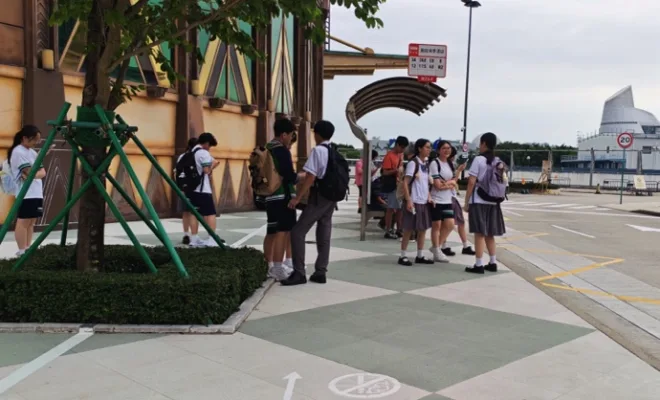

[Photo: Lynzy Valles]
Community leaders have urged time-limited drop-off zones, peripheral pick-up points, better technology, more patrols and crossing guards, a student “buffer week,” and faster legal updates to ease school traffic and improve safety.
The Central District Community Services Consultative Council convened its regular monthly session recently, with several council members putting forward a range of suggestions to ease traffic congestion around schools following the reopening of the new academic year.
To address persistent congestion around schools in the city’s old districts, leaders proposed introducing time limits for temporary drop-off zones to enforce a “stop-and-go” system, and creating peripheral pick-up points near narrow school entrances to guide parents to nearby public parking lots. They also called for a combination of fixed-post and mobile patrols at high-risk locations, alongside improved emergency response plans.
Some suggested making better use of wider roads and small vacant plots in the area to designate temporary parking and drop-off zones, allowing parents to drop off their children outside the narrowest streets and reducing long-standing congestion at school gates.
Others recommended that schools adopt a “buffer week” at the start of the term, reducing early homework and tests and adding adaptation activities. They also urged authorities to increase patrols around schools, enforce parking rules, and deploy crossing guards during peak hours to improve safety.
Regarding cross-border students, leaders called for additional clearance channels during peak times. Regarding traffic management, they proposed a year-round system of traffic supervisors at major school routes during morning and afternoon peaks, along with better use of electronic signs and mobile apps to inform parents of real-time road conditions.
Some leaders urged faster legislative amendments to the Road Traffic Law to enforce speed reductions around school zones, and called for interdepartmental reviews of traffic black spots with rolling micro-adjustments – such as extending drop-off zones, adjusting traffic light timing, or temporarily relocating bus stops. They also suggested a dedicated feedback channel through mobile apps for parents and residents to report issues in real time.
Meanwhile, according to authorities, the first two days of the new school term saw morning peak bus ridership reach between 120,000 and 130,000 passengers, of whom 10% to 13% were students using travel cards, while bus frequencies were increased by 10% to 15% during peak periods.





Leave a reply
You must be logged in to post a comment.