MACAU DAILY TIMES 澳門每日時報

Top Menu

  • Our Team
  • Editorial Statute
    • Code of Ethics
    • Privacy Policy
    • Terms and Conditions
  • Archive
    • PDF Editions
  • Contacts
  • Extra Times
    • Drive In
    • Book It
    • tTunes
    • Features
    • World of Bacchus
    • Taste of Edesia

Main Menu

  • Home
  • Macau
    • Photo Shop
    • Advertorial
  • Interview
  • Greater Bay
  • Business
    • Corporate Bits
  • China
  • Asia
  • World
  • Sports
  • Opinion
    • Editorial
    • Our Desk
    • Business Views
    • China Daily
    • Multipolar World
    • The Conversation
    • World Views
  • Our Team
  • Editorial Statute
    • Code of Ethics
    • Privacy Policy
    • Terms and Conditions
  • Archive
    • PDF Editions
  • Contacts
  • Extra Times
    • Drive In
    • Book It
    • tTunes
    • Features
    • World of Bacchus
    • Taste of Edesia
Generic selectors
Exact matches only
Search in title
Search in content
Post Type Selectors
logo
FOUNDER & PUBLISHER Kowie Geldenhuys
EDITOR-IN-CHIEF Paulo Coutinho
Macau,

MACAU DAILY TIMES 澳門每日時報

  • Home
  • Macau
    • Photo Shop
    • Advertorial
  • Interview
  • Greater Bay
  • Business
    • Corporate Bits
  • China
  • Asia
  • World
  • Sports
  • Opinion
    • Editorial
    • Our Desk
    • Business Views
    • China Daily
    • Multipolar World
    • The Conversation
    • World Views
  • “Luminous Brilliance: The Artistry of Zibo Liuli” Opens This October at POLY MGM MUSEUM in Macau

  • Gov’t rolls out 10-week spending drive with three stackable voucher types

  • Uber’s numbers climb, but users see little change

  • The Chinese Library welcomes autumn at Tai Kwun

  • DSEDJ will implement AI-based education across all school stages

  • Property firm busted for selling foreign worker quotas in RMB1 million scheme

Features
Home›Extra Times›Features›News of the World | Why robots, not trade, are behind so many factory job losses

News of the World | Why robots, not trade, are behind so many factory job losses

By -
Friday, November 4, 2016
184
0
Share:
A worker moves a tube to sort recycled plastic bottle chips being processed at the Repreve Bottle Processing Center

A worker moves a tube to sort recycled plastic bottle chips being processed at the Repreve Bottle Processing Center

Here’s a thought despite the Republican presidential nominee’s charge that “we don’t make anything anymore,” manufacturing is still flourishing in America. Problem is, factories don’t need as many people as they used to because machines now do so much of the work.
America has lost more than 7 million factory jobs since manufacturing employment peaked in 1979. Yet American factory production, minus raw materials and some other costs, more than doubled over the same span to USD1.91 trillion last year, according to the Commerce Department, which uses 2009 dollars to adjust for inflation. That’s a notch below the record set on the eve of the Great Recession in 2007. And it makes U.S. manufacturers No. 2 in the world behind China.
Trump and other critics are right that trade has claimed some American factory jobs, especially after China joined the World Trade Organization in 2001 and gained easier access to the U.S. market. And industries that have relied heavily on labor — like textile and furniture manufacturing — have lost jobs and production to low-wage foreign competition. U.S. textile production, for instance, is down 46 percent since 2000. And over that time, the textile industry has shed 366,000, or 62 percent, of its jobs in the United States.
But research shows that the automation of U.S. factories is a much bigger factor than foreign trade in the loss of factory jobs. A study at Ball State University’s Center for Business and Economic Research last year found that trade accounted for just 13 percent of America’s lost factory jobs. The vast majority of the lost jobs — 88 percent — were taken by robots and other homegrown factors that reduce factories’ need for human labor.
“We’re making more with fewer people,” says Howard Shatz, a senior economist at the Rand Corp. think tank.
General Motors, for instance, now employs barely a third of the 600,000 workers it had in the 1970s. Yet it churns out more cars and trucks than ever.
Or look at production of steel and other primary metals. Since 1997, the United States has lost 265,000 jobs in the production of primary metals — a 42 percent plunge — at a time when such production in the U.S. has surged 38 percent.
Allan Collard-Wexler of Duke University and Jan De Loecker of Princeton University found last year that America didn’t lose most steel jobs to foreign competition or faltering sales. Steel jobs vanished because of the rise of a new technology: Super-­efficient mini-mills that make steel largely from scrap metal.
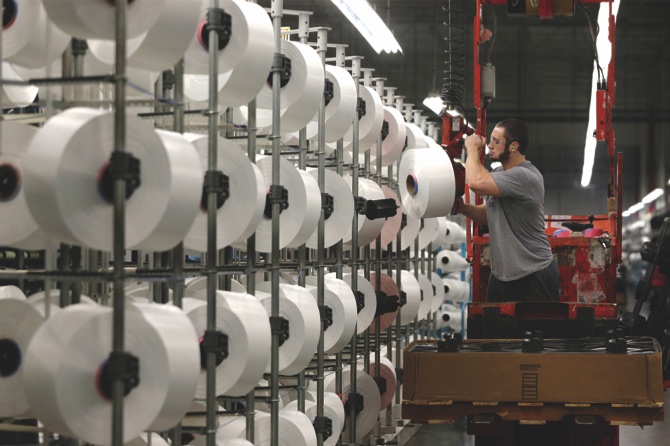
A worker loads spools of thread

A worker loads spools of thread

The robot revolution is just beginning. The Boston Consulting Group predicts that investment in industrial robots will grow 10 percent a year in the 25-biggest export nations through 2025, up from 2 or 3 percent growth in recent years.
The economics of robotics are hard to argue with. When products are replaced or updated, robots can be reprogrammed far faster and more easily than people can be retrained.
And the costs are dropping: Owning and operating a robotic spot welder cost an average $182,000 in 2005 and $133,000 in 2014 and will likely run $103,000 by 2025, Boston Consulting says. Robots will shrink labor costs 22 percent in the United States, 25 percent in Japan and 33 percent in South Korea, the firm estimates.
CEO Ronald De Feo is overseeing a turnaround at Kennametal, a Pittsburgh-based industrial materials company. The effort includes investing $200 million to $300 million to modernize Kennametal’s factories while cutting 1,000 of 12,000 jobs. Automation is claiming some of those jobs and will claim more in the future, De Feo says.
“What we want to do is automate and let attrition” reduce the workforce, he says.
Visiting a Kennametal plant in Germany, De Feo found workers packing items by hand. He ordered $10 million in machinery to automate the process in Germany and North America.
That move, he says, will produce “better quality at lower cost” and “likely result in a combination of job cuts and reassignments.”
But the rise of the machines offers an upside to some American workers: The increased use of robots — combined with higher labor costs in China and other developing countries — has reduced the incentive for companies to chase low-wage labor around the world.
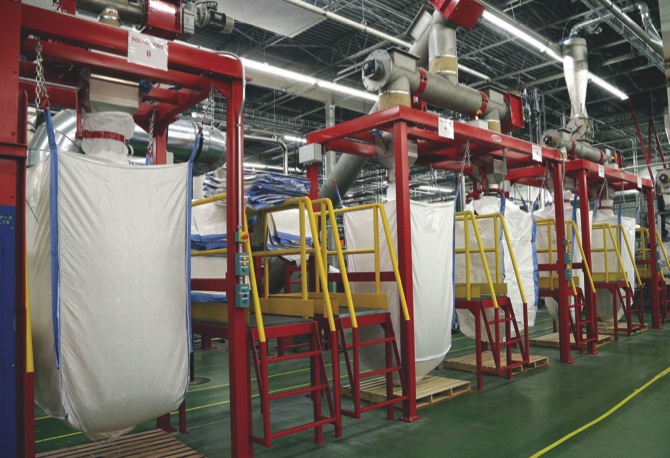
Recycled plastic chips are packed into bags for delivery

Recycled plastic chips are packed into bags for delivery

Multinational companies are also rethinking how they spread production across the globe in the 1990s and 2000s, when they tended to manufacture components in different countries and then assemble a product at a plant in China or other low-wage country. The 2011 earthquake and tsunami in Japan, which disrupted shipments of auto parts, and the bankruptcy of the South Korean shipping line Hanjin Shipping, which stranded cargo in ports, exposed the risk of relying on far-flung supply lines.
“If your supply chain gets interrupted and your raw materials are coming from offshore, all of a sudden shelves are empty and you can’t sell product,” says Thomas Caudle, president of the North Carolina-based textile company Unifi.
So companies have been returning to the United States, capitalizing on the savings provided by robots, cheap energy and the chance to be closer to customers.
“They don’t have all their eggs in that Asian basket anymore,” Caudle says.
Over the past six years, Unifi has added about 200 jobs, bringing the total to over 1,100, at its automated factory in Yadkinville, North Carolina, where recycled plastic bottles are converted into Repreve yarn. Unmanned carts crisscross the factory floor, retrieving packages of yarn with mechanical arms — work once done by people.
In a survey by the consulting firm Deloitte, global manufacturing executives predicted that that the United States — now No. 2 — will overtake China as the most competitive country in manufacturing by 2020. (Competitiveness is measured by such factors as costs, productivity and the protection of intellectual property.)
The Reshoring Initiative, a nonprofit that lobbies manufacturers to return jobs to the United States, says America was losing an average of 220,000 net jobs a year to other countries a decade ago. Now, the number being moved abroad is roughly offset by the number that are coming back or being created by foreign investment.
Harold Sirkin, senior partner at Boston Consulting, says the global scramble by companies for cheap labor is ending.
“When I hear that [foreigners] are taking all our jobs — the answer is, they’re not,” he says.
Paul Wiseman, AP Economics Writer

FacebookTweetPin

Share this:

  • Share on Facebook (Opens in new window) Facebook
  • Share on X (Opens in new window) X

Like this:

Like Loading…

Related

Previous Article

The Quintessence of Purity

Next Article

Alejandro Escovedo rocks out on ‘Burn’

0
Shares

    Related articles More from author

    • Features

      News of the World | Pitt, DiCaprio & Robbie reconcile a changing Hollywood

      Friday, July 26, 2019
      By -
    • Features

      News of the World | Eight things you may not know about Leonardo da Vinci

      Friday, May 3, 2019
      By -
    • Features

      News of the World | Peacekeepers left more than 6,000 children in Liberia

      Friday, November 23, 2018
      By -
    • Features

      News of the world | The mysterious life and death of a North Korean exile

      Friday, March 3, 2017
      By -
    • Features

      News of the World | Notre Dame fire was a warning bell. But will Europe listen?

      Friday, April 26, 2019
      By -
    • Features

      News of the World | Smog chokes Chinese cities, grounding flights, closing roads

      Friday, December 23, 2016
      By -

    Leave a reply Cancel reply

    You must be logged in to post a comment.

    0

    • Chinese Zodiac

      Troubled life with the Rooster

    • Daily Edition

      Tuesday, November 14, 2023 – edition no. 4367

    • Macau

      Education | Portuguese language course attracts record number of students

    DAILY EDITION

    Friday, September 18, 2026 – edition no. 5039
    Friday, September 18, 2026 – edition no. 5039

    Greater Bay

    MDT MACAU GRAND PRIX SPECIAL

    September 2026
    M T W T F S S
     123456
    78910111213
    14151617181920
    21222324252627
    282930  
    « Aug    

    Timeline

    • Friday, September 18, 2026

      “Luminous Brilliance: The Artistry of Zibo Liuli” Opens This October at POLY MGM MUSEUM in Macau

    • Friday, September 18, 2026

      Gov’t rolls out 10-week spending drive with three stackable voucher types

    • Friday, September 18, 2026

      Uber’s numbers climb, but users see little change

    • Friday, September 18, 2026

      The Chinese Library welcomes autumn at Tai Kwun

    • Friday, September 18, 2026

      DSEDJ will implement AI-based education across all school stages

    • Friday, September 18, 2026

      Property firm busted for selling foreign worker quotas in RMB1 million scheme

    • Friday, September 18, 2026

      Huawei unveils new chips as firm steps up the AI race with Nvidia

    • Friday, September 18, 2026

      AI agents learn from ‘the best’

    • Friday, September 18, 2026

      Survey finds high satisfaction among Macau families in Hengqin

    • Friday, September 18, 2026

      Late renewal fees for non-resident workers rise

    Extra Times

    Extra TimesHeadlinesTaste of Edesia

    The Chinese Library welcomes autumn at Tai Kwun

    The Chinese Library, the contemporary Chinese restaurant at Tai Kwun, has unveiled a new autumn menu led by Executive Chef Junno Li. Recognised with One Diamond in the Black Pearl ...
    • Ethan Hawke leads a tense, Depression-era thriller in ‘The Weight’

      By MDT/AP
      Friday, September 18, 2026
    • QMS Medicosmetics launches at Mandarin Oriental Macau: Where German science meets luxury skincare

      By -
      Friday, September 18, 2026
    • The confluence of craft: An evening at Estuary

      By Irene Sam, MDT
      Friday, September 11, 2026
    • The Korean thriller ‘Hope’ is a creature feature to the tilt

      By MDT/AP
      Friday, September 11, 2026
    • Recent

    • Popular

    • “Luminous Brilliance: The Artistry of Zibo Liuli” Opens This October at POLY MGM MUSEUM in ...

      By MGM Macau PR
      Friday, September 18, 2026
    • Gov’t rolls out 10-week spending drive with three stackable voucher ...

      By Yuki Lei, MDT
      Friday, September 18, 2026
    • Uber’s numbers climb, but users see little change

      By Renato Marques, MDT
      Friday, September 18, 2026
    • The Chinese Library welcomes autumn at Tai Kwun

      By Irene Sam, MDT
      Friday, September 18, 2026
    • DSEDJ will implement AI-based education across all school stages

      By Ricaela Diputado, MDT
      Friday, September 18, 2026
    • Property firm busted for selling foreign worker quotas in RMB1 million scheme

      By Ricaela Diputado, MDT
      Friday, September 18, 2026
    • Huawei unveils new chips as firm steps up the AI race with Nvidia

      By -
      Friday, September 18, 2026
    • Canidrome may have its days numbered, decision in ‘one or two months’

      By Paulo Coutinho, MDT
      Thursday, May 26, 2016
    • Animal Welfare | Macau: Anima slams Canidrome management for avoiding debate

      By -
      Wednesday, May 4, 2016
    • Editorial | Canidoomed

      By Paulo Coutinho, MDT
      Wednesday, June 1, 2016
    • Animal Welfare | Canidrome presented with ultimatum: close or move

      By Daniel Beitler, MDT
      Friday, July 22, 2016
    • Australia regulator cracks down on alleged exportation of dogs to Macau

      By Paulo Coutinho, MDT
      Friday, June 10, 2016
    • USE OF ENGLISH IN MACAU | A ‘de facto’ official language

      By Catarina Pinto
      Monday, July 6, 2015
    • Animal rights | Canidrome: Anima in fresh airline negotiations as Canidrome closure looks more likely

      By Daniel Beitler, MDT
      Friday, May 27, 2016
    • Contact our Administrator
    • Contact our Editor-in-Chief
    • Contacts
    • Our Team
    • Privacy Policy
    • Terms and Conditions
    • Editorial Statute
    • Code of Ethics
    COPYRIGHT © MACAU DAILY TIMES 2008-2026. ALL RIGHTS RESERVED
    MACAU DAILY TIMES
    • Home
    • Macau
      • Photo Shop
      • Advertorial
    • Interview
    • Greater Bay
    • Business
      • Corporate Bits
    • China
    • Asia
    • World
    • Sports
    • Opinion
      • Editorial
      • Our Desk
      • Business Views
      • China Daily
      • Multipolar World
      • The Conversation
      • World Views
    • Our Team
    • Editorial Statute
      • Code of Ethics
      • Privacy Policy
      • Terms and Conditions
    • Archive
      • PDF Editions
    • Contacts
    • Extra Times
      • Drive In
      • Book It
      • tTunes
      • Features
      • World of Bacchus
      • Taste of Edesia
    Loading Comments...

    You must be logged in to post a comment.

    %d